Month: July 2026

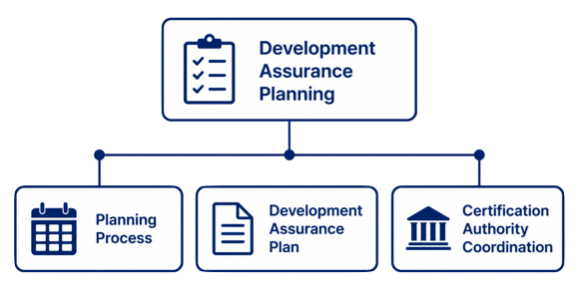
Overview of ARP4754B Chapter 3 showing the Development Assurance Planning Process, Development Assurance Plan, and Certification Authority Coordination

ARP4754B Chapter 3 Explained – Development Assurance Planning

ARP4754B Chapter 3 Explained – Development Assurance Planning Aircraft development projects involve thousands of requirements, numerous engineering teams, and strict certification expectations. Without a structured planning process, maintaining consistency, traceability, and compliance throughout the project quickly becomes a challenge. This is why Chapter 3 of SAE ARP4754B focuses on Development Assurance Planning. Before detailed design …

ARP4754B Chapter 3 Explained – Development Assurance Planning Read More »
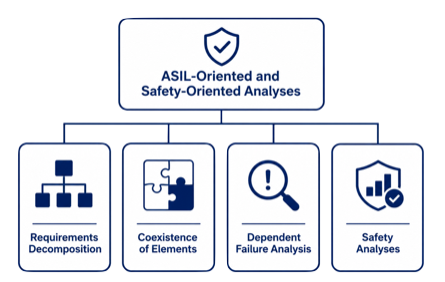
Overview of ISO 26262 Part 9 showing ASIL tailoring, coexistence of elements, dependent failure analysis, and safety analyses

ISO 26262 Part 9 Explained – ASIL-Oriented and Safety-Oriented Analyses

ISO 26262 Part 9 Explained – ASIL-Oriented and Safety-Oriented Analyses Developing a safety-critical automotive system requires more than defining safety requirements and implementing safety mechanisms. Engineers must also demonstrate that the chosen safety architecture is sufficiently robust, that redundant elements remain independent, and that potential failure mechanisms have been systematically analyzed. This is the purpose …

ISO 26262 Part 9 Explained – ASIL-Oriented and Safety-Oriented Analyses Read More »

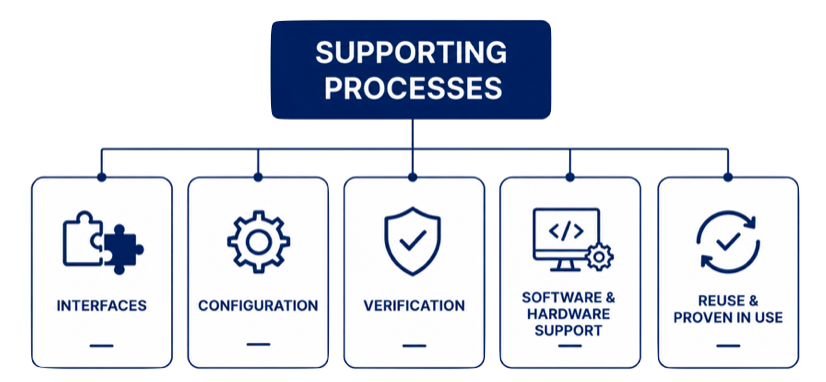
Overview of ISO 26262 Part 8 showing the supporting processes including configuration management, change management, documentation, software tools, and component qualification

ISO 26262 Part 8 Explained – Supporting Processes

ISO 26262 Part 8 Explained – Supporting Processes Developing a functionally safe vehicle requires much more than system, hardware, and software engineering. Throughout the development lifecycle, numerous supporting activities ensure that requirements remain traceable, changes are controlled, tools are trustworthy, and safety evidence is properly managed. This is the purpose of ISO 26262 Part 8 …

ISO 26262 Part 8 Explained – Supporting Processes Read More »

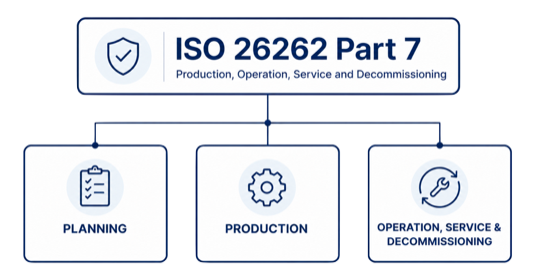
Overview of ISO 26262 Part 7 showing planning, production, operation, service, and decommissioning across the complete vehicle lifecycle

ISO 26262 Part 7 Explained – Production, Operation, Service and Decommissioning

ISO 26262 Part 7 Explained – Production, Operation, Service and Decommissioning Functional Safety does not end when a vehicle leaves the development department. Even after system, hardware, and software development have been completed, safety must be maintained throughout production, vehicle operation, servicing, maintenance, and ultimately decommissioning. This is the focus of ISO 26262 Part 7 …

ISO 26262 Part 7 Explained – Production, Operation, Service and Decommissioning Read More »

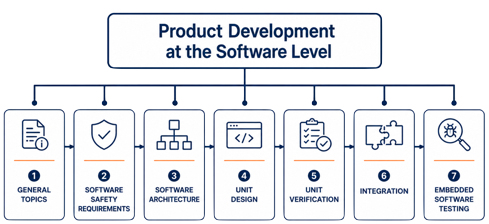
Overview of ISO 26262 Part 6 showing Software Safety Requirements, Software Architecture, Software Unit Design, Software Verification, and Software Integration Testing

ISO 26262 Part 6 Explained – Product Development at the Software Level

ISO 26262 Part 6 Explained – Product Development at the Software Level Software has become the defining element of modern vehicles. From braking and steering to battery management, powertrain control, and advanced driver assistance systems (ADAS), software now performs many of the functions that directly influence vehicle safety. As software complexity continues to increase, so …

ISO 26262 Part 6 Explained – Product Development at the Software Level Read More »

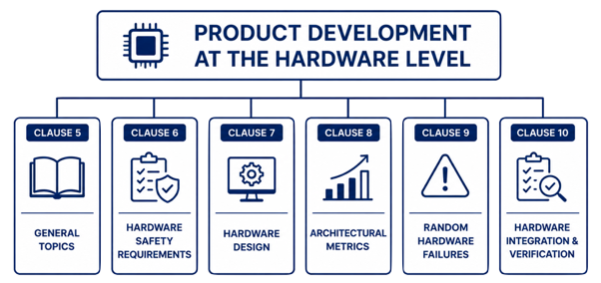
Overview of ISO 26262 Part 5 showing Hardware Safety Requirements, Hardware Design, Hardware Architectural Metrics, Random Hardware Failure Evaluation, and Hardware Verification

ISO 26262 Part 5 Explained – Product Development at the Hardware Level

ISO 26262 Part 5 Explained – Product Development at the Hardware Level Modern vehicles rely on highly complex electronic hardware to perform safety-critical functions such as braking, steering, battery management, and advanced driver assistance. To ensure that these systems remain safe even in the presence of hardware failures, automotive engineers must follow a structured hardware …

ISO 26262 Part 5 Explained – Product Development at the Hardware Level Read More »

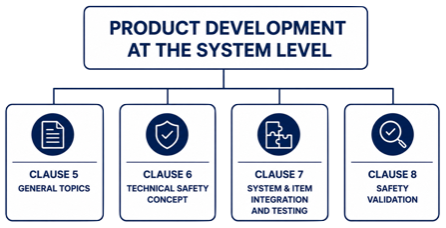
Overview of ISO 26262 Part 4 showing General Topics, Technical Safety Concept, System Integration and Testing, and Safety Validation

ISO 26262 Part 4 Explained – Product Development at the System Level

ISO 26262 Part 4 Explained – Product Development at the System Level Developing a safe automotive system requires much more than implementing safety mechanisms in hardware or software. Before detailed development begins, engineers must translate high-level safety objectives into a structured system architecture that ensures Functional Safety throughout the vehicle lifecycle. This is the purpose …

ISO 26262 Part 4 Explained – Product Development at the System Level Read More »

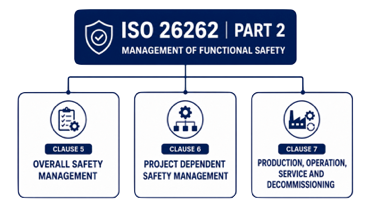
Overview of the structure of ISO 26262 Part 2 including Overall Safety Management, Project Dependent Safety Management, and Production, Operation, Service and Decommissioning

ISO 26262 Part 2 Explained – Management of Functional Safety

ISO 26262 Part 2 Explained – Management of Functional Safety Functional Safety is not achieved through technical solutions alone. Even the most advanced hardware and software architectures require structured planning, clear responsibilities, and systematic oversight to ensure that safety objectives are consistently achieved throughout the vehicle lifecycle. This is exactly the purpose of ISO 26262 …

ISO 26262 Part 2 Explained – Management of Functional Safety Read More »

Shopping Cart
Cookie Consent with Real Cookie Banner