
Trusted by 14,000+ Engineers
From 100+ Countries
Master AUTOSAR Classic Platform – Automotive Software Architecture
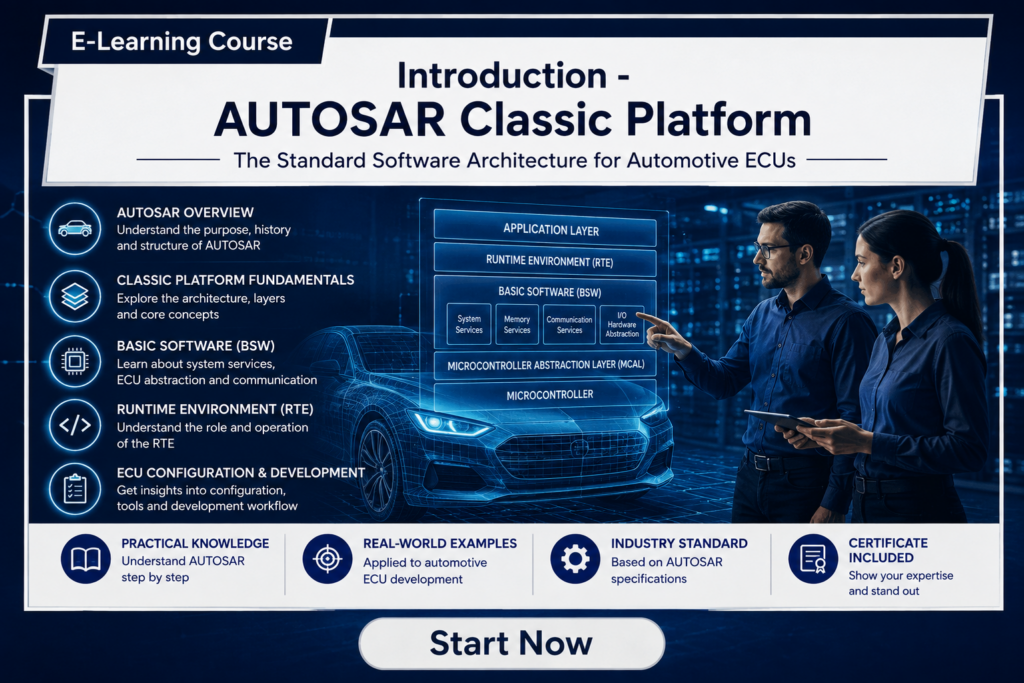
Understand the architecture, software layers, core services, and development concepts of the AUTOSAR Classic Platform – from applications and the RTE to Basic Software and ECU integration.
 2h video training 70+ pages training material Certificate of Completion included 60 days access (Single license) Course language: English
What you'll learn
- Understand the fundamentals of the AUTOSAR Classic Platform
- Understand the layered AUTOSAR software architecture
- Learn how Application Software Components interact through the RTE
- Understand the structure and purpose of AUTOSAR Basic Software
- Explore communication, memory, diagnostics, and ECU state management
- Understand the role of the AUTOSAR Operating System and Watchdog
- Learn how AUTOSAR software is configured and integrated into an ECU
- Understand the AUTOSAR development process and its role in modern vehicles
Course Preview: Get a Real Insight into the Training
Description
Modern vehicles contain increasingly complex embedded software systems that must integrate applications, communication, diagnostics, memory, hardware abstraction, and operating system services within a structured architecture. The AUTOSAR Classic Platform provides a standardized software architecture for developing automotive ECUs.
This course provides a structured and practical introduction to the AUTOSAR Classic Platform and its role in modern automotive software development.
You will first learn the fundamental ideas behind AUTOSAR, including its purpose, architecture, and the separation between application software and infrastructure software.
The course then explores the major layers of the AUTOSAR Classic Platform. You will understand how Application Software Components, the Runtime Environment (RTE), and Basic Software (BSW) interact to create a modular and standardized ECU software architecture.
A major part of the training focuses on the services provided by the Basic Software. You will explore important areas including the Communication Stack, ECU State Management, Operating System, Memory Stack, Diagnostics, Watchdog, and safety-related mechanisms.
The training also explains how AUTOSAR software is developed and integrated in practice. You will gain an understanding of the AUTOSAR development process, configuration concepts, interfaces, and the interaction between different software layers.
Finally, the course places AUTOSAR within the broader context of modern automotive development and explains how the architecture interacts with other important engineering disciplines and standards.
By completing this course, you will gain a clear understanding of how the AUTOSAR Classic Platform is structured, how its major software components interact, and how AUTOSAR supports the development of complex automotive ECUs.
This course is ideal for automotive software engineers, embedded software developers, system engineers, software architects, functional safety engineers, ECU developers, testers, project managers, and professionals who want to understand AUTOSAR Classic Platform architecture and development.
Course content
Introduction
- Course overview and learning objectives
- Introduction to automotive embedded software
- Role of AUTOSAR in modern ECU development
AUTOSAR Fundamentals
- Motivation and fundamental AUTOSAR concepts
- History and evolution of AUTOSAR
- Standardization and reuse in automotive software development
AUTOSAR Architecture
- Layered architecture of the AUTOSAR Classic Platform
- Application Layer, Runtime Environment, and Basic Software
- Interaction between the major AUTOSAR software layers
Inside the Basic Software
- Structure and purpose of the Basic Software
- Services and hardware abstraction
- Role of BSW modules within the ECU architecture
Inside the Application Layer
- Risk-based thinking
- Application Software Components
- Ports and interfaces
- Communication between software components
Inside the Runtime Environment
- Purpose and role of the Runtime Environment (RTE)
- Communication between applications and Basic Software
- Separation of application software from ECU implementation
Communication Stack
- Structure of the AUTOSAR Communication Stack
- Signal and message communication
- Communication services and hardware abstraction
ECU State Management
- ECU startup and shutdown
- Management of ECU operating states
- Coordination of Basic Software services
Operating System
- Role of the AUTOSAR Operating System
- Tasks, events, and scheduling
- Execution of software within the ECU
Memory Stack
- Non-volatile memory management
- EEPROM abstraction and memory services
- Interaction between memory layers
Diagnostics
- Diagnostic Event Manager (DEM)
- Diagnostic Communication Manager (DCM)
- Diagnostic data and fault handling
Watchdog & Safety
- Watchdog architecture and supervision
- Monitoring of software execution
- Safety-related mechanisms within AUTOSAR
AUTOSAR Development Process
- From system description to ECU configuration
- Configuration and integration of AUTOSAR software
- Development workflow and generated artifacts
AUTOSAR in Modern Automotive Development
- AUTOSAR within modern ECU development
- Interaction with functional safety and automotive development processes
- Role of AUTOSAR in increasingly complex vehicle architectures
Trusted by 14,000+ Engineers
From 100+ Countries
“It was such a great experience in learning Fusa from such a genius person!! concept were very clear and the way of teaching was very simple.”
Rohan Arora
“Great introduction to the most relevant parts of ASPICE. Totally recommended for beginners!“
Jose F. Gonzalez A.
“Great overview of ASPICE!”
Veselina Demireva
“The course is very structured and is based on the chapters of ISO 21434, which helped me a lot to compare the content of the course with the standard. This course is highly recommended for an initial overview of ISO. The content is clearly explained and easy to understand.”
Markus Simon
“The course has broken down a rather tough topic into a simpler words by connecting the right dots.“
Priyanka Pacharne
“Amazing, above expectations!“
Asfiyan Ali Khan
“I am coming to this program with 20+ years of experience with MIL-STD-882. This class allowed me to see what I would need to change in order to transition from 882 to ISO 26262. Overall, I thought this was a good presentation. I think the class provides a good overview for both the novice safety engineer and the old and crusty veteran. The class brought out many topics that forced me to go back to my old standard”
Patrick Norris
“Over all the course was really amazing with usefull information”
Prashanth Chotu
Looking for a complete automotive training?
Get access to all essential automotive standards in one structured learning path – from functional safety to cybersecurity and process quality.

Build a complete understanding of modern automotive development by combining functional safety, cybersecurity, and process standards in one training.
This bundle includes:
- ISO 26262 – Functional Safety
- ISO/SAE 21434 – Automotive Cybersecurity
- ISO 21448 (SOTIF) – Safety of the Intended Functionality
- Automotive SPICE® (ASPICE)
- ASPICE for Cybersecurity
- IATF 16949 – Automotive Quality Management
- AUTOSAR Classic Platform
Automotive Engineering Bundle – All Courses in One
Build a complete understanding of modern automotive standards – from functional safety to cybersecurity and process quality
694,00€ 399,00€
Save 42%
✔ 20+ hours of video training
✔ 1000+ pages of training material
✔ 60 days access (Single license)
✔ Practical examples and real-world use cases
✔ Exercises, quizzes, and structured learning path