Trusted by 15,000+ Engineers
From 115+ Countries
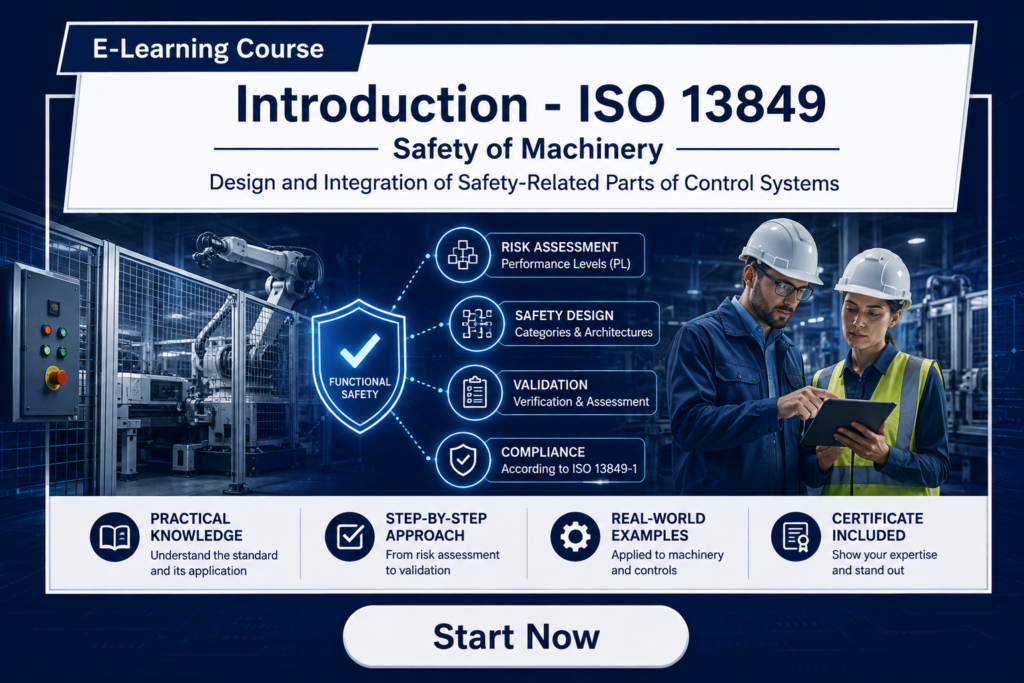
Master ISO 13849 – Functional Safety of Machinery
Learn how to design, evaluate, verify, and validate safety-related control systems according to ISO 13849 – from risk assessment to Performance Level verification.
 3h video training 80+ pages training material Certificate of Completion included 60 days access (Single license) Course language: English
What you'll learn
- Understand the fundamentals of machinery functional safety
- Understand the structure and key concepts of ISO 13849
- Learn how to define and specify safety functions
- Determine the required Performance Level (PLr)
- Design safety-related parts of control systems (SRP/CS)
- Understand Categories, MTTFd, DCavg and CCF
- Verify and validate achieved Performance Levels
- Understand documentation and lifecycle requirements
Course Preview: Get a Real Insight into the Training
Description
Functional safety is a key element in the design of modern machinery and automated systems. ISO 13849 provides an internationally recognized framework for designing and evaluating safety-related parts of control systems.
This course provides a structured and practical introduction to ISO 13849 and its application in machinery safety engineering.
You will learn how risk assessment results are translated into safety functions and how the required Performance Level is determined. The course then explains how safety-related control systems are designed using the concepts and requirements defined by ISO 13849.
A major focus is placed on the engineering parameters that determine the achieved Performance Level, including system categories, MTTFd, diagnostic coverage (DCavg), common cause failures (CCF), and fault considerations.
The training also covers the complete ISO 13849 engineering workflow – from the initial risk assessment and definition of safety functions through system design to verification, validation, documentation, and lifecycle management.
Practical examples are used throughout the course to demonstrate how the different concepts interact in real machinery safety projects.
By completing this course, you will gain a clear understanding of how safety-related control systems are developed and evaluated according to ISO 13849 and how the standard supports the reduction of machinery-related risks.
This course is ideal for functional safety engineers, machinery engineers, automation engineers, control system engineers, electrical engineers, system engineers, safety specialists, and professionals involved in the development or assessment of machinery safety systems.
Course content
Introduction
- Course overview and learning objectives
- Introduction to ISO 13849 and machinery functional safety
Machine Safety Fundamentals
- Fundamental principles of machinery safety
- Hazards, risks, and risk reduction
- Machinery safety standards and regulatory context
ISO 13849 Overview
- Purpose, scope, and structure of ISO 13849
- Role within the machinery safety standards landscape
- Relationship to other relevant machinery safety standards
Fundamental Concepts & Terminology
- Safety-related parts of control systems (SRP/CS)
- Safety functions and Performance Levels
- Categories and fundamental reliability concepts
ISO 13849 Engineering Workflow
- From risk assessment to safety-related control system design
- Definition and specification of safety functions
- Performance Level determination and verification
Risk Assessment & Safety Functions
- Identification of hazards and safety functions
- Determination of the required Performance Level (PLr)
- Translation of risk reduction requirements into safety functions
Designing Safety-Related Control Systems
- Categories B, 1, 2, 3, and 4
- Mean Time to Dangerous Failure (MTTFd)
- Diagnostic Coverage (DCavg)
- Common Cause Failure (CCF)
- Fault exclusion and architectural considerations
- Determination of the achieved Performance Level
- Practical application of ISO 13849 design principles
Verification and Validation
- Verification of the achieved Performance Level
- Validation of safety functions and safety-related control systems
- Reviews, testing, and validation evidence
Documentation and Functional Safety Lifecycle
- Required engineering documentation
- Traceability and lifecycle considerations
- Maintaining functional safety throughout the machinery lifecycle
Trusted by 14,000+ Engineers
From 100+ Countries
“It was such a great experience in learning Fusa from such a genius person!! concept were very clear and the way of teaching was very simple.”
Rohan Arora
“Great introduction to the most relevant parts of ASPICE. Totally recommended for beginners!“
Jose F. Gonzalez A.
“Great overview of ASPICE!”
Veselina Demireva
“The course is very structured and is based on the chapters of ISO 21434, which helped me a lot to compare the content of the course with the standard. This course is highly recommended for an initial overview of ISO. The content is clearly explained and easy to understand.”
Markus Simon
“The course has broken down a rather tough topic into a simpler words by connecting the right dots.“
Priyanka Pacharne
“Amazing, above expectations!“
Asfiyan Ali Khan
“I am coming to this program with 20+ years of experience with MIL-STD-882. This class allowed me to see what I would need to change in order to transition from 882 to ISO 26262. Overall, I thought this was a good presentation. I think the class provides a good overview for both the novice safety engineer and the old and crusty veteran. The class brought out many topics that forced me to go back to my old standard”
Patrick Norris
“Over all the course was really amazing with usefull information”
Prashanth Chotu