ISO 26262 Part 2 Explained – Management of Functional Safety
Functional Safety is not achieved through technical solutions alone.
Even the most advanced hardware and software architectures require structured planning, clear responsibilities, and systematic oversight to ensure that safety objectives are consistently achieved throughout the vehicle lifecycle.
This is exactly the purpose of ISO 26262 Part 2 – Management of Functional Safety.
Part 2 establishes the organizational framework for managing Functional Safety activities, ensuring that safety responsibilities, planning, confirmation measures, and lifecycle management are integrated into every automotive development project.
In this article, we explain the structure of ISO 26262 Part 2 and its key requirements.
If you want to deepen your understanding of ISO 26262, ASPICE, Automotive Cybersecurity, and other engineering standards for safety-critical systems, explore our complete online training portfolio:
Developing safety-related systems involves many engineering disciplines, including systems engineering, hardware development, software development, testing, manufacturing, and maintenance.
Without effective management, organizations may experience:
unclear safety responsibilities
inconsistent safety activities
incomplete documentation
insufficient verification
missed safety objectives
reduced compliance with ISO 26262
Functional Safety Management ensures that all safety-related activities are properly planned, coordinated, monitored, and documented throughout the project.
It provides the governance necessary to transform safety requirements into safe products.
Structure of ISO 26262 Part 2
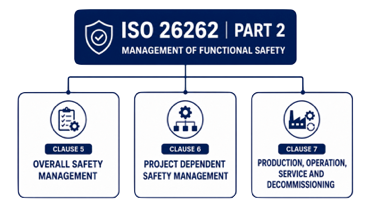
ISO 26262 Part 2 is organized around three major areas:
Clause 5 – Overall Safety Management
Defines the organizational framework for Functional Safety.
Clause 6 – Project Dependent Safety Management
Defines how Functional Safety is managed during individual development projects.
Clause 7 – Production, Operation, Service and Decommissioning
Extends Functional Safety activities beyond development into the operational lifecycle of the vehicle.
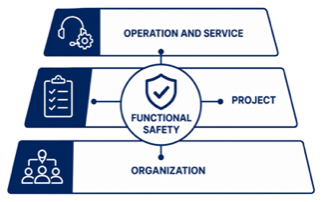
Together, these clauses ensure that Functional Safety remains an ongoing management responsibility rather than a one-time engineering activity.
ISO 26262 Part 2 establishes the organizational framework for managing Functional Safety throughout the vehicle lifecycle.
Clause 5 – Overall Safety Management
Clause 5 establishes the organization-wide foundation for Functional Safety.
Its objective is to ensure that organizations create an environment capable of supporting safety throughout all development projects.
Typical activities include:
defining Functional Safety policies
assigning organizational responsibilities
establishing competence management
maintaining safety culture
defining organizational processes
This organizational framework ensures that every project starts from a consistent and well-defined safety management system.
Without this foundation, project-level safety activities become difficult to execute consistently.
Clause 6 – Project Dependent Safety Management
While Clause 5 defines organizational responsibilities, Clause 6 focuses on individual projects.
Each safety-related project requires dedicated management activities to ensure that Functional Safety objectives are achieved.
Typical activities include:
assigning project safety responsibilities
coordinating safety activities
monitoring project progress
managing interfaces
ensuring compliance with the safety plan
Project-dependent safety management ensures that safety remains an integral part of daily project execution rather than a separate compliance exercise.
Safety Planning
A central requirement of Clause 6 is the development of a Safety Plan.
The Safety Plan defines how Functional Safety activities will be performed throughout the project.
Typical contents include:
project milestones
safety activities
responsibilities
work products
reviews
verification activities
confirmation measures
The Safety Plan serves as the roadmap for Functional Safety management and helps ensure that all required activities are completed at the appropriate stages of development.
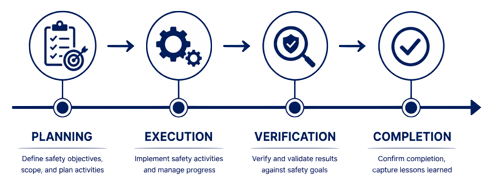
The Safety Plan defines how Functional Safety activities are organized, coordinated, and monitored throughout a development project.
Confirmation Measures
ISO 26262 requires independent confirmation that Functional Safety activities have been performed correctly.
These confirmation measures provide objective confidence in both the development process and the resulting work products.
Typical confirmation measures include:
Functional Safety Reviews
Functional Safety Audits
Functional Safety Assessments
Independence is a key principle.
The required level of independence depends on the Automotive Safety Integrity Level (ASIL) and the nature of the activity being evaluated.
Confirmation Measures strengthen confidence that safety objectives have been achieved before product release.
Clause 7 – Production, Operation, Service and Decommissioning
Functional Safety does not end when development is complete.
Clause 7 extends safety management into the operational phase of the product lifecycle.
Typical considerations include:
production readiness
manufacturing controls
service procedures
maintenance activities
field monitoring
product modifications
end-of-life and decommissioning
Managing Functional Safety throughout operation helps ensure that vehicles remain safe even after they leave the development environment.
Management Across the Safety Lifecycle
One of the most important messages of ISO 26262 Part 2 is that Functional Safety Management is a continuous activity.
It begins before development starts and continues throughout:
concept development
system design
hardware development
software development
verification and validation
production
vehicle operation
service
decommissioning
This lifecycle perspective ensures that safety considerations remain integrated into every phase of product development and operation.
Functional Safety Management is a continuous activity that spans the entire safety lifecycle, from project initiation to vehicle decommissioning.
Summary
ISO 26262 Part 2 establishes the organizational and project-level framework for managing Functional Safety.
Its core elements include:
Overall Safety Management
Project Dependent Safety Management
Safety Planning
Confirmation Measures
Production, Operation, Service and Decommissioning
Together, these requirements ensure that Functional Safety activities are planned, coordinated, verified, and maintained throughout the complete safety lifecycle.
While engineers often focus on technical development, effective Functional Safety ultimately depends on strong management processes, clear responsibilities, and independent confirmation of safety activities.
Understanding ISO 26262 Part 2 is therefore essential for Functional Safety Managers, Project Managers, Systems Engineers, Quality Engineers, and organizations developing safety-related automotive systems.
If you prefer a visual explanation, this video explains ISO 26262-2 Management of Functional Safety step by step: