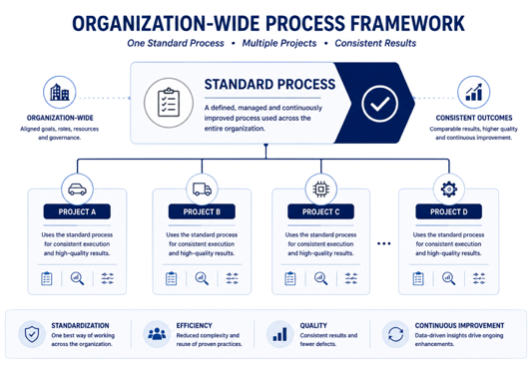
Processes become standardized across the organization and are deployed consistently.
Typical characteristics include:
organizational process standards
defined methods and procedures
common templates
standardized training
consistent implementation across projects
The emphasis shifts from project-specific execution to organization-wide process consistency.
This enables improved collaboration and more predictable development outcomes.
Capability Level 3 focuses on establishing standardized engineering processes across the entire organization.
Capability Levels 4 and 5
The highest Capability Levels focus on measurement, predictability, and continuous optimization.
Capability Level 4 – Predictable Process
At CL4, organizations use quantitative data to control process performance.
Typical activities include:
performance measurement
statistical monitoring
quantitative process control
performance prediction
Objective metrics support informed management decisions and improve process stability.
Capability Level 5 – Innovating Process
Capability Level 5 emphasizes continuous improvement and innovation.
Organizations actively optimize processes using measurement results, lessons learned, and emerging best practices.
Typical activities include:
continuous improvement initiatives
innovation programs
root cause analysis
process optimization
organizational learning
Although relatively few organizations pursue CL4 or CL5 across all processes, these levels represent the highest degree of process capability.
How Capability Levels Build Upon Each Other
One of the key principles of ASPICE is that Capability Levels are cumulative.
Each level builds on the foundation established by the previous level.
The progression can be summarized as follows:
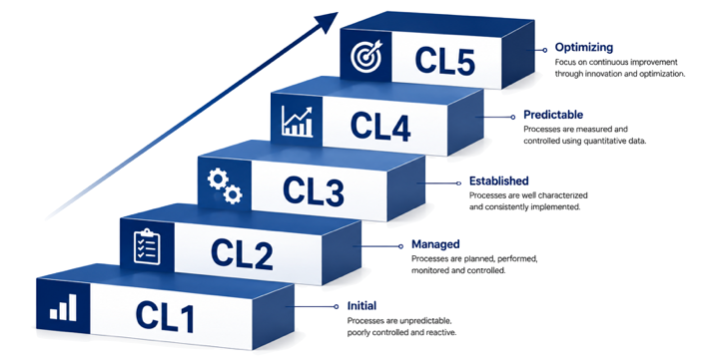
CL1 – The process is performed.
CL2 – The process is managed.
CL3 – The process is standardized across the organization.
CL4 – The process is quantitatively controlled.
CL5 – The process is continuously optimized.
This structured progression helps organizations improve systematically rather than attempting to implement advanced practices before establishing a stable foundation.
Capability Levels and ASPICE Assessments
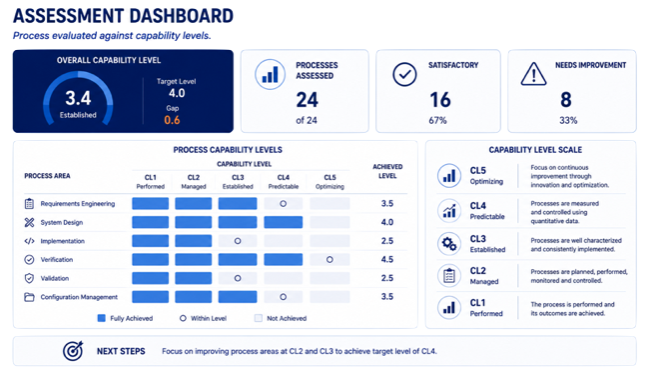
Capability Levels are at the heart of every ASPICE assessment.
Assessors evaluate Process Attributes (PAs) associated with each Capability Level and determine whether they are achieved according to the ASPICE rating scale.
Assessment results provide valuable insight into:
process strengths
improvement opportunities
organizational capability
supplier maturity
customer confidence
For many automotive suppliers, achieving the required Capability Levels is essential for participating in customer projects and demonstrating process excellence.
Understanding the Capability Level model is therefore fundamental for engineers, project managers, quality professionals, and assessment teams.
Capability Levels form the foundation of ASPICE assessments and help organizations identify strengths and improvement opportunities.
Summary
The ASPICE 4.0 Capability Levels provide a structured framework for evaluating process capability and organizational maturity.
The five Capability Levels are:
CL1 – Performed Process
CL2 – Managed Process
CL3 – Established Process
CL4 – Predictable Process
CL5 – Innovating Process
Each level builds upon the previous one, encouraging organizations to improve processes in a systematic and sustainable way.
Whether preparing for an ASPICE assessment or implementing process improvements, understanding the Capability Level model is essential for achieving consistent, high-quality automotive development.
If you prefer a visual explanation, this video explains ASPICE Capability Levels step by step: