Successful automotive development requires more than excellent engineering.
Even the best system, software, and hardware engineers cannot deliver successful products without effective project planning, risk management, and performance monitoring.
This is where the ASPICE 4.0 Management Process Group (MAN) comes into play.
The Management Processes provide the framework for planning, controlling, monitoring, and improving development activities throughout the project lifecycle.
In this article, we explain the ASPICE 4.0 Management Process Group and show how Project Management, Risk Management, and Measurement contribute to successful automotive projects.
If you want to understand ASPICE, Systems Engineering, Functional Safety, and Automotive Cybersecurity in greater depth:
Modern automotive development projects are highly complex.
Teams often consist of hundreds of engineers working across multiple disciplines, suppliers, and international locations.
Without structured management processes, organizations may experience:
missed milestones
uncontrolled project risks
poor communication
insufficient project visibility
ineffective decision-making
budget and schedule overruns
The ASPICE Management Processes help organizations establish control over development activities and provide objective information for project decisions.
Rather than replacing engineering activities, they enable engineering teams to work more effectively and predictably.
The ASPICE 4.0 Management Processes
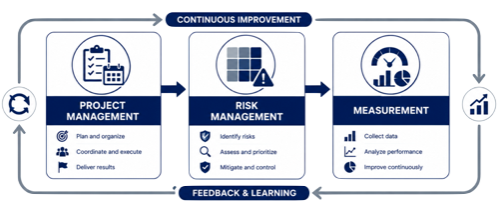
The ASPICE 4.0 Management Process Group consists of three core processes.
MAN.3 – Project Management
Planning, monitoring, and controlling project execution.
MAN.5 – Risk Management
Identifying, evaluating, and mitigating project risks.
MAN.6 – Measurement
Collecting and analyzing project data to support informed decision-making.
Together, these processes provide the management foundation for successful automotive development projects.
Overview of the ASPICE 4.0 Management Process Group supporting planning, risk management, and performance measurement
MAN.3 – Project Management
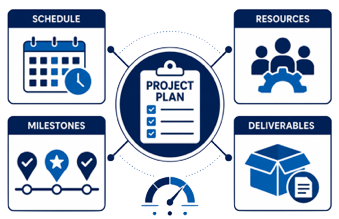
Project Management ensures that development activities are properly planned, coordinated, and monitored throughout the project lifecycle.
Typical activities include:
project planning
scheduling
resource management
milestone tracking
progress monitoring
stakeholder communication
Effective Project Management provides visibility into project status and enables early identification of deviations.
Rather than reacting to problems after they occur, organizations can proactively manage schedules, resources, and deliverables.
Project Management therefore serves as the central coordination process for automotive development projects.
MAN.3 ensures that automotive development projects are planned, monitored, and controlled throughout the lifecycle
MAN.5 – Risk Management
Every automotive development project involves uncertainty.
Technical challenges, supplier issues, changing requirements, and resource constraints all introduce risks that may affect project success.
The objective of MAN.5 is to identify, evaluate, and manage these risks before they become major problems.
Typical activities include:
risk identification
risk assessment
mitigation planning
risk monitoring
management reporting
A structured Risk Management process helps organizations prioritize actions and allocate resources where they provide the greatest benefit.
Managing risks proactively improves both project predictability and product quality.
MAN.6 – Measurement
Good decisions require reliable data.
The purpose of MAN.6 is to establish measurement activities that provide objective insight into project performance.
Rather than relying on assumptions, project managers can use objective metrics to evaluate progress, identify emerging issues, and support continuous improvement.
Well-designed measurement programs improve transparency across the entire project.
How MAN Processes Work Together
Although each Management Process has a specific purpose, they work closely together.
Project Management defines project objectives, plans, and milestones.
Risk Management identifies potential threats that could affect those objectives.
Measurement provides objective data showing whether the project is progressing as expected.
For example:
Project Management defines the schedule.
Measurement monitors actual progress.
Risk Management evaluates deviations and identifies potential impacts.
Project Management adjusts plans based on measurement data and risk assessments.
Together, these processes support informed decision-making throughout the development lifecycle.
Management Processes Across the Lifecycle
Management Processes are not isolated activities performed only at the beginning of a project.
Instead, they operate continuously across every development phase.
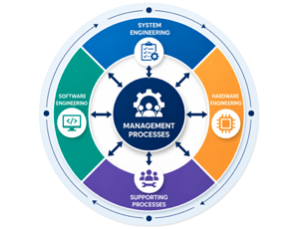
Whether teams are working on:
System Engineering
Hardware Engineering
Software Engineering
Supporting Processes
the Management Process Group provides planning, monitoring, and decision support.
This continuous oversight helps organizations maintain project control despite increasing technical complexity.
As automotive systems continue to evolve, effective project governance becomes an increasingly important competitive advantage.
The ASPICE Management Process Group provides continuous planning, monitoring, and decision support across the entire automotive development lifecycle
Summary
The ASPICE 4.0 Management Process Group provides the framework for planning, controlling, and monitoring automotive development projects.
The process group consists of:
MAN.3 Project Management
MAN.5 Risk Management
MAN.6 Measurement
Together, these processes help organizations improve project visibility, manage uncertainty, and make objective decisions based on reliable information.
While engineering processes define how products are developed, Management Processes ensure that development activities remain aligned with project objectives throughout the lifecycle.
Understanding the Management Process Group is therefore essential for project managers, engineering managers, quality professionals, and organizations preparing for ASPICE assessments.
If you prefer a visual explanation, this video explains ASPICE management Process Group step by step: