The foundation of every safe automotive system is established long before hardware is designed or software is written.
The decisions made during the Concept Phase determine how hazards are identified, risks are evaluated, and safety objectives are defined for the entire development lifecycle.
This is the purpose of ISO 26262 Part 3 – Concept Phase.
Part 3 introduces the systematic activities required to understand potential hazards, determine Automotive Safety Integrity Levels (ASILs), and derive the Safety Goals that guide all subsequent development activities.
In this article, we explain the structure of ISO 26262 Part 3 and its key concepts.
If you want to deepen your understanding of ISO 26262, ASPICE, Automotive Cybersecurity, and other engineering standards for safety-critical systems, explore our complete online training portfolio:
Every safety-related function begins with a simple question:
What could go wrong, and how can we prevent it?
The Concept Phase answers this question before technical implementation begins.
Its objective is to identify hazardous situations, evaluate their associated risks, and establish safety objectives that reduce these risks to an acceptable level.
Without a structured Concept Phase, organizations risk:
overlooking hazardous scenarios
underestimating safety risks
assigning incorrect safety requirements
inconsistent safety concepts
costly redesigns later in development
The quality of the entire Functional Safety lifecycle depends on the decisions made during this early phase.
Structure of ISO 26262 Part 3
ISO 26262 Part 3 consists of several closely connected activities.
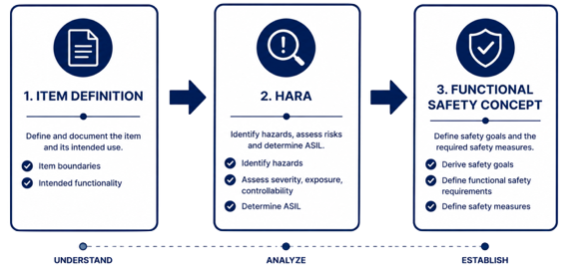
The overall workflow can be summarized as follows:
Item Definition
Hazard Analysis and Risk Assessment (HARA)
ASIL Determination
Safety Goals
Functional Safety Concept
Each activity builds upon the results of the previous one.
Together, they establish the functional safety strategy before detailed system development begins.
ISO 26262 Part 3 establishes the foundation of Functional Safety by defining the Concept Phase workflow from hazard identification to the Functional Safety Concept.
Item Definition
The first step is defining the item.
An item represents the system or function that will be analyzed from a Functional Safety perspective.
The Item Definition describes:
system functionality
intended behavior
operational environment
interfaces
system boundaries
assumptions
A well-defined item provides the necessary context for identifying hazards during the Hazard Analysis and Risk Assessment.
If the item is poorly defined, subsequent safety analyses become unreliable.
Hazard Analysis and Risk Assessment (HARA)
The Hazard Analysis and Risk Assessment (HARA) is one of the central activities of ISO 26262.
Its purpose is to systematically identify hazardous events and evaluate the associated safety risks.
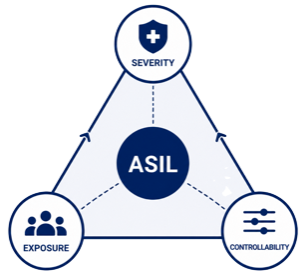
The analysis combines three key factors:
Severity (S) – How serious are the potential consequences?
Exposure (E) – How frequently could the operational situation occur?
Controllability (C) – How likely is it that the driver or other road users can avoid the hazardous event?
These factors are evaluated together to determine the appropriate Automotive Safety Integrity Level (ASIL).
The HARA ensures that safety requirements are based on objective risk evaluation rather than assumptions.
What Is a Hazard?
A hazard is a potential source of harm caused by the malfunctioning behavior of an item.
Importantly, ISO 26262 distinguishes between a hazard and a failure.
A hardware or software failure is only one possible cause of a hazard.
For example:
unintended acceleration
unintended braking
steering malfunction
loss of propulsion
incorrect sensor information
These hazards are evaluated within specific operational scenarios to determine their potential safety impact.
Understanding this distinction is essential for performing an effective Hazard Analysis and Risk Assessment.
ASIL Determination
Following the HARA, each hazardous event is assigned an Automotive Safety Integrity Level (ASIL).
The available classifications are:
QM (Quality Management)
ASIL A
ASIL B
ASIL C
ASIL D
ASIL D represents the highest level of safety rigor.
The assigned ASIL determines the level of confidence required throughout system, hardware, and software development.
It influences:
development methods
verification activities
confirmation measures
documentation
validation effort
Correct ASIL determination is therefore fundamental for the entire Functional Safety lifecycle.
ASIL determination evaluates Severity, Exposure, and Controllability to define the appropriate Automotive Safety Integrity Level for each hazardous event.
Safety Goals
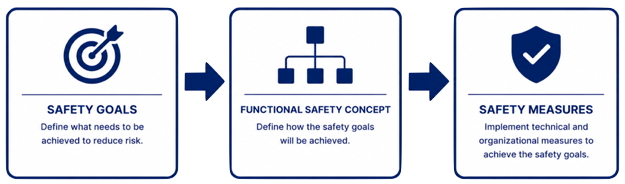
Based on the results of the HARA, Safety Goals are defined.
Safety Goals describe the high-level safety objectives required to prevent or mitigate hazardous events.
Examples include:
prevent unintended acceleration
maintain steering capability
avoid unintended braking
maintain vehicle stability
Safety Goals do not specify technical implementation.
Instead, they define what must be achieved to ensure acceptable safety.
These objectives serve as the foundation for all lower-level Functional Safety Requirements.
Functional Safety Concept
The Functional Safety Concept (FSC) translates Safety Goals into a structured functional safety strategy.
It defines:
Functional Safety Requirements
fault detection strategies
fault handling concepts
safe state definitions
interactions between system elements
The Functional Safety Concept focuses on system behavior rather than implementation details.
Technical solutions are developed later during system, hardware, and software development.
A well-defined Functional Safety Concept provides the roadmap for achieving the Safety Goals established during the Concept Phase.
The Functional Safety Concept translates Safety Goals into Functional Safety Requirements that guide subsequent system, hardware, and software development.
Summary
ISO 26262 Part 3 establishes the foundation for Functional Safety by identifying hazards and defining the high-level safety strategy before development begins.
Its key activities include:
Item Definition
Hazard Analysis and Risk Assessment (HARA)
Hazard Identification
ASIL Determination
Safety Goals
Functional Safety Concept
Together, these activities ensure that safety considerations are integrated into automotive development from the very beginning.
Because every subsequent engineering activity depends on the outputs of the Concept Phase, understanding ISO 26262 Part 3 is essential for Functional Safety Engineers, Systems Engineers, Project Managers, and organizations developing safety-related automotive systems.
If you prefer a visual explanation, this video explains ISO 26262-3 Concept Phase step by step: