ISO 26262 Part 4 Explained – Product Development at the System Level
Developing a safe automotive system requires much more than implementing safety mechanisms in hardware or software.
Before detailed development begins, engineers must translate high-level safety objectives into a structured system architecture that ensures Functional Safety throughout the vehicle lifecycle.
This is the purpose of ISO 26262 Part 4 – Product Development at the System Level.
Part 4 provides the framework for transforming the outputs of the Concept Phase into a complete system design, including Technical Safety Requirements, system architecture, integration, testing, and safety validation.
In this article, we explain the structure of ISO 26262 Part 4 and its key activities.
If you want to deepen your understanding of ISO 26262, ASPICE, Automotive Cybersecurity, and other engineering standards for safety-critical systems, explore our complete online training portfolio:
The Concept Phase defines what must be achieved to ensure Functional Safety.
System-Level Development defines how those objectives are implemented within the vehicle system.
Without structured system engineering, organizations may face:
incomplete allocation of safety requirements
inconsistent system architectures
missing safety mechanisms
integration problems
insufficient verification
increased development costs
ISO 26262 Part 4 ensures that Functional Safety becomes an integral part of the system architecture before hardware and software development begin.
It serves as the bridge between the Functional Safety Concept and detailed implementation.
Structure of ISO 26262 Part 4
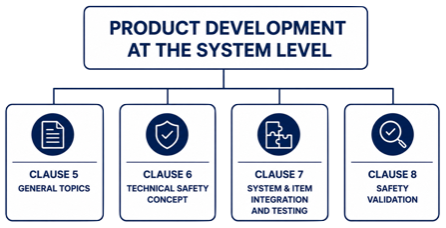
ISO 26262 Part 4 is organized into four main technical areas:
Clause 5 – General Topics
Establishes the prerequisites and general requirements for system-level development.
Clause 6 – Technical Safety Concept
Defines Technical Safety Requirements and allocates them to system elements.
Clause 7 – System and Item Integration and Testing
Verifies that integrated system elements satisfy the allocated Technical Safety Requirements.
Clause 8 – Safety Validation
Confirms that the complete vehicle fulfills the Safety Goals established during the Concept Phase.
Together, these activities ensure that Functional Safety is systematically integrated into system development.
ISO 26262 Part 4 defines how Functional Safety is implemented at the system level through technical safety concepts, integration, testing, and validation.
Clause 5 – General Topics
Clause 5 establishes the overall framework for Product Development at the System Level.
It defines the general principles that guide system development throughout the project.
Typical activities include:
planning system development
managing interfaces
maintaining traceability
coordinating safety activities
supporting communication between engineering disciplines
Although often less visible than later clauses, these general topics provide the organizational foundation for successful system engineering.
Clause 6 – Technical Safety Concept
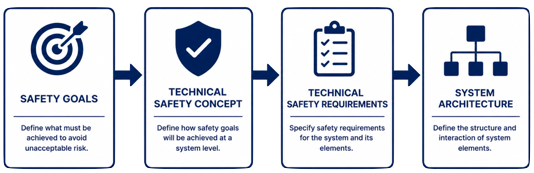
The Technical Safety Concept (TSC) is one of the most important outputs of Part 4.
Its purpose is to translate the Functional Safety Concept into implementable Technical Safety Requirements.
Typical activities include:
deriving Technical Safety Requirements
allocating requirements to system elements
defining safety mechanisms
developing the system architecture
establishing interfaces between system components
The Technical Safety Concept explains how the system will achieve the Safety Goals defined during the Concept Phase.
It provides the technical foundation for subsequent hardware and software development.
The Technical Safety Concept transforms Safety Goals into implementable Technical Safety Requirements and system architecture.
Clause 7 – System and Item Integration and Testing
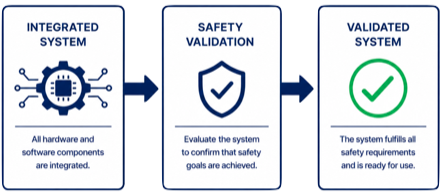
After the system architecture has been implemented, individual system elements must be integrated and tested.
The objective is to verify that the complete system behaves as intended.
Typical activities include:
system integration
interface verification
integration testing
system testing
verification of Technical Safety Requirements
Integration testing helps identify issues that may not be visible when components are evaluated individually.
It provides confidence that the overall system functions safely under realistic operating conditions.
Clause 8 – Safety Validation
Verification demonstrates that the system has been built correctly.
Safety Validation answers a different question:
Has the correct system been built to achieve the intended Safety Goals?
Validation evaluates the complete item under representative operating conditions.
Typical validation activities include:
validating Safety Goals
confirming intended functionality
evaluating hazardous scenarios
validating operational behavior
documenting validation evidence
Safety Validation provides the final confirmation that the developed system satisfies its intended Functional Safety objectives.
Safety Validation confirms that the complete vehicle fulfills the intended Safety Goals under realistic operating conditions.
How Part 4 Fits into ISO 26262
ISO 26262 follows a structured development lifecycle in which each part builds upon the previous one.
The relationship can be summarized as follows:
Part 2 establishes Functional Safety Management.
Part 3 defines the Concept Phase, including HARA, ASIL determination, Safety Goals, and the Functional Safety Concept.
Part 4 transforms these outputs into a complete system architecture and Technical Safety Concept.
Part 5 continues with hardware development.
Part 6 continues with software development.
Part 4 therefore represents the critical link between high-level safety analysis and technical implementation.
It ensures that Functional Safety is embedded into the overall system before detailed development begins.
Summary
ISO 26262 Part 4 defines how Functional Safety is implemented at the system level.
Its main activities include:
General Topics
Technical Safety Concept
System and Item Integration and Testing
Safety Validation
Together, these activities transform high-level Safety Goals into a structured system architecture that enables safe and reliable vehicle development.
For Functional Safety Engineers, Systems Engineers, System Architects, and Project Managers, understanding Part 4 is essential because it connects safety analysis with practical engineering implementation.
If you prefer a visual explanation, this video explains ISO 26262-4 Product development at the system level step by step: