When engineers think about ASPICE, they often focus on System Engineering, Software Engineering, or Hardware Engineering.
However, successful automotive development depends on much more than engineering activities alone.
Projects also require quality assurance, configuration control, issue management, change management, and increasingly, machine learning data management.
This is where the ASPICE 4.0 Supporting Process Group (SUP) comes into play.
Supporting Processes provide the framework that helps organizations maintain quality, traceability, consistency, and control across the entire development lifecycle.
In this article, we explain the most important ASPICE 4.0 Supporting Processes and how they contribute to successful automotive projects.
Why Supporting Processes Matter
Modern vehicle development involves large teams, complex architectures, evolving requirements, and frequent changes.
Without structured supporting processes, organizations can quickly face problems such as:
uncontrolled changes
inconsistent documentation
lost traceability
unresolved defects
configuration errors
reduced product quality
Supporting Processes help organizations establish discipline and governance across development activities.
They provide confidence that engineering work is performed consistently and that project information remains reliable throughout the lifecycle.
For ASPICE assessments, Supporting Processes are often just as important as engineering processes because they provide evidence that development activities are properly managed and controlled.
The ASPICE 4.0 Supporting Processes
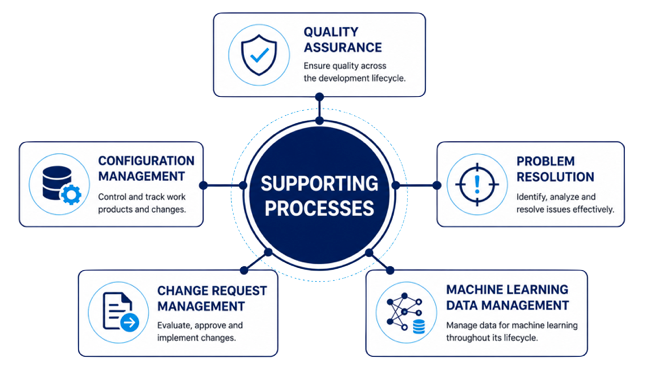
Overview of the key ASPICE 4.0 Supporting Processes that enable quality, traceability, and governance across automotive development
SUP.1 – Quality Assurance
Quality Assurance provides independent confidence that development activities comply with defined processes and standards.
The objective is not to perform the engineering work itself but to evaluate whether activities are performed correctly.
Typical Quality Assurance activities include:
process audits
work product reviews
compliance assessments
process monitoring
corrective action tracking
Quality Assurance helps identify weaknesses early and supports continuous process improvement.
In ASPICE assessments, Quality Assurance often plays a key role in demonstrating process compliance.
SUP.8 – Configuration Management
Modern automotive projects generate enormous amounts of information.
Requirements, specifications, software, hardware designs, test cases, and reports all require version control and traceability.
The objective of Configuration Management is to establish control over these artifacts.
Typical activities include:
identifying configuration items
managing versions
establishing baselines
controlling releases
maintaining configuration records
Without Configuration Management, maintaining consistency across complex projects becomes extremely difficult.
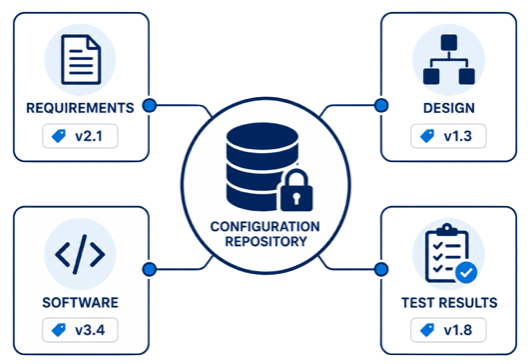
SUP.8 ensures control of versions, baselines, and development artifacts throughout the lifecycle
If you want to understand ASPICE, Systems Engineering, Functional Safety, and Automotive Cybersecurity in greater depth:
It also protects traceability throughout the lifecycle.
SUP.11 – Machine Learning Data Management
One of the major additions in ASPICE 4.0 is Machine Learning Data Management.
As artificial intelligence becomes increasingly important in automotive systems, organizations must manage machine learning data with the same level of discipline applied to traditional engineering artifacts.
Typical activities include:
data collection
data labeling
dataset versioning
dataset quality assurance
data traceability
data maintenance
Machine Learning Data Management helps ensure that AI-based systems are developed using controlled and reliable datasets.
This process reflects the growing importance of AI-driven functionality in modern vehicles.
How Supporting Processes Work Together
Although each Supporting Process has a specific purpose, they are highly interconnected.
For example:
Quality Assurance evaluates compliance with supporting and engineering processes.
Configuration Management controls versions of requirements, software, hardware, and datasets.
Problem Resolution Management identifies defects and issues.
Change Request Management controls modifications resulting from identified problems.
Machine Learning Data Management controls datasets used for AI-enabled systems.
Together, these processes create a framework that supports:
quality
traceability
consistency
compliance
continuous improvement
Without Supporting Processes, even well-defined engineering activities can become difficult to manage.
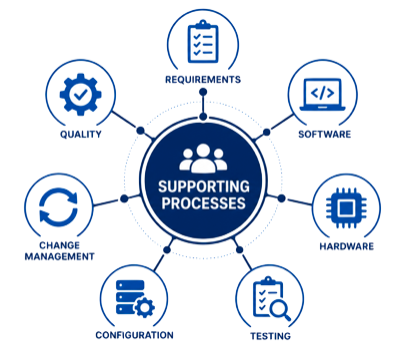
Supporting Processes work together to ensure quality, traceability, consistency, and governance throughout automotive development
Summary
The ASPICE 4.0 Supporting Process Group provides essential governance and control mechanisms for automotive development.
Key Supporting Processes include:
SUP.1 Quality Assurance
SUP.8 Configuration Management
SUP.9 Problem Resolution Management
SUP.10 Change Request Management
SUP.11 Machine Learning Data Management
Together, these processes help organizations maintain quality, traceability, consistency, and control throughout the development lifecycle.
While they often receive less attention than engineering processes, Supporting Processes are critical for successful projects and ASPICE assessments.
As automotive systems continue to increase in complexity, their importance will only continue to grow.
If you prefer a visual explanation, this video explains ASPICE Supporting Process Group step by step: