Modern vehicles rely on sophisticated electronic hardware to deliver functionality, safety, connectivity, and performance.
Electronic Control Units (ECUs), sensors, power electronics, communication interfaces, and processing hardware form the foundation upon which automotive software operates.
As vehicle complexity continues to increase, hardware development requires structured engineering processes that ensure quality, traceability, and verification throughout the lifecycle.
This is where the ASPICE 4.0 Hardware Engineering (HWE) process group comes into play.
ASPICE Hardware Engineering provides a framework for developing and verifying automotive hardware products from requirements through design and verification.
In this article, we explain the ASPICE 4.0 Hardware Engineering process group and how its processes support successful hardware development.
Why Hardware Engineering Matters
When discussing ASPICE, many engineers immediately think about software development.
However, software can only perform as intended if the underlying hardware platform provides the necessary functionality and reliability.
Automotive hardware must meet demanding requirements related to:
performance
reliability
safety
cybersecurity
environmental conditions
manufacturing constraints
Failures in hardware design can result in:
functional issues
integration problems
increased costs
delayed projects
safety concerns
Structured hardware engineering helps organizations manage these risks and establish a repeatable development process.
If you want to understand ASPICE, Systems Engineering, Functional Safety, and Automotive Cybersecurity in greater depth:
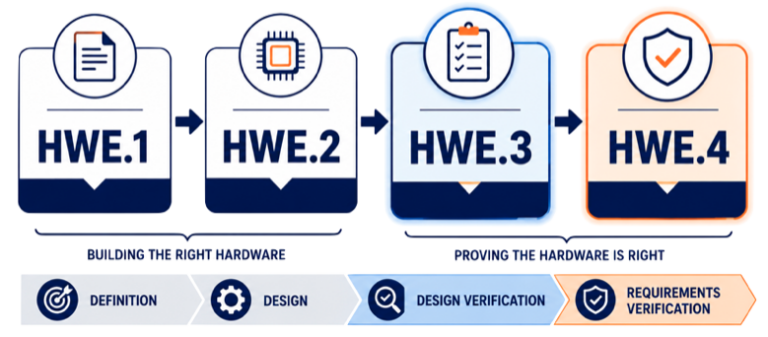
ASPICE 4.0 defines four Hardware Engineering processes:
HWE.1 – Hardware Requirements Analysis
Transforming system requirements into hardware requirements.
HWE.2 – Hardware Design
Developing the hardware architecture and detailed design.
HWE.3 – Verification against Hardware Design
Verifying that the implemented hardware correctly realizes the hardware design.
HWE.4 – Verification against Hardware Requirements
Verifying that the hardware satisfies its defined requirements.
Together, these processes provide a structured path from hardware requirements to verified hardware products.
Overview of the ASPICE 4.0 Hardware Engineering process group and its core development and verification processes
HWE.1 – Hardware Requirements Analysis
The Hardware Engineering lifecycle begins with requirements.
The purpose of HWE.1 is to transform system-level requirements into hardware-specific requirements.
Typical activities include:
analyzing system requirements
defining hardware functions
identifying hardware interfaces
documenting hardware requirements
establishing traceability
Good hardware requirements should be:
complete
consistent
verifiable
feasible
traceable
The quality of hardware requirements directly influences all downstream development activities.
Errors introduced at this stage often become expensive to correct later in the project.
HWE.2 – Hardware Design
Once hardware requirements have been defined, engineers develop the hardware design.
The objective is to create a hardware solution capable of satisfying all allocated requirements.
Typical activities include:
hardware architecture development
component selection
interface design
schematic design
hardware decomposition
The hardware design establishes the structure of the product and provides the foundation for implementation activities.
A well-designed architecture improves maintainability, testability, and overall product quality.
HWE.2 defines the hardware architecture and design used to satisfy hardware requirements
Verification in Hardware Engineering
Verification is a central concept within ASPICE Hardware Engineering.
Verification answers an important question:
“Was the hardware built correctly?”
ASPICE 4.0 distinguishes between two verification perspectives:
Verification against Hardware Design (HWE.3)
Verification against Hardware Requirements (HWE.4)
Verification is a central concept within ASPICE Hardware Engineering.
Verification answers an important question:
“Was the hardware built correctly?”
ASPICE 4.0 distinguishes between two verification perspectives:
Verification against Hardware Design (HWE.3)
Verification against Hardware Requirements (HWE.4)
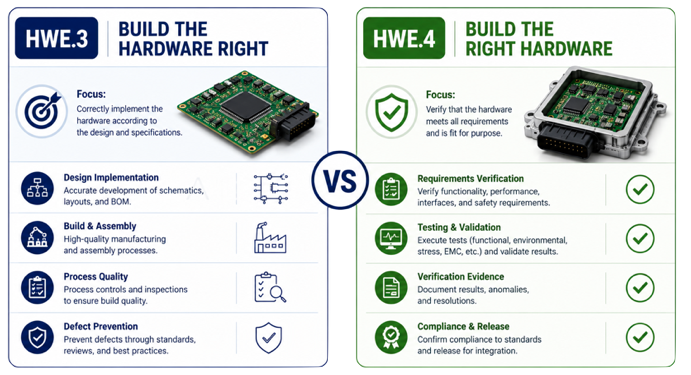
Although these activities are closely related, they serve different purposes and provide different forms of evidence.
This distinction is one of the key characteristics of the ASPICE Hardware Engineering process group.
HWE.3 – Verification against Hardware Design
The objective of HWE.3 is to verify that the implemented hardware correctly realizes the hardware design.
Typical verification activities include:
design reviews
schematic reviews
implementation inspections
design conformance checks
hardware design verification testing
The focus is on confirming that the implemented hardware matches the approved design definition.
In simple terms:
HWE.3 asks whether the hardware was built according to the design.
This process helps identify implementation errors before they propagate into later development stages.
HWE.4 – Verification against Hardware Requirements
While HWE.3 focuses on design conformance, HWE.4 focuses on requirement satisfaction.
The objective is to verify that the hardware fulfills its intended requirements.
Typical activities include:
requirements-based testing
environmental testing
performance testing
interface verification
hardware qualification testing
The focus is on demonstrating that the hardware performs as required under expected operating conditions.
In simple terms:
HWE.4 asks whether the hardware fulfills its requirements.
This verification provides evidence that the hardware is suitable for its intended purpose.
Why Two Verification Processes?
A common question from engineers new to ASPICE Hardware Engineering is:
“Why are HWE.3 and HWE.4 separate processes?”
The answer lies in the difference between:
Design Conformance
Was the hardware implemented according to the design?
(HWE.3)
Requirement Satisfaction
Does the hardware satisfy its requirements?
(HWE.4)
A hardware design may be implemented perfectly and still fail to satisfy requirements if the design itself is inadequate.
Likewise, a hardware product may appear to satisfy certain requirements while deviating from the approved design.
By separating these verification perspectives, ASPICE improves traceability and confidence in the development process.
This approach supports both product quality and assessment readiness.
ASPICE separates design verification and requirements verification to improve traceability and product quality
Summary
ASPICE 4.0 Hardware Engineering provides a structured framework for developing and verifying automotive hardware products.
The HWE process group consists of:
HWE.1 Hardware Requirements Analysis
HWE.2 Hardware Design
HWE.3 Verification against Hardware Design
HWE.4 Verification against Hardware Requirements
Together, these processes support traceability, design quality, verification, and systematic hardware development.
As vehicles continue to rely on increasingly sophisticated electronics, effective hardware engineering becomes a critical success factor.
Understanding ASPICE Hardware Engineering is therefore essential for hardware engineers, systems engineers, quality engineers, project managers, and organizations preparing for ASPICE assessments.
If you prefer a visual explanation, this video explains ASPICE Hardware Engineering Process Group step by step: