
ISO/IEC 27001 Clause 4 Explained – Context of the Organization
Before an organization can effectively manage information security risks, implement security controls, or define information security objectives, it first needs to understand the environment in which it operates.
What business activities need protection? Which internal and external factors influence information security? Who are the relevant stakeholders? What requirements must be considered? And where should the boundaries of the Information Security Management System be established?
These questions are addressed by ISO/IEC 27001 Clause 4 – Context of the Organization.
Clause 4 provides the foundation for establishing an effective Information Security Management System (ISMS). It requires organizations to understand their context, identify relevant interested parties and their requirements, determine the scope of the ISMS, and establish the management system itself.
In this article, we explain the requirements and purpose of ISO/IEC 27001 Clause 4 and show how organizational context connects business needs with information security management.
Want to deepen your understanding of ISO/IEC 27001, Information Security Management Systems, cybersecurity risk management, and the individual requirements of the standard?
Explore our professional online training covering ISO/IEC 27001, ISO/SAE 21434, ISO 31000, ISO 9001, cybersecurity, risk management, and other engineering and management system standards.
Why Context Matters in ISO/IEC 27001
An Information Security Management System should not exist independently from the organization it is intended to protect.
Every organization operates in a unique environment.
A global technology company may depend heavily on cloud infrastructure, software development environments, international suppliers, and customer data.
A manufacturing organization may need to protect production networks, engineering data, intellectual property, operational technology, and supply-chain interfaces.
A financial services organization may face particularly demanding regulatory, contractual, and data protection requirements.
The appropriate ISMS therefore depends on the organization’s actual business environment, stakeholders, dependencies, technologies, and information security requirements.
Clause 4 establishes this connection.
A simplified logic is:
Organizational Context
↓
Interested Parties & Requirements
↓
ISMS Scope
↓
Information Security Management System
Understanding this context helps ensure that subsequent information security activities are aligned with the organization’s real needs rather than being based on a generic security framework.
Structure of ISO/IEC 27001 Clause 4
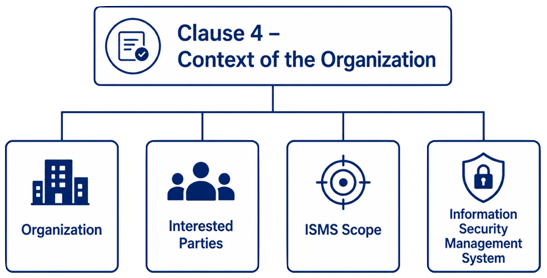
Clause 4 of ISO/IEC 27001 is structured around four closely connected requirements:
4.1 Understanding the Organization and Its Context
Determine relevant external and internal issues that can influence the intended outcomes of the ISMS.
4.2 Understanding the Needs and Expectations of Interested Parties
Identify relevant interested parties and determine which of their requirements are applicable to information security.
4.3 Determining the Scope of the Information Security Management System
Define the boundaries and applicability of the ISMS.
4.4 Information Security Management System
Establish, implement, maintain, and continually improve the ISMS in accordance with the requirements of ISO/IEC 27001.
These four elements create the organizational foundation on which the remaining ISMS requirements are built.
Clause 4.1 – Understanding the Organization and Its Context
The first step is understanding the environment in which the organization operates.
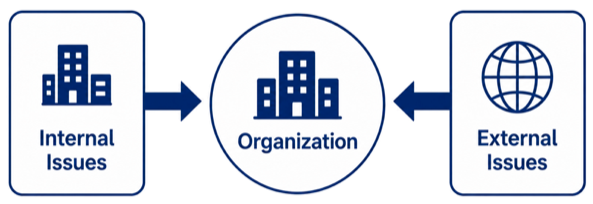
ISO/IEC 27001 requires organizations to determine the external and internal issues that are relevant to their purpose and that can affect the ability of the ISMS to achieve its intended outcomes.
The objective is not simply to create a general description of the company.
Instead, organizations need to identify contextual factors that are relevant to information security.
External Issues
External issues originate outside the organization but can influence its information security environment.
Examples can include:
- legal and regulatory requirements
- cybersecurity threats
- technological developments
- market conditions
- customer expectations
- supplier dependencies
- geopolitical developments
- industry-specific requirements
- contractual obligations
- external infrastructure dependencies
For example, an organization heavily dependent on cloud services should consider how external service providers and technological dependencies influence information security.
Similarly, changing regulatory requirements may affect how information must be processed, stored, protected, or reported.
Internal Issues
Internal issues arise from within the organization.
Examples can include:
- organizational structure
- governance
- internal policies
- business processes
- information systems
- technical infrastructure
- organizational culture
- employee competencies
- available resources
- existing security processes
A decentralized organization with several business units may face different information security challenges from a company operating from a single location with centralized IT infrastructure.
Understanding these factors provides important input for the design of the ISMS.
Clause 4.2 – Understanding Interested Parties
Organizations do not manage information security solely for themselves.
Customers, employees, regulators, suppliers, business partners, shareholders, and other stakeholders may all have expectations or requirements related to information security.
ISO/IEC 27001 therefore requires organizations to determine the interested parties relevant to the ISMS.
Potential interested parties can include:
- customers
- employees
- regulators
- government authorities
- suppliers
- cloud service providers
- business partners
- shareholders
- certification bodies
- contractual partners
However, identifying stakeholders is only the first step.
The organization must also determine which requirements of these interested parties are relevant to the ISMS.
Requirements of Interested Parties
Different interested parties can create different information security requirements.
For example:
Customers
Customers may require protection of confidential information, defined security practices, incident notification, or compliance with contractual security requirements.
Regulators
Regulatory authorities may impose legal requirements concerning information security, cybersecurity, privacy, reporting, or data protection.
Suppliers and Partners
Contracts with suppliers and business partners may contain security requirements relating to access control, confidentiality, information exchange, or incident management.
Employees
Employees depend on secure systems, appropriate access, clear responsibilities, and processes for handling sensitive information.
Understanding these requirements ensures that the ISMS reflects not only internal security objectives but also relevant external expectations and obligations.
Clause 4.3 – Determining the Scope of the ISMS
Once the organization understands its context and interested parties, it can determine the scope of the Information Security Management System.
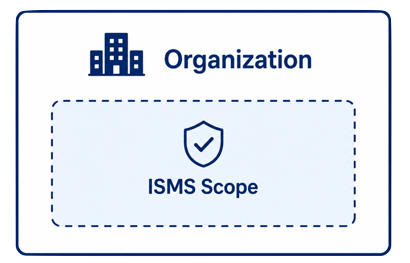
The ISMS scope defines the boundaries and applicability of the management system.
This is one of the most important decisions made during ISO/IEC 27001 implementation.
Depending on the organization, the scope might cover:
- the complete organization
- specific business units
- particular locations
- selected products or services
- certain business processes
- specific information systems
- particular technical environments
The scope should clearly communicate what is covered by the ISMS.
What Should Be Considered When Defining the ISMS Scope?
The scope should not be defined arbitrarily.
Several factors need to be considered.
Internal and External Issues
The organizational context identified under Clause 4.1 provides important input.
Interested Parties and Requirements
Relevant stakeholder requirements identified under Clause 4.2 must also be considered.
Organizational Interfaces and Dependencies
Modern organizations rarely operate as completely isolated entities.
The ISMS may depend on:
- cloud providers
- external data centers
- suppliers
- outsourced IT services
- corporate headquarters
- other business units
- shared infrastructure
- external software platforms
These interfaces and dependencies can affect information security even when certain activities occur outside the formal organizational boundary.
The scope therefore needs to reflect the actual operating environment of the organization.
Why the ISMS Scope Matters
A poorly defined ISMS scope can create significant problems.
If the scope is too narrow, important information assets, processes, dependencies, or interfaces may not receive appropriate consideration.
If the scope is unnecessarily broad, the organization may introduce additional complexity and administrative effort.
A well-defined scope provides clarity regarding:
What is protected?
Which organizational areas are included?
Which processes and technologies are relevant?
Where are the boundaries?
Which external interfaces must be considered?
The defined scope also becomes important during ISO/IEC 27001 certification, because it establishes the boundaries against which the ISMS is evaluated.
Clause 4.4 – Establishing the Information Security Management System
After understanding the organizational context, interested parties, relevant requirements, and ISMS scope, the organization establishes the Information Security Management System.
Clause 4.4 requires the organization to establish, implement, maintain, and continually improve an ISMS in accordance with ISO/IEC 27001.
This is an important point:
The ISMS is not a one-time cybersecurity project.
It is an ongoing management system.
The basic lifecycle can be understood as:
Establish
↓
Implement
↓
Maintain
↓
Continually Improve
The management system provides the organizational framework through which information security risks, objectives, responsibilities, controls, monitoring activities, and improvement actions are managed.
Clause 4 as the Foundation of the ISMS
Clause 4 should not be viewed as an isolated administrative requirement.
The information established here provides input for many of the activities addressed by subsequent ISO/IEC 27001 clauses.
For example:
Clause 5 – Leadership establishes leadership responsibilities and information security policy.
Clause 6 – Planning addresses risks, opportunities, information security risk assessment, risk treatment, and objectives.
Clause 7 – Support addresses resources, competence, awareness, communication, and documented information.
Clause 8 – Operation covers operational planning and execution of information security risk assessment and treatment.
Clause 9 – Performance Evaluation addresses monitoring, internal audits, and management review.
Clause 10 – Improvement focuses on nonconformities, corrective actions, and continual improvement.
The effectiveness of these later activities depends partly on having a clear understanding of the organization established through Clause 4.
Example: Defining the Context and ISMS Scope
Consider a technology company providing a cloud-based service to business customers.
The organization may identify external issues such as:
- evolving cybersecurity threats
- regulatory requirements
- cloud infrastructure dependencies
- customer security expectations
Relevant internal issues might include:
- distributed development teams
- remote working
- software development processes
- internal IT infrastructure
- security competencies
Interested parties could include:
Customers → confidentiality and availability requirements
Regulators → legal and compliance obligations
Cloud Provider → infrastructure dependencies and contractual responsibilities
Employees → secure access and clearly defined security responsibilities
Based on this context, the organization could establish an ISMS scope covering the people, processes, systems, and infrastructure involved in providing and supporting the cloud service.
This illustrates why Clause 4 comes before detailed information security planning.
The organization first needs to understand what it is protecting, why it needs protection, and where the boundaries are.
Common Mistakes When Applying ISO/IEC 27001 Clause 4
Although Clause 4 appears straightforward, several mistakes can reduce the effectiveness of the ISMS.
Treating Context Analysis as a Formality
Simply producing a generic list of internal and external issues provides little value if those issues are not actually relevant to information security.
Identifying Interested Parties Without Their Requirements
A stakeholder list alone is insufficient. Organizations should understand which relevant requirements need to be addressed by the ISMS.
Defining the Scope Too Narrowly
Artificially excluding important processes, interfaces, or dependencies can create security gaps.
Ignoring External Dependencies
Cloud services, outsourced processes, suppliers, and shared infrastructure may remain highly relevant even when they are outside direct organizational control.
Treating the ISMS as a One-Time Project
Clause 4.4 establishes an ongoing management system that must be maintained and continually improved.
Avoiding these mistakes helps ensure that organizational context becomes useful input for information security management rather than merely certification documentation.
ISO/IEC 27001 Clause 4 Summary
Clause 4 establishes the organizational foundation of an effective Information Security Management System.
Its four core requirements are:
4.1 – Understand the Organization and Its Context
Identify relevant internal and external issues.
4.2 – Understand Interested Parties
Determine relevant stakeholders and their applicable requirements.
4.3 – Determine the ISMS Scope
Define the boundaries and applicability of the Information Security Management System.
4.4 – Establish the ISMS
Establish, implement, maintain, and continually improve the management system.
The complete Clause 4 logic can therefore be summarized as:
Internal & External Issues
↓
Interested Parties & Requirements
↓
ISMS Scope
↓
Establish the ISMS
For Information Security Managers, Cybersecurity Professionals, Risk Managers, Compliance Specialists, Internal Auditors, and organizations implementing ISO/IEC 27001, understanding Clause 4 is essential because it establishes the context on which the entire Information Security Management System is built.