Developing safe and certifiable aircraft requires more than following a structured development process.
Throughout the aircraft lifecycle, several engineering activities continuously support development by ensuring that safety objectives are achieved, requirements remain traceable, verification is performed correctly, and development artifacts are properly controlled.
These activities are known as Integral Processes.
Chapter 5 of SAE ARP4754B introduces these processes and explains how they support every phase of aircraft and system development.
In this article, we explore the structure of Chapter 5 and explain why Integral Processes are fundamental to successful aerospace systems engineering.
If you would like to deepen your understanding of ARP4754B, ARP4761A, DO-178C, DO-254, and aerospace systems engineering, explore our professional online training courses.
Modern aircraft development involves numerous engineering disciplines working simultaneously.
Systems engineers, hardware engineers, software developers, safety engineers, verification specialists, and certification authorities all contribute to the final aircraft.
Without common supporting processes, organizations may encounter:
inconsistent requirements
missing verification evidence
uncontrolled configuration changes
inadequate safety assessments
certification delays
reduced traceability
Integral Processes provide the engineering framework that keeps these activities synchronized throughout the complete development lifecycle.
Rather than representing a separate development phase, they operate continuously from project initiation through certification.
Structure of Chapter 5
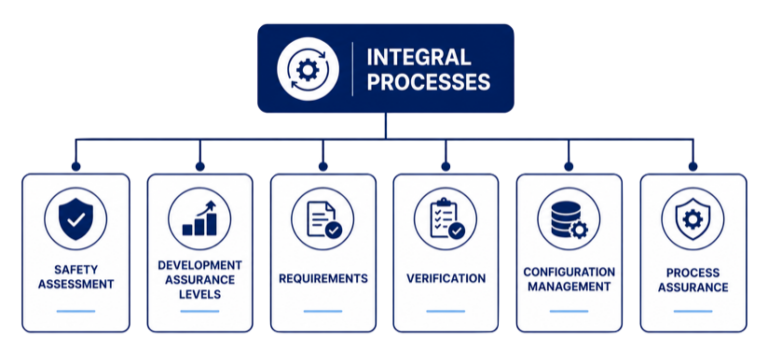
ARP4754B Chapter 5 introduces the Integral Processes that support every phase of aircraft and system development, from Safety Assessment to Process Assurance.
Safety Assessment
Safety Assessment is one of the central Integral Processes within ARP4754B.
Its objective is to identify hazards, evaluate potential failure conditions, and support the development of safe aircraft architectures.
Safety Assessment is not performed only once.
Instead, it evolves throughout development as the aircraft design becomes more detailed.
Typical activities include:
identifying aircraft functions
evaluating failure conditions
allocating safety objectives
supporting architectural decisions
confirming compliance with safety objectives
Safety Assessment also provides essential input for related standards such as ARP4761A, which defines analytical methods including Functional Hazard Assessment (FHA), Preliminary System Safety Assessment (PSSA), and System Safety Assessment (SSA).
Development Assurance Levels (DAL)
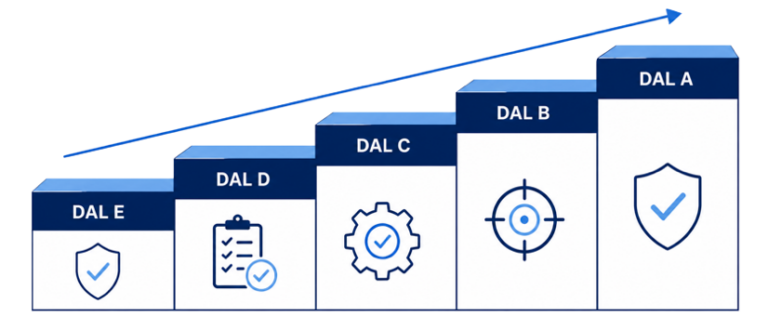
Development Assurance Levels define the level of engineering rigor required for aircraft functions and systems.
The assigned DAL depends on the severity of potential failure conditions.
Higher Development Assurance Levels require more comprehensive development, verification, independence, and process assurance activities.
Typical objectives of DAL assignment include:
determining development rigor
selecting appropriate verification activities
defining independence requirements
supporting certification planning
ensuring proportional engineering effort
DAL assignment helps organizations allocate development resources where they provide the greatest contribution to aircraft safety.
Safety Assessments support the assignment of Development Assurance Levels, ensuring that development activities are proportional to the potential safety impact of system failures.
Requirements Capture and Validation
Well-defined requirements form the foundation of successful aircraft development.
Chapter 5 emphasizes that requirements should be:
correct
complete
consistent
verifiable
traceable
unambiguous
Requirements validation ensures that the captured requirements accurately represent stakeholder expectations and aircraft-level objectives before implementation begins.
Maintaining bidirectional traceability throughout development helps ensure that every implementation can be linked back to an approved aircraft requirement.
Verification
Verification confirms that development outputs satisfy their allocated requirements.
Unlike validation, which answers “Are we building the right system?”, verification answers “Are we building the system correctly?”
Typical verification activities include:
requirements reviews
design reviews
analyses
inspections
integration testing
system testing
Verification occurs continuously throughout development rather than only at the end of the project.
Early verification reduces project risk while improving certification readiness.
Configuration Management and Process Assurance
Large aircraft programs generate thousands of engineering artifacts, including requirements, design documents, models, software, hardware data, verification results, and certification evidence.
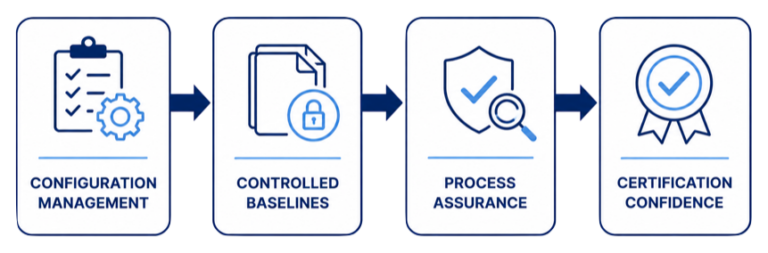
Configuration Management ensures that these work products remain uniquely identified, version controlled, and reproducible.
Process Assurance complements Configuration Management by confirming that engineering activities follow the approved development processes defined during Development Assurance Planning.
Together, these processes provide confidence that both the engineering products and the engineering process remain under control throughout development.
Configuration Management and Process Assurance ensure that engineering work products remain controlled, traceable, and compliant throughout the aircraft development lifecycle.
How Chapter 5 Supports ARP4754B
Unlike the technical development activities described in Chapter 4, the Integral Processes of Chapter 5 support every phase of aircraft development.
They contribute to:
Development Assurance Planning
Requirements Development
System Architecture
Hardware Development
Software Development
Integration
Verification
Certification
Because they operate continuously, Integral Processes provide the consistency, traceability, and governance required for successful certification.
They effectively serve as the engineering backbone of the ARP4754B development framework.
Summary
ARP4754B Chapter 5 introduces the Integral Processes that support the complete aircraft and system development lifecycle.
Its key topics include:
Safety Assessment
Development Assurance Levels (DAL)
Requirements Capture and Validation
Verification
Configuration Management
Process Assurance
Together, these activities ensure that aircraft systems are developed safely, systematically, and in accordance with certification requirements.
For Systems Engineers, Safety Engineers, Verification Engineers, Certification Specialists, and Aerospace Project Managers, understanding Chapter 5 is essential because these supporting processes provide the structure and confidence needed to develop safe, reliable, and certifiable aircraft systems.
If you prefer a visual explanation, this video explains ARP4754B Chapter 5: