Development Assurance Levels (DAL) Explained – Aerospace Engineering Guide
Safety-critical aerospace systems require significantly more development rigor than systems whose failure has little or no impact on aircraft safety.
A failure in a flight control system, for example, can have fundamentally different consequences from a failure of a non-essential cabin function. Applying the same level of development and verification effort to both would therefore make little sense.
This is where Development Assurance Levels (DAL) become important.
Development Assurance Levels provide a structured way to relate the safety consequences of potential failures to the rigor applied during aircraft, system, software, and airborne electronic hardware development.
The concept plays an important role across the aerospace development and certification landscape, particularly in guidance such as ARP4754B, DO-178C, and DO-254.
In this article, we explain what a Development Assurance Level is, the differences between DAL A, B, C, D, and E, how DAL influences engineering activities, and how Development Assurance Levels are assigned.
Want to deepen your understanding of Development Assurance Levels, ARP4754B, ARP4761A, DO-178C, and safety-critical aerospace development?
Explore our professional aerospace engineering online training.
What Is a Development Assurance Level?
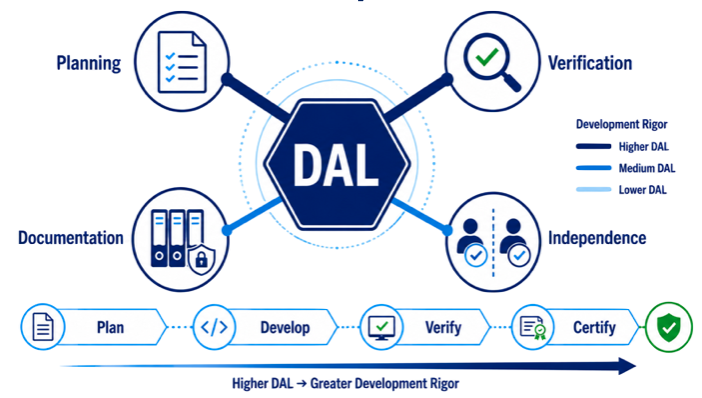
A Development Assurance Level represents the level of rigor applied to development activities to provide confidence that development errors have been identified and controlled appropriately.
The fundamental principle is:
Higher safety impact → Higher Development Assurance → Greater development rigor
Development Assurance does not simply describe the reliability of a component.
Instead, it influences the processes used to develop and verify the aircraft function, system, software, or hardware.
Depending on the applicable DAL, development activities can differ in areas such as:
- requirements definition
- requirements traceability
- architecture and design
- verification
- validation
- reviews and analyses
- independence
- configuration management
- process assurance
- certification evidence
A system associated with potentially catastrophic consequences therefore requires significantly stronger development assurance than one whose failure has only a minor effect.
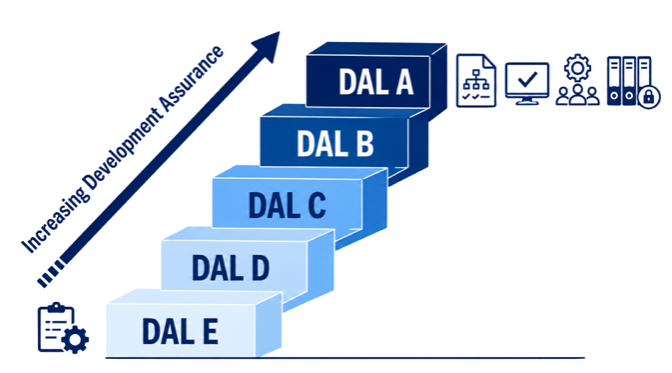
The Five Development Assurance Levels: DAL A to DAL E
Development Assurance Levels are commonly divided into five levels ranging from DAL A to DAL E.
Each level is associated with the potential safety consequences of a failure condition.
DAL A – Catastrophic
DAL A represents the highest level of Development Assurance.
It is associated with failure conditions that could have catastrophic consequences for the aircraft and its occupants.
Development activities therefore require the highest degree of rigor.
Typical characteristics can include:
- extensive requirements traceability
- comprehensive verification
- stronger independence requirements
- rigorous process assurance
- detailed configuration control
- extensive certification evidence
DAL A is applied where development errors could contribute to the most severe safety consequences.
DAL B – Hazardous
DAL B is associated with hazardous failure conditions.
These failures can have severe effects on aircraft operation or occupants but are below the catastrophic classification associated with DAL A.
Development and verification remain highly rigorous, although some objectives and independence requirements may differ from DAL A.
DAL C – Major
DAL C is associated with major failure conditions.
Such failures can significantly affect aircraft operation, crew workload, or safety margins but generally do not reach the severity associated with hazardous or catastrophic conditions.
DAL C therefore still requires structured development and verification processes while applying less rigor than DAL A or DAL B.
DAL D – Minor
DAL D is generally associated with minor failure conditions.
The safety impact is comparatively limited, and the required development assurance activities are correspondingly less demanding.
However, this does not mean that development becomes uncontrolled.
Appropriate planning, development, verification, and configuration activities are still required according to the applicable guidance.
DAL E – No Safety Effect
DAL E is associated with failure conditions that have no effect on aircraft safety.
As a result, the Development Assurance objectives associated with DAL A through DAL D are generally not required in the same way.
The complete simplified relationship can therefore be represented as:
Catastrophic → DAL A
Hazardous → DAL B
Major → DAL C
Minor → DAL D
No Safety Effect → DAL E
This relationship helps ensure that development effort is proportional to the potential safety impact of the function or system.
How DAL Influences Aerospace Development
Development Assurance Levels directly influence how safety-critical aerospace systems are developed.
As the DAL becomes more critical, the required engineering rigor generally increases.
This affects several areas.
Requirements Engineering
Higher DALs place greater emphasis on complete, correct, consistent, and traceable requirements.
Engineers must demonstrate that requirements are properly derived, allocated, implemented, and verified.
Verification
Verification becomes increasingly rigorous for higher Development Assurance Levels.
This can include:
- requirements-based testing
- reviews
- analyses
- structural coverage activities for software
- verification of derived requirements
- additional independence
The objective is to provide confidence that development errors are detected before they can affect aircraft safety.
Independence
One important consequence of higher DALs is increased independence between certain development and verification activities.
For highly critical functions, it may not be sufficient for the person who created an engineering artifact to be solely responsible for verifying it.
Independent verification provides an additional layer of confidence.
Traceability
Bidirectional traceability becomes particularly important in safety-critical development.
Engineers may need to demonstrate relationships such as:
Aircraft Safety Objective → System Requirement → Software/Hardware Requirement → Implementation → Verification Evidence
This allows certification authorities and development organizations to understand how safety objectives are realized and verified throughout the development lifecycle.
Process Assurance
Higher DALs also increase the importance of demonstrating that the planned development processes have actually been followed.
Process assurance activities provide confidence that deviations are identified, controlled, and resolved appropriately.
The key principle remains:
The higher the safety criticality, the stronger the evidence required to demonstrate correct development.
DAL Across Aerospace Standards
Development Assurance Levels are not limited to a single aerospace standard.
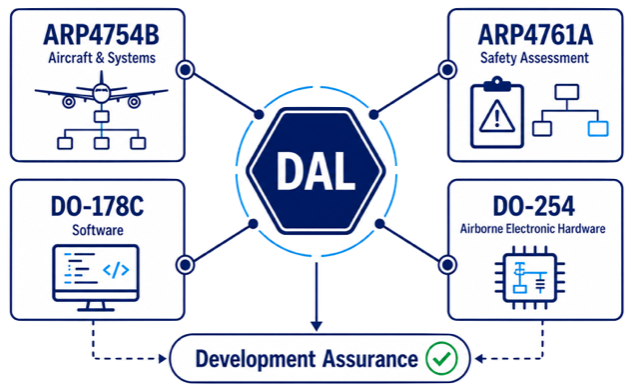
The concept connects several important aerospace development and certification frameworks.
ARP4754B – Aircraft and System Development
ARP4754B addresses the development of civil aircraft and aircraft systems.
At aircraft and system level, safety assessments identify potential failure conditions and their consequences.
These safety considerations influence the Development Assurance objectives applied throughout aircraft and system development.
ARP4754B therefore provides an important bridge between aircraft-level safety objectives and the development processes used to implement them.
DO-178C – Airborne Software
DO-178C provides guidance for the development of airborne software.
Software criticality influences the objectives that must be satisfied during activities such as:
- software planning
- requirements development
- software design
- coding
- verification
- configuration management
- quality assurance
Higher software levels introduce more demanding objectives and stronger verification expectations.
DO-254 – Airborne Electronic Hardware
DO-254 applies similar Development Assurance principles to airborne electronic hardware.
Complex electronic hardware used in safety-critical aircraft systems requires structured development and verification processes proportional to its safety significance.
This can include devices such as:
- FPGAs
- ASICs
- complex programmable logic
- other airborne electronic hardware
How ARP4754B, DO-178C and DO-254 Work Together
A simplified aerospace development chain can be represented as:
Aircraft Safety Assessment
↓
Aircraft / System Development – ARP4754B
↓
System Requirements & Architecture
↓
Software – DO-178C
Hardware – DO-254
The safety significance established at aircraft and system level therefore influences the development rigor applied further down the implementation chain.
This creates a consistent Development Assurance concept across different engineering disciplines.
How Is a Development Assurance Level Assigned?
A Development Assurance Level should not be selected simply because a system appears important.
DAL assignment is driven by the safety consequences associated with failure conditions.
The process begins at aircraft level.
Engineers identify aircraft functions and analyze what could happen if those functions fail or behave incorrectly.
A simplified process is:
Aircraft Function
↓
Failure Condition
↓
Safety Assessment
↓
Failure Condition Classification
↓
Development Assurance Level
Safety assessment activities therefore provide essential input to Development Assurance.
Methods associated with guidance such as ARP4761A help engineers systematically analyze potential failure conditions and their effects.
Failure Condition Classification
Failure conditions are classified according to their potential consequences.
The familiar categories include:
- Catastrophic
- Hazardous
- Major
- Minor
- No Safety Effect
This classification then influences the corresponding Development Assurance rigor.
However, real aircraft architectures can be more complex than a simple one-to-one mapping.
Functions may be distributed across several systems, redundancy may be introduced, and safety requirements may be allocated to multiple independent elements.
Development Assurance allocation must therefore consider the actual aircraft architecture and safety assessment rather than relying only on a simple table.
Why Development Assurance Levels Matter
Development Assurance Levels solve an important engineering problem:
How much development rigor is enough?
Applying maximum rigor to every aircraft function would consume enormous engineering resources without necessarily providing proportional safety benefits.
Applying insufficient rigor to safety-critical functions, on the other hand, could leave critical development errors undetected.
DAL provides a risk-based framework for balancing these considerations.
It ensures that engineering effort is concentrated where development errors could have the greatest safety consequences.
This provides several important benefits:
- development rigor proportional to safety criticality
- systematic verification expectations
- clear independence requirements
- improved traceability
- stronger certification evidence
- consistent development across engineering disciplines
- efficient allocation of engineering resources
DAL therefore represents much more than a classification label.
It directly shapes the way aerospace systems are engineered.
DAL Is Not the Same as Reliability
A common misunderstanding is to interpret DAL as a direct measure of component reliability or probability of failure.
That is not its primary purpose.
A Development Assurance Level addresses confidence in the development process and the prevention or detection of development errors.
Reliability and quantitative failure probabilities are important aspects of aircraft safety assessment, but they represent a different engineering dimension.
A component could have excellent predicted hardware reliability while still requiring rigorous Development Assurance because systematic errors in requirements, architecture, design, or implementation could lead to unsafe behavior.
This distinction is fundamental when working with safety-critical aerospace systems.
Development Assurance Levels Summary
Development Assurance Levels provide the link between aircraft safety consequences and development rigor.
The five levels can be summarized as:
| Development Assurance Level | Typical Failure Condition Classification | Relative Development Rigor |
|---|---|---|
| DAL A | Catastrophic | Highest |
| DAL B | Hazardous | Very High |
| DAL C | Major | High |
| DAL D | Minor | Reduced |
| DAL E | No Safety Effect | No applicable DAL A–D assurance objectives |
The fundamental principle is straightforward:
Higher potential safety consequences require stronger Development Assurance.
DAL therefore influences requirements engineering, verification, independence, traceability, process assurance, configuration management, and certification evidence throughout aerospace development.
It also provides an important conceptual connection between ARP4754B, ARP4761A, DO-178C, and DO-254.
For Aerospace Systems Engineers, Safety Engineers, Avionics Engineers, Software Engineers, Hardware Engineers, Verification Engineers, and Certification Specialists, understanding Development Assurance Levels is essential for working effectively with safety-critical aircraft systems.