
ISO/IEC 27001 Clause 5 Explained – Leadership
An effective Information Security Management System cannot be established by the IT department alone.
Information security affects business processes, employees, suppliers, customers, technology, strategic decisions, and ultimately the entire organization. For this reason, ISO/IEC 27001 Clause 5 – Leadership places clear responsibilities on top management.
Leadership must ensure that information security is integrated into the organization rather than treated as an isolated technical activity.
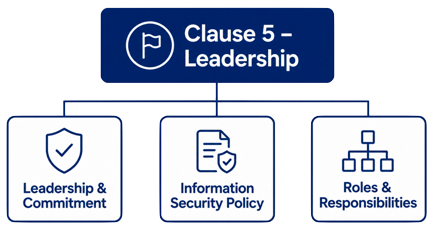
Clause 5 therefore addresses three fundamental areas:
- Leadership and Commitment
- Information Security Policy
- Organizational Roles, Responsibilities and Authorities
Together, these requirements establish management direction and accountability for the Information Security Management System (ISMS).
In this article, we explain the requirements of ISO/IEC 27001 Clause 5, why leadership matters for information security, and how management commitment, policy, and organizational responsibilities support an effective ISMS.
Want to deepen your understanding of ISO/IEC 27001, Information Security Management Systems, cybersecurity risk management, and the individual requirements of the standard?
Explore our professional online training covering ISO/IEC 27001, ISO/SAE 21434, ISO 31000, ISO 9001, cybersecurity, risk management, and other engineering and management system standards.
Why Leadership Matters in ISO/IEC 27001
Organizations can implement firewalls, access controls, encryption, monitoring systems, and other technical security measures.
But technology alone does not create an effective Information Security Management System.
Information security decisions frequently involve questions such as:
- Which risks are acceptable?
- Which resources should be allocated?
- What information requires protection?
- Who is responsible for security activities?
- How should information security support business objectives?
- Which requirements must the organization fulfill?
- How should security responsibilities be integrated into business processes?
These are organizational and management questions rather than purely technical ones.
This is why ISO/IEC 27001 requires top management to demonstrate leadership and commitment with respect to the ISMS.
Leadership establishes direction.
The ISMS then translates this direction into structured information security activities throughout the organization.
Structure of ISO/IEC 27001 Clause 5
ISO/IEC 27001 Clause 5 can be divided into three main requirements:
5.1 Leadership and Commitment
Top management must demonstrate leadership and commitment regarding the Information Security Management System.
5.2 Policy
Management must establish an Information Security Policy that provides direction and supports the organization’s information security objectives.
5.3 Organizational Roles, Responsibilities and Authorities
Relevant responsibilities and authorities for information security must be assigned and communicated.
The overall logic can therefore be summarized as:
- Management Commitment
- Information Security Direction
- Defined Responsibilities
- Effective ISMS
Each element supports the others.
A policy without management commitment may have little practical effect.
Management commitment without clearly assigned responsibilities can create uncertainty.
And responsibilities without organizational direction may lead to fragmented security activities.
Clause 5.1 – Leadership and Commitment
Clause 5.1 focuses on the role of top management in the Information Security Management System.
Leadership does not simply mean approving the ISMS or signing an Information Security Policy.
Management needs to demonstrate active commitment to information security.
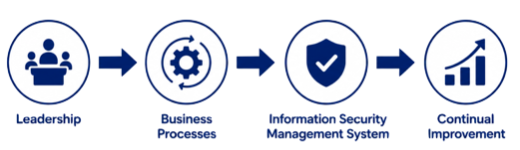
A central principle is that the ISMS should be integrated into the organization’s business processes.
Information security should therefore not operate as a separate system that exists only for certification or auditing purposes.
Instead, security considerations should become part of the way relevant business activities are planned, performed, monitored, and improved.
Aligning the ISMS with Organizational Direction
One important management responsibility is ensuring that the Information Security Policy and information security objectives are compatible with the organization’s strategic direction.
This connection is essential.
Consider two very different organizations.
A software-as-a-service provider may depend heavily on:
- cloud availability
- protection of customer information
- secure software development
- identity and access management
- resilience of online services
A manufacturing organization may instead place greater emphasis on:
- intellectual property
- production systems
- engineering data
- operational technology
- supplier interfaces
- availability of manufacturing infrastructure
Their information security priorities are therefore not necessarily identical.
Leadership helps ensure that the ISMS reflects the actual business environment and objectives of the organization.
Integrating Information Security into Business Processes
An effective ISMS should not operate in isolation.
Information security can interact with many organizational processes, including:
Procurement
Supplier selection and contractual requirements can introduce information security considerations.
Human Resources
Employee onboarding, access rights, awareness, role changes, and offboarding can affect information security.
Product Development
Development environments, source code, intellectual property, customer requirements, and technical data may require protection.
IT Operations
Infrastructure, access management, backups, monitoring, and system administration directly influence information security.
Management
Risk acceptance, resource allocation, priorities, and strategic decisions can determine how effectively security is implemented.
Integrating the ISMS into relevant business processes helps make information security part of normal organizational operations.
Providing Resources for the ISMS
An Information Security Management System requires resources.
Depending on the organization, these may include:
- qualified personnel
- cybersecurity expertise
- technical infrastructure
- security tools
- training
- monitoring capabilities
- financial resources
- time for audits and reviews
Management therefore has an important role in ensuring that appropriate resources are available.
An organization cannot reasonably establish ambitious information security objectives while failing to provide the people, technology, competence, or budget required to achieve them.
Supporting People and Continual Improvement
Leadership also influences how information security is perceived throughout the organization.
If management treats security requirements as unnecessary bureaucracy, employees may adopt the same attitude.
If leadership consistently communicates that information security is part of business performance and organizational responsibility, the ISMS is more likely to become embedded in everyday activities.
Management should therefore support relevant personnel, promote effective information security management, and encourage continual improvement.
This establishes an important connection between Clause 5 and the broader ISO/IEC 27001 management system.
Clause 5.2 – Information Security Policy
The Information Security Policy provides high-level direction for information security within the organization.
It establishes management’s overall intentions and commitment regarding information security.
The policy should be appropriate to the purpose of the organization and provide a framework for establishing information security objectives.
This is important because security objectives should not emerge independently from organizational direction.
The policy creates a common foundation from which more specific objectives, processes, requirements, and controls can be developed.
What Should the Information Security Policy Address?
At a high level, the Information Security Policy should demonstrate the organization’s commitment to:
- information security
- applicable requirements
- appropriate information security objectives
- continual improvement of the ISMS
The policy does not need to contain every technical security rule.
Detailed requirements may be addressed through supporting policies, procedures, standards, or other documented information.
Instead, the Information Security Policy provides the overall direction for the management system.
A useful conceptual hierarchy is:
- Organizational Direction
- Information Security Policy
- Information Security Objectives
- Processes & Controls
This connects management intent with operational information security activities.
Communicating the Information Security Policy
Creating a policy document is not enough.
The policy needs to be available as documented information, communicated within the organization, and available to relevant interested parties where appropriate.
This matters because a policy has limited value if the people expected to support the ISMS are unaware of it.
Communication helps employees and other relevant parties understand the organization’s overall information security direction.
The way this communication is implemented can vary depending on organizational size, structure, risk profile, and working environment.
Clause 5.3 – Organizational Roles, Responsibilities and Authorities
An Information Security Management System involves many different activities.
Someone may need to coordinate risk assessments.
Someone may maintain security documentation.
Others may manage access rights, security incidents, supplier requirements, audits, monitoring, or technical controls.
Without clearly assigned responsibilities, important activities can easily fall between organizational boundaries.
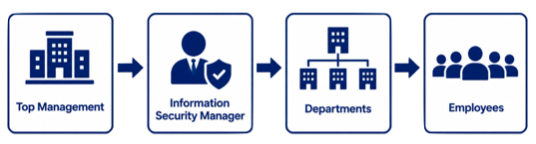
ISO/IEC 27001 therefore requires relevant roles, responsibilities and authorities to be assigned and communicated.
Why Clear Information Security Responsibilities Matter
Consider a security incident involving sensitive customer information.
Several questions immediately arise:
Who investigates the incident?
Who determines whether escalation is required?
Who communicates with customers or authorities?
Who coordinates technical containment?
Who approves corrective actions?
If responsibilities are unclear, valuable time can be lost precisely when rapid action is required.
The same principle applies to routine ISMS activities.
Clear responsibilities improve accountability and help ensure that necessary information security activities are actually performed.
Responsibility for ISMS Conformity
Top management needs to ensure that responsibility and authority are assigned for ensuring that the ISMS conforms to the requirements of ISO/IEC 27001.
Management also needs appropriate information regarding ISMS performance.
This does not mean that top management personally performs every information security activity.
Responsibilities can be delegated to appropriate roles.
However, accountability for leadership cannot simply be transferred away from top management.
This distinction is important.
Operational tasks may be distributed throughout the organization, while leadership remains responsible for establishing direction and ensuring that the management system receives appropriate organizational support.
Information Security Is Not Only an IT Responsibility
One of the most important practical lessons from Clause 5 is that information security should not be treated purely as an IT function.
IT departments clearly play an important role, but many information security risks originate elsewhere.
For example:
Human Resources manages employee lifecycle processes.
Procurement interacts with suppliers and external service providers.
Engineering may handle sensitive intellectual property.
Sales may process customer information.
Management makes decisions regarding risk acceptance and resources.
Legal and Compliance may interpret regulatory and contractual obligations.
An effective ISMS therefore requires clearly defined responsibilities across relevant parts of the organization.
Clause 5 establishes the leadership framework needed to support this organization-wide approach.
How Clause 5 Supports ISO/IEC 27001
Clause 5 does not operate independently.
It connects the organizational context established in Clause 4 with the planning and operational requirements that follow.
Clause 4 establishes:
Where are we?
It examines organizational context, interested parties, requirements, and the ISMS scope.
Clause 5 establishes:
Who provides direction and accountability?
It addresses leadership, policy, and responsibilities.
Clause 6 then asks:
What do we need to achieve and how should we address risks and opportunities?
This creates a logical progression:
- Context
- Leadership
- Planning
- Support
- Operation
- Performance Evaluation
- Improvement
Leadership therefore acts as a bridge between understanding the organization and implementing an effective Information Security Management System.
Leadership Throughout the ISMS Lifecycle
The influence of leadership extends beyond Clause 5 itself.
For example, management involvement supports:
Information Security Objectives
Leadership establishes direction from which meaningful objectives can be developed.
Risk Management
Management decisions influence risk criteria, priorities, resources, and acceptance of information security risks.
Resources and Competence
The organization requires appropriate resources and competent personnel to operate the ISMS effectively.
Performance Evaluation
Management needs visibility into whether the ISMS achieves its intended outcomes.
Management Review
Top management periodically reviews the ISMS to evaluate its continuing suitability, adequacy, and effectiveness.
Continual Improvement
Leadership supports corrective actions and ongoing improvement of information security performance.
Clause 5 therefore establishes principles that continue throughout the entire management system.
Example: Leadership in a Cloud-Based Organization
Consider a company providing cloud-based software to business customers.
The organization depends on the confidentiality, integrity, and availability of customer information and its online services.
Top management may establish information security as an important organizational priority.
An Information Security Policy provides overall direction.
Responsibilities are then distributed across the organization:
Management
Provides direction, resources, and oversight.
Information Security
Coordinates ISMS activities and security governance.
Software Development
Applies secure development practices.
IT Operations
Protects and monitors infrastructure.
Human Resources
Supports employee security processes.
Procurement
Addresses information security requirements for suppliers.
Rather than making information security the responsibility of one isolated department, leadership integrates it across the organization.
This is the practical intent behind many of the requirements in Clause 5.
Common Mistakes When Applying ISO/IEC 27001 Clause 5
Several common approaches can weaken the effectiveness of Clause 5.
Treating Leadership as a Signature
Having top management sign an Information Security Policy does not by itself demonstrate effective leadership.
Making Information Security an IT-Only Responsibility
Information security frequently involves processes and decisions throughout the organization.
Creating a Generic Policy
A policy should reflect the organization’s purpose and provide meaningful direction for its ISMS.
Assigning Responsibilities Without Authority
Individuals need sufficient authority and organizational support to fulfill assigned responsibilities.
Failing to Connect Security with Business Objectives
An ISMS that is disconnected from organizational strategy can become a compliance exercise rather than an effective management system.
The objective of Clause 5 is therefore not simply to produce documentation.
It is to establish real organizational leadership and accountability for information security.
ISO/IEC 27001 Clause 5 Summary
ISO/IEC 27001 Clause 5 establishes the leadership framework for the Information Security Management System.
Its three main areas are:
5.1 – Leadership and Commitment
Top management demonstrates commitment, integrates the ISMS into relevant business processes, provides support, and promotes effective information security management.
5.2 – Information Security Policy
The organization establishes a policy that provides direction and a framework for information security objectives.
5.3 – Organizational Roles, Responsibilities and Authorities
Relevant responsibilities and authorities are assigned and communicated throughout the organization.
The overall Clause 5 logic can therefore be summarized as:
- Leadership & Commitment
- Information Security Policy
- Roles & Responsibilities
- Organization-Wide ISMS
The central message is simple:
Information security requires leadership, not only technology.
For Information Security Managers, Cybersecurity Professionals, Risk Managers, Compliance Specialists, Internal Auditors, IT Managers, and organizations implementing ISO/IEC 27001, understanding Clause 5 is essential for establishing an ISMS that is supported by the organization rather than existing only on paper.