ISO 12100 Explained – Machine Safety, Risk Assessment & Risk Reduction
Every machine introduces potential hazards. Moving components, sharp edges, electrical energy, high temperatures, unexpected startup, or stored energy can all create situations in which people may be harmed.
The challenge for machine manufacturers is therefore not simply to identify hazards, but to systematically assess and reduce the associated risks throughout the machine lifecycle.
This is the fundamental purpose of ISO 12100 – Safety of Machinery.
ISO 12100 provides general principles for risk assessment and risk reduction in machinery design. It establishes a structured process for identifying hazards, estimating and evaluating risks, selecting appropriate protective measures, and determining whether further risk reduction is necessary.
In this article, we explain the core ISO 12100 workflow—from Hazard Identification and Risk Assessment to the Three-Step Method for Risk Reduction and the evaluation of Residual Risk.
Want to deepen your understanding of ISO 12100, machinery risk assessment, hazard identification, the Three-Step Method, and risk reduction?
Explore our professional online engineering training covering ISO 12100, ISO 13849, Functional Safety, and safety-critical engineering standards.
Why Machine Safety Starts with Risk
Machine safety should begin with understanding the risks created by the machine—not with selecting a particular guard, safety controller, or protective device.
Before deciding how a machine should be protected, engineers need to understand:
- What hazards exist?
- Who could be exposed?
- In which operating situations could exposure occur?
- How severe could the resulting harm be?
- How likely is that harm to occur?
- Which measures can eliminate or reduce the risk?
ISO 12100 provides a systematic framework for answering these questions.
This risk-based approach is important because different hazards require different protective strategies. A crushing hazard created by an industrial robot may require a completely different solution from an electrical hazard inside a control cabinet or a hot surface on a processing machine.
The objective is therefore not to apply the same safety solution everywhere.
The objective is to identify the specific risks associated with the machine and reduce them systematically.
The ISO 12100 Risk Assessment Process
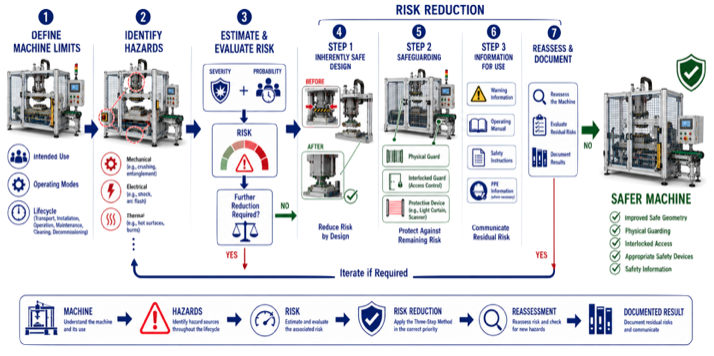
Risk assessment according to ISO 12100 consists of several connected activities.
At a high level, the process can be represented as:
Machine Limits → Hazard Identification → Risk Estimation → Risk Evaluation
The process begins by understanding the machine, its intended use, reasonably foreseeable misuse, operating conditions, and relevant lifecycle phases.
Potential hazards and hazardous situations are then identified.
For each relevant hazard, the associated risk is estimated and evaluated.
The central question becomes:
Has the risk been adequately reduced?
If the answer is no, additional risk reduction measures are required.
This creates an iterative engineering process rather than a one-time checklist.
Hazard Identification
Hazard Identification is one of the most important steps in machinery risk assessment.
If a relevant hazard is overlooked, the associated risk may never be properly evaluated or reduced.
ISO 12100 therefore encourages engineers to consider hazards across the complete machine lifecycle, rather than focusing only on normal production.
Relevant lifecycle phases may include:
- transport
- assembly
- installation
- commissioning
- normal operation
- setup and adjustment
- cleaning
- troubleshooting
- maintenance
- repair
- decommissioning
Engineers should also consider different categories of hazards.
Examples include:
Mechanical Hazards
Crushing, shearing, cutting, entanglement, impact, or drawing-in hazards caused by moving machine elements.
Electrical Hazards
Electric shock, short circuits, electrical faults, or other hazardous electrical conditions.
Thermal Hazards
Hot or cold surfaces, flames, or hazardous process temperatures.
Noise and Vibration
Exposure that may result in injury or long-term health effects.
Ergonomic Hazards
Poor machine interfaces, unsuitable working positions, excessive physical effort, or human-machine interaction problems.
The objective is to systematically identify hazardous situations before attempting to select protective measures.
Risk Estimation & Evaluation
Once a hazard has been identified, engineers estimate the associated risk.
Risk generally depends on two fundamental aspects:
Severity of Harm
and
Probability of Occurrence of Harm
The probability of harm can itself depend on several factors, including exposure to the hazard and the possibility of avoiding or limiting the harm.
For example, consider an industrial robot with a hazardous movement.
The potential severity could be high because contact with the robot could result in serious injury.
However, the overall risk also depends on factors such as:
- how frequently a person enters the hazardous area
- how long exposure lasts
- whether the hazardous movement can be recognized
- whether the person can avoid the hazardous event
After estimating the risk, engineers perform Risk Evaluation.
The purpose of Risk Evaluation is to determine whether the risk has been adequately reduced or whether additional measures are necessary.
If additional risk reduction is required, the process continues with the ISO 12100 Three-Step Method.
The Three-Step Method for Risk Reduction
One of the most important concepts in ISO 12100 is the Three-Step Method for Risk Reduction.
The hierarchy is:
1. Inherently Safe Design Measures
↓
2. Safeguarding and Complementary Protective Measures
↓
3. Information for Use
The order is important.
Machine manufacturers should not immediately rely on guards, warning labels, or operating instructions if the hazard can reasonably be eliminated or reduced through the design of the machine itself.
The hierarchy therefore prioritizes measures that address the hazard as close to its source as possible.
Step 1: Inherently Safe Design
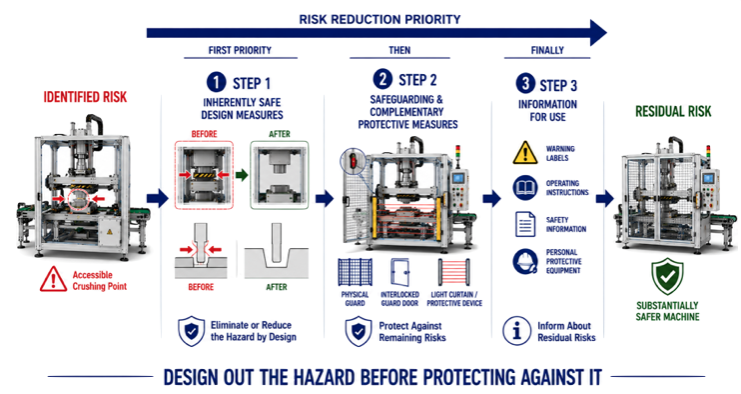
The first priority is to eliminate hazards or reduce risks through the machine design itself.
This is generally the most effective form of risk reduction because it reduces dependence on additional protective equipment or human behavior.
Examples of inherently safe design measures can include:
- eliminating hazardous movements
- reducing forces or speeds
- increasing distances from hazardous machine elements
- eliminating sharp edges
- reducing stored energy
- selecting safer materials
- improving ergonomic design
- designing components to reduce foreseeable failure risks
Consider a machine with a powerful moving mechanism.
If the required function can be achieved using lower forces or lower speeds, the potential severity or probability of harm may be reduced directly through the design.
This approach is preferable to simply placing a warning sign next to an unnecessarily hazardous design.
Risk reduction begins with engineering the hazard out of the machine wherever reasonably practicable.
Step 2: Safeguarding and Complementary Protective Measures
Not every hazard can be eliminated through inherently safe design.
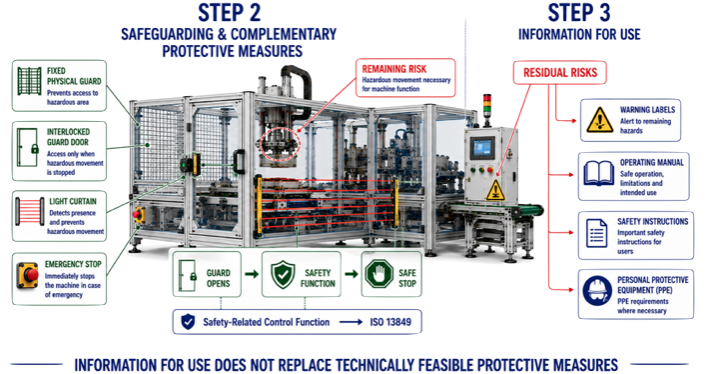
When residual risks remain, the second step is to introduce Safeguards and Complementary Protective Measures.
Typical measures include:
- fixed guards
- movable guards
- interlocking devices
- safety light curtains
- emergency stop functions
- protective barriers
- safe distances
- safety-related control functions
For example, access to an industrial robot cell may be prevented using physical guarding.
Where regular access is necessary, an interlocked guard or electro-sensitive protective equipment such as a safety light curtain may be required.
Some of these protective measures introduce safety-related control functions.
This is where standards such as ISO 13849 or IEC 62061 become particularly relevant.
ISO 12100 establishes the overall risk reduction strategy, while these Functional Safety standards provide more detailed requirements for the design and evaluation of safety-related control systems.
Step 3: Information for Use
After inherently safe design measures and safeguarding have been applied, some risks may still remain.
These are commonly referred to as Residual Risks.
Users must be informed about relevant residual risks through appropriate information for use.
Examples include:
- warnings
- operating instructions
- safety signs
- training requirements
- information about required personal protective equipment
- maintenance instructions
- descriptions of remaining hazards
However, information for use should not be treated as a substitute for technically feasible design or safeguarding measures.
A warning label cannot compensate for a hazardous design when the hazard could reasonably have been eliminated through engineering measures.
This hierarchy is one of the most important principles of ISO 12100.
Residual Risk & Iteration
Risk reduction does not automatically end after implementing a protective measure.
The remaining Residual Risk must be evaluated again.
The fundamental question is:
Has the risk been adequately reduced?
If the answer is no, additional risk reduction measures are necessary.
The process therefore becomes iterative:
Identify Hazard → Estimate Risk → Evaluate Risk → Reduce Risk → Reassess Residual Risk
If the remaining risk is still unacceptable, engineers return to the risk reduction process and consider further measures.
Another important consideration is whether a protective measure introduces new hazards.
For example, modifying a machine to reduce one mechanical hazard could unintentionally introduce ergonomic, electrical, or accessibility problems.
Risk assessment must therefore consider the machine as a complete system.
The process continues until the risks have been adequately reduced according to the applicable requirements and state of the art.
The Complete ISO 12100 Workflow
The complete ISO 12100 process connects risk assessment and risk reduction into one continuous engineering workflow.
It can be summarized as:
Define Machine Limits
↓
Identify Hazards
↓
Estimate Risk
↓
Evaluate Risk
↓
Is Further Risk Reduction Required?
↓
Apply the Three-Step Method
Step 1
Inherently Safe Design
↓
Step 2
Safeguarding & Complementary Protective Measures
↓
Step 3
Information for Use
↓
Evaluate Residual Risk
If the remaining risk has not been adequately reduced, the process is repeated.
This iterative structure is fundamental to ISO 12100.
Machine safety is therefore not achieved by selecting individual safety components. It results from a systematic engineering process that begins with understanding hazards and continues until the associated risks have been adequately reduced.
ISO 12100 and ISO 13849
ISO 12100 and ISO 13849 are closely related, but they address different parts of machinery safety.
ISO 12100 provides the overall framework for:
- Hazard Identification
- Risk Estimation
- Risk Evaluation
- Risk Reduction
When this process determines that a safety-related control function is required, ISO 13849 can provide a framework for designing and evaluating the corresponding safety-related parts of the control system.
A simplified relationship is:
ISO 12100
Hazard → Risk Assessment → Risk Reduction
↓
Safety Function Required
↓
ISO 13849
Required Performance Level → Safety System Design → Achieved Performance Level → Verification & Validation
This distinction is important.
ISO 12100 answers the broader question:
How should machinery risks be systematically identified and reduced?
ISO 13849 addresses the more specific question:
How should safety-related control functions be designed and evaluated?
Together, the standards provide complementary foundations for modern machinery safety engineering.
Key Takeaways
ISO 12100 provides a systematic framework for machine safety, risk assessment, and risk reduction.
Its most important principles include:
- Machine safety begins with understanding risk.
- Hazards should be identified across the complete machine lifecycle.
- Risk estimation considers the severity and probability of harm.
- Risk Evaluation determines whether further risk reduction is required.
- Risk reduction follows a defined Three-Step Method.
- Inherently Safe Design has the highest priority.
- Safeguards and Complementary Protective Measures are applied when risks cannot be sufficiently reduced through design.
- Information for Use addresses relevant remaining residual risks.
- Residual Risk must be reassessed after implementing protective measures.
- The process is iterative and may need to be repeated.
- ISO 13849 and IEC 62061 complement ISO 12100 when safety-related control functions are required.
For Machine Safety Engineers, Mechanical Engineers, Automation Engineers, Functional Safety Engineers, Machine Designers, System Integrators, and Machine Manufacturers, understanding ISO 12100 provides an essential foundation for systematically developing safer machinery.