
IATF 16949 Explained – Automotive Quality Management
Quality management plays a central role in the automotive industry. Modern vehicles contain highly complex electronics, software, mechanical systems, and safety-critical components developed across global supply chains.
A single quality issue can lead to expensive recalls, production delays, safety risks, and major reputational damage.
This is why automotive manufacturers and suppliers rely on structured quality management systems to ensure consistent engineering and production quality throughout the entire lifecycle.
IATF 16949 is one of the most important automotive quality standards and forms the foundation for quality management across the global automotive industry.
In this article, you will learn what IATF 16949 is, why it matters, and how it supports automotive development and manufacturing.
Why Automotive Quality is Different
Automotive development operates under extremely demanding conditions.
Manufacturers must manage:
- large-scale global production
- complex supplier networks
- safety-critical systems
- software integration
- strict regulatory expectations
- long product lifecycles
Unlike many other industries, automotive defects can affect millions of vehicles worldwide.
Even relatively small process weaknesses may lead to:
- costly recalls
- warranty claims
- production interruptions
- customer safety risks
- legal consequences
Because of this, automotive companies require highly structured and repeatable quality management processes.
Quality is not treated as a final inspection activity. It must be integrated into engineering, manufacturing, supplier management, and continuous improvement activities from the beginning.
What is IATF 16949?
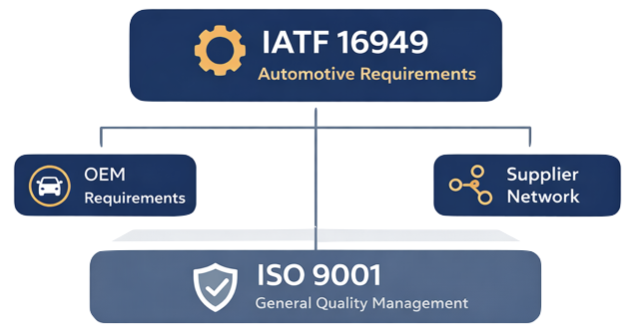
IATF 16949 is the international quality management standard for the automotive industry.
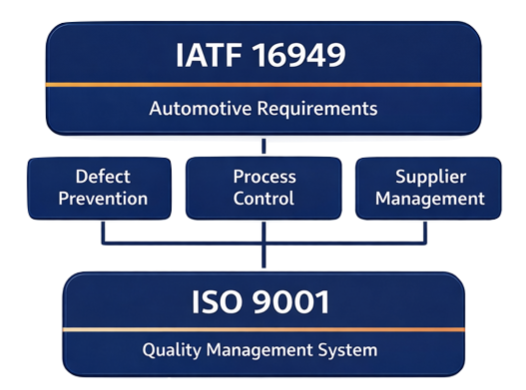
It is based on ISO 9001 but introduces additional automotive-specific requirements focused on:
- defect prevention
- process consistency
- risk reduction
- continuous improvement
- supplier quality management
The standard was developed by the International Automotive Task Force (IATF) together with major automotive manufacturers.
IATF 16949 defines how organizations should establish and maintain effective quality management systems across automotive development and production activities.
It is widely required throughout the automotive supply chain and is often mandatory for suppliers working with major OEMs.
Key Elements of IATF 16949
IATF 16949 includes several important quality management principles.
One key focus is process orientation. Organizations must define, manage, monitor, and continuously improve their engineering and manufacturing processes.
The standard also emphasizes:
- risk-based thinking
- defect prevention
- supplier management
- traceability
- change management
- corrective and preventive actions
Another important element is continuous improvement.
Organizations are expected to systematically analyze:
- quality issues
- process weaknesses
- customer feedback
- production performance
The goal is to improve quality and reduce variation throughout the organization.
IATF 16949 also places strong emphasis on leadership involvement and organizational accountability.
If you want to understand automotive quality management and engineering standards in greater depth:
Outputs of IATF 16949
IATF 16949 generates multiple important outputs that support automotive quality and operational consistency.
Typical outputs include:
- documented quality processes
- process performance metrics
- supplier quality controls
- traceability records
- audit results
- corrective action plans
- continuous improvement activities
These outputs help organizations improve:
- manufacturing stability
- product consistency
- engineering quality
- supplier performance
- customer satisfaction
The standard also supports better coordination across complex automotive supply chains.
Role within the Automotive Industry
IATF 16949 plays a major role throughout the automotive ecosystem.
OEMs use the standard to establish common quality expectations across suppliers and development partners.
Suppliers use IATF 16949 to demonstrate process maturity, quality management capability, and operational reliability.
The standard also supports alignment between:
- engineering
- manufacturing
- supplier management
- logistics
- production operations
As vehicles become increasingly software-defined and electronically complex, maintaining high process quality becomes even more important.
Modern automotive quality management now extends far beyond manufacturing alone and increasingly interacts with:
- ASPICE
- ISO 26262
- ISO 21434
- software engineering processes
Challenges in Practice
Implementing IATF 16949 in real organizations can be highly demanding.
One major challenge is maintaining process consistency across global teams, suppliers, and manufacturing locations.
Organizations also struggle with balancing:
- process rigor
- operational efficiency
- engineering flexibility
- project timelines
Another difficulty is integrating quality management into rapidly evolving software-driven development environments.
Many traditional automotive quality systems were originally optimized for hardware-focused manufacturing processes. Modern software-defined vehicles require more agile and integrated quality approaches.
Supplier management also creates significant complexity, especially when multiple tiers of suppliers are involved.
Common Misunderstandings
One common misconception is that IATF 16949 mainly focuses on documentation.
In reality, the purpose of the standard is to improve operational quality and reduce process variation.
Another misunderstanding is assuming that certification alone guarantees high-quality products.
A certified quality management system only creates value when the processes are implemented effectively and continuously improved.
It is also often assumed that IATF 16949 applies only to manufacturing organizations. In practice, the standard influences engineering, supplier management, software development, and project management activities as well.
Finally, some organizations focus too heavily on audits instead of actual process effectiveness and engineering quality.
Summary
IATF 16949 is one of the most important quality management standards in the automotive industry.
It helps organizations establish structured, repeatable, and continuously improving processes across engineering, manufacturing, and supplier management activities.
As automotive systems become more software-driven and globally interconnected, strong quality management becomes increasingly important for ensuring reliable and safe vehicle development.
Understanding IATF 16949 is essential for anyone involved in automotive engineering, supplier management, manufacturing, or quality assurance.