
ISO 9001 Explained – Quality Management Systems
Quality management plays an essential role in modern organizations. Whether in engineering, manufacturing, software development, healthcare, or services, companies must ensure that their processes consistently deliver reliable results.
As organizations grow in complexity, maintaining process consistency, customer satisfaction, and operational efficiency becomes increasingly challenging.
This is where ISO 9001 becomes important.
ISO 9001 is the world’s most widely used quality management standard and provides a structured framework for establishing effective quality management systems across organizations of all sizes and industries.
In this article, you will learn what ISO 9001 is, why it matters, and how it supports continuous improvement and process quality.
Why ISO 9001 Matters
Organizations operate in highly competitive environments where quality, efficiency, and reliability directly affect customer satisfaction and long-term success.
Without structured processes, companies often struggle with:
- inconsistent outputs
- communication problems
- unclear responsibilities
- inefficient workflows
- recurring quality issues
These problems frequently lead to:
- increased costs
- delays
- customer complaints
- reduced operational performance
ISO 9001 helps organizations establish repeatable and controlled processes that improve consistency and reduce unnecessary variation.
The standard also supports:
- continuous improvement
- customer-focused thinking
- risk-based decision-making
- organizational transparency
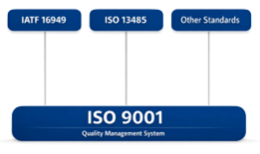
Because of its broad applicability, ISO 9001 is used across industries worldwide and serves as the foundation for many sector-specific standards such as:
- IATF 16949
- ISO 13485
- AS9100
If you want to understand quality management systems and engineering standards in greater depth:
What is ISO 9001?
ISO 9001 is an international standard for quality management systems (QMS).
It defines requirements for establishing structured organizational processes focused on delivering consistent quality and improving customer satisfaction.
The standard does not prescribe exactly how organizations must operate. Instead, it defines a flexible framework that organizations can adapt to their specific business environment.
ISO 9001 focuses strongly on:
- process-oriented thinking
- leadership involvement
- customer focus
- risk-based approaches
- continuous improvement
The standard is maintained by the International Organization for Standardization (ISO) and is globally recognized across many industries.
Key Elements of ISO 9001
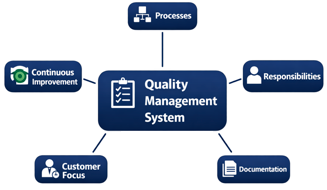
One of the central concepts of ISO 9001 is the process approach.
Organizations are expected to identify, manage, monitor, and continuously improve their business processes.
The standard also emphasizes risk-based thinking. Companies should proactively identify potential problems and implement measures to reduce risks before issues occur.
Another major focus is customer satisfaction. Organizations must ensure that customer requirements are understood, fulfilled, and continuously monitored.
Additional important elements include:
- leadership commitment
- employee competence
- documented information
- performance evaluation
- corrective actions
- continuous improvement activities
ISO 9001 promotes a culture where organizations continuously evaluate and optimize their operations.
Outputs of ISO 9001
A well-implemented ISO 9001 quality management system generates multiple important outputs.
Typical outputs include:
- documented organizational processes
- quality objectives
- performance indicators
- audit results
- corrective action records
- process improvement activities
- customer feedback evaluations
These outputs help organizations improve:
- operational consistency
- efficiency
- transparency
- communication
- product and service quality
The standard also supports stronger organizational alignment by clearly defining responsibilities and workflows.
Role within Organizations
ISO 9001 plays a foundational role in many organizations.
It establishes a structured management framework that supports coordination across departments, teams, and business activities.
The standard often becomes integrated into:
- engineering workflows
- manufacturing processes
- supplier management
- project management
- customer support activities
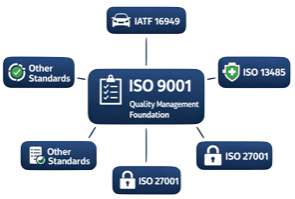
Many organizations also use ISO 9001 as a starting point before implementing more specialized standards such as:
- IATF 16949 for automotive
- ISO 13485 for medical devices
- AS9100 for aerospace
Because ISO 9001 is broadly applicable, it helps organizations establish a consistent quality culture across the entire company.
Challenges in Practice
Implementing ISO 9001 effectively can be challenging.
One common difficulty is balancing structured processes with operational flexibility. Organizations sometimes create excessive bureaucracy instead of focusing on process effectiveness.
Another challenge is ensuring that quality management becomes part of the actual organizational culture rather than simply a documentation exercise.
Leadership involvement is also critical. Without active management support, quality systems often become disconnected from real operational activities.
Organizations may additionally struggle with:
- maintaining process consistency
- managing organizational changes
- employee engagement
- continuous improvement activities
Successful implementation requires long-term commitment and continuous organizational alignment.
Common Misunderstandings
One common misconception is that ISO 9001 guarantees high-quality products or services automatically.
In reality, the standard provides a framework for managing processes effectively. The actual quality still depends on how well the organization implements and maintains its processes.
Another misunderstanding is assuming that ISO 9001 mainly focuses on documentation.
While documented information is important, the real purpose of the standard is improving operational consistency, process control, and continuous improvement.
Some organizations also treat certification itself as the primary objective. However, the real value of ISO 9001 comes from improving organizational effectiveness and reducing inefficiencies over time.
Finally, ISO 9001 is often perceived as relevant only for manufacturing companies. In practice, the standard is widely applicable across many industries and service organizations.
Summary
ISO 9001 is the world’s leading quality management system standard.
It helps organizations establish structured, repeatable, and continuously improving processes that support operational consistency and customer satisfaction.
The standard promotes:
- process-oriented thinking
- risk-based approaches
- leadership involvement
- continuous improvement
As organizations become more complex and interconnected, effective quality management systems become increasingly important for long-term success.
Understanding ISO 9001 is valuable for anyone involved in engineering, manufacturing, management, operations, or organizational improvement.