ISO 27001 Explained – Information Security Management Systems
Information has become one of the most valuable assets of modern organizations.
Whether it is customer data, intellectual property, financial records, business strategies, or engineering documentation, organizations depend on secure and reliable information to operate effectively.
At the same time, cyberattacks, data breaches, insider threats, and regulatory requirements continue to increase.
This is where ISO/IEC 27001 comes into play.
ISO 27001 is the world’s leading standard for Information Security Management Systems (ISMS) and provides organizations with a structured framework for managing information security risks.
In this article, you will learn what ISO 27001 is, why it matters, and how organizations use it to protect their information assets.
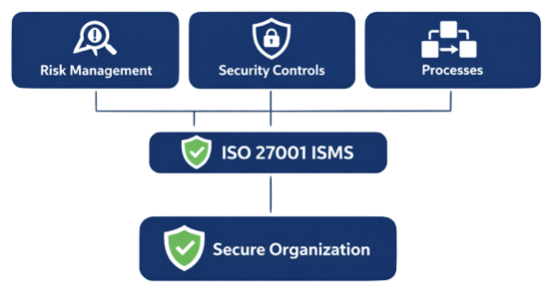
Overview of ISO 27001 and information security management systems
If you want to understand cybersecurity, information security, and engineering standards in greater depth:
Modern organizations are more connected than ever before.
Business operations increasingly rely on:
cloud services
digital collaboration tools
connected devices
remote work environments
software platforms
third-party suppliers
While these technologies improve efficiency, they also introduce new security risks.
Organizations face threats such as:
cyberattacks
ransomware
data breaches
phishing attacks
insider threats
accidental information disclosure
The consequences can be severe:
financial losses
operational disruptions
reputational damage
legal penalties
loss of customer trust
Information security is therefore no longer only an IT issue. It has become a strategic business concern that affects the entire organization.
What is ISO 27001?
ISO/IEC 27001 is an international standard for Information Security Management Systems (ISMS).
It provides a systematic approach to managing information security risks across people, processes, and technology.
Rather than focusing on individual technical controls, ISO 27001 establishes a management framework that helps organizations continuously identify, assess, and mitigate information security risks.
The standard focuses on:
confidentiality
integrity
availability
These three principles form the foundation of information security.
ISO 27001 is applicable to organizations of all sizes and industries, from small businesses to multinational enterprises.
It is often used to demonstrate a structured and risk-based approach to information security management.
ISMS Structure
At the core of ISO 27001 is the Information Security Management System (ISMS).
An ISMS provides a structured framework for managing security throughout the organization.
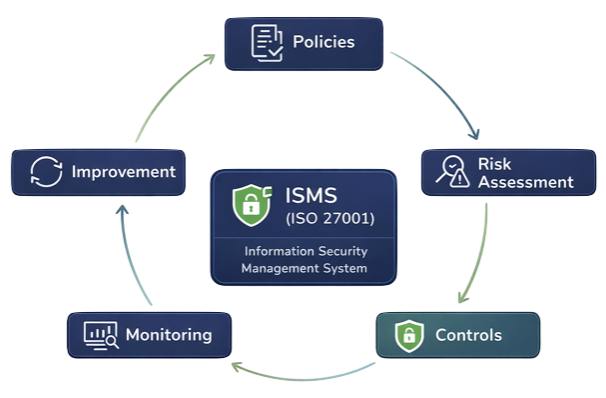
Key components typically include:
Information Security Policies
Organizations establish policies that define security objectives, responsibilities, and expectations.
Risk Assessment
Potential threats and vulnerabilities are identified and evaluated based on their impact and likelihood.
Risk Treatment
Organizations implement appropriate controls to reduce identified risks.
Security Controls
Technical, organizational, and physical measures are used to protect information assets.
Examples include:
access control
encryption
backup management
incident response
supplier security management
Monitoring and Improvement
Security performance is continuously monitored and improved through audits, reviews, and corrective actions.
The goal is to create a continuous cycle of risk management and security improvement.
Core components of an Information Security Management System (ISMS)
Outputs of ISO 27001
A well-implemented ISO 27001 management system generates several important outputs.
Typical outputs include:
information security policies
risk assessments
risk treatment plans
security objectives
audit reports
incident management processes
corrective action plans
management review records
These outputs help organizations demonstrate that information security risks are being managed in a structured and repeatable manner.
They also provide evidence for certification activities and regulatory compliance efforts.
Role within Organizations
ISO 27001 plays an increasingly important role in modern organizations.
It provides a common framework for aligning security activities across departments and business functions.
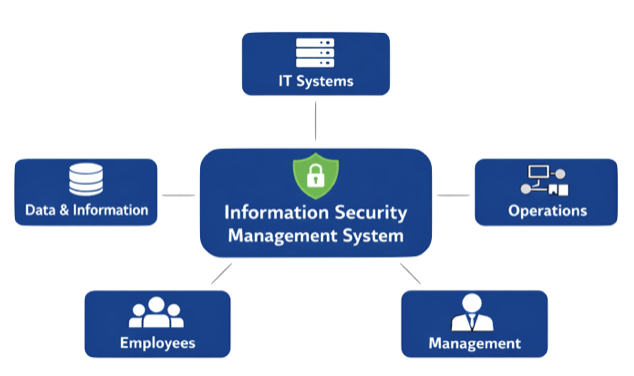
The standard supports collaboration between:
management
IT teams
cybersecurity specialists
operations
human resources
suppliers
Many organizations also use ISO 27001 as a foundation for broader governance, risk, and compliance activities.
The standard helps ensure that security is integrated into daily operations rather than treated as an isolated technical function.
As organizations become more digital and interconnected, the role of structured information security management continues to grow.
ISO 27001 supports organization-wide information security management and governance
Challenges in Practice
Implementing ISO 27001 can be challenging.
One common difficulty is defining the scope of the Information Security Management System.
Organizations must determine:
which assets are included
which processes are covered
which risks must be managed
Another challenge is maintaining security awareness throughout the organization.
Technology alone cannot provide effective security.
Employees, suppliers, and management all play important roles in protecting information.
Organizations also often struggle with:
risk assessment methodologies
documentation requirements
security culture
resource constraints
continuous improvement activities
Successful implementation requires ongoing commitment from both management and operational teams.
Common Misunderstandings
One common misconception is that ISO 27001 is primarily an IT security standard.
In reality, the standard addresses organizational information security and involves people, processes, and governance in addition to technology.
Another misunderstanding is assuming that certification automatically guarantees security.
No security framework can eliminate all risks.
Instead, ISO 27001 helps organizations manage risks in a structured and continuously improving manner.
Some organizations also focus too heavily on documentation.
The true objective of ISO 27001 is improving security performance and reducing risk, not simply producing documents.
Finally, many people assume that ISO 27001 only applies to large corporations.
In practice, organizations of all sizes can benefit from structured information security management.
Summary
ISO/IEC 27001 is the leading international standard for Information Security Management Systems.
It provides a structured framework for identifying, assessing, and managing information security risks across an organization.
The standard promotes:
risk-based thinking
security governance
continuous improvement
organizational security awareness
As cyber threats continue to evolve and organizations become increasingly digital, effective information security management becomes more important than ever.
Understanding ISO 27001 is valuable for anyone involved in cybersecurity, risk management, governance, compliance, or organizational leadership.
If you prefer a visual explanation, this video explains ISO 27001 step by step: