ASPICE Process Groups Explained
ASPICE has become one of the most important process assessment frameworks in the automotive industry.
Many engineers initially associate ASPICE primarily with software development. However, ASPICE covers much more than software alone.
Modern vehicles are complex systems consisting of hardware, software, systems engineering activities, management processes, and supporting processes. To address this complexity, ASPICE organizes its processes into several process groups.
Understanding these process groups is essential for anyone working with automotive development, process improvement, or ASPICE assessments.
In this article, we explain the major ASPICE process groups and how they work together to support successful automotive projects.
Why ASPICE Uses Process Groups
Automotive development involves many different disciplines.
Engineers must manage:
- customer requirements
- system architecture
- hardware development
- software development
- project management
- verification activities
- quality assurance
Without a structured framework, coordinating these activities becomes difficult.
ASPICE addresses this challenge by grouping related processes into logical categories.
This approach provides several advantages:
- improved process organization
- clearer responsibilities
- better traceability
- easier assessments
- improved process improvement activities
The process group structure helps organizations understand how individual activities contribute to the overall development lifecycle.
If you want to understand ASPICE, Automotive Systems Engineering, Functional Safety, and Cybersecurity in greater depth:
The Main ASPICE Process Groups
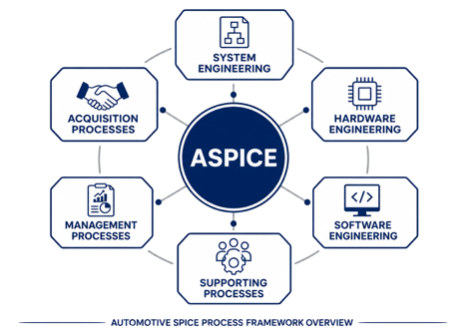
ASPICE organizes its processes into several major groups.
The most important process groups include:
System Engineering (SYS)
Processes related to system requirements, architecture, integration, and verification.
Software Engineering (SWE)
Processes covering software requirements, design, implementation, integration, and testing.
Hardware Engineering (HWE)
Processes supporting hardware development and verification activities.
Supporting Processes (SUP)
Processes that support development activities across the project.
Management Processes (MAN)
Processes related to planning, monitoring, risk management, and project control.
Acquisition Processes (ACQ)
Processes supporting customer-supplier relationships and acquisition activities.
Together, these process groups provide a comprehensive framework for automotive development.
System Engineering Process Group
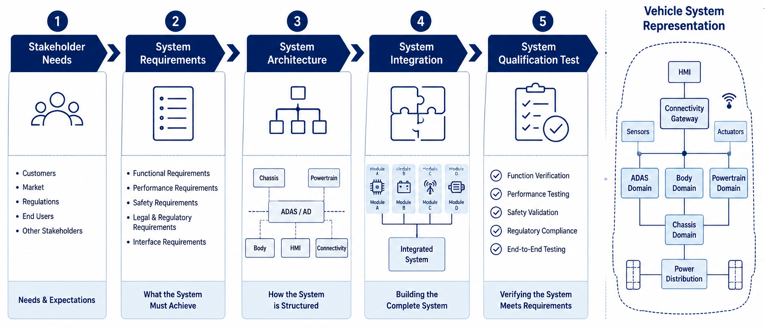
The System Engineering process group forms the foundation of many automotive development projects.
Its primary purpose is to transform stakeholder and customer needs into complete system solutions.
Typical activities include:
- system requirements engineering
- system architectural design
- system integration
- system verification
- system validation
The System Engineering processes ensure that all system-level requirements are properly defined, allocated, and verified.
Because modern vehicles consist of numerous interconnected components, strong systems engineering is critical for project success.
Software Engineering Process Group
The Software Engineering process group is one of the most widely known areas of ASPICE.
Software plays a central role in modern vehicles, controlling everything from powertrain systems to advanced driver assistance functions.
The Software Engineering group includes processes such as:
- software requirements analysis
- software architectural design
- software detailed design
- software construction
- software integration
- software testing
These processes help ensure that software is developed systematically and meets both functional and quality requirements.
Software Engineering is often the focus of ASPICE assessments due to the increasing importance of automotive software.
Hardware Engineering Process Group
As vehicles become more sophisticated, hardware development remains equally important.
The Hardware Engineering process group supports the development and verification of hardware components.
Typical activities include:
- hardware requirements engineering
- hardware architectural design
- hardware detailed design
- hardware integration
- hardware verification
Hardware and software development frequently occur in parallel and must remain closely aligned throughout the project lifecycle.
The Hardware Engineering processes help ensure consistency and traceability across hardware development activities.
Supporting Processes
Supporting Processes provide essential services that enable successful development activities across all engineering domains.
Examples include:
- quality assurance
- configuration management
- change request management
- problem resolution management
- verification support
These processes help maintain consistency, traceability, and process discipline throughout the project.
Although they may receive less attention than engineering processes, Supporting Processes are often critical for successful ASPICE assessments.
They provide the infrastructure needed to manage complex development environments.
Management Processes
The Management Process group focuses on planning, monitoring, and controlling development activities.
Typical management activities include:
- project planning
- project monitoring
- risk management
- measurement and analysis
- resource management
These processes help ensure that projects remain aligned with objectives, schedules, and budgets.
Effective management processes improve transparency and enable organizations to identify problems early.
In practice, strong management processes are often a key factor in achieving successful ASPICE capability levels.
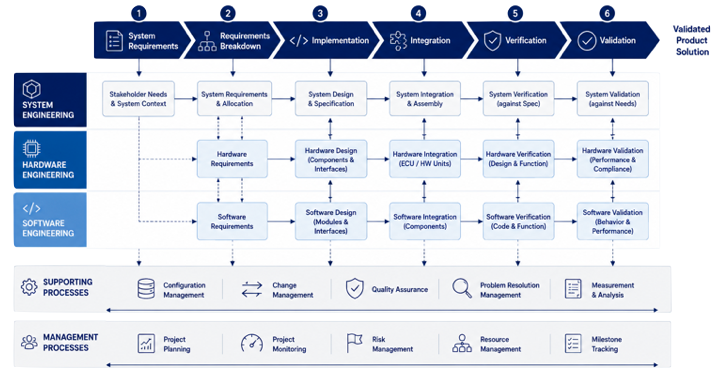
How Process Groups Work Together
One of the strengths of ASPICE is the integration of its process groups.
The groups do not operate independently.
Instead, they interact continuously throughout the development lifecycle.
For example:
- System requirements drive software and hardware development.
- Management processes coordinate project activities.
- Supporting processes ensure traceability and quality.
- Verification activities occur across multiple engineering domains.
A change in one area often affects several other process groups.
This interconnected structure reflects the reality of modern automotive development, where system, hardware, software, quality, and project management activities must remain aligned.
Understanding these interactions is often more important than understanding individual processes in isolation.
Summary
ASPICE organizes automotive development activities into structured process groups that support effective systems, hardware, and software engineering.
The major process groups include:
- System Engineering (SYS)
- Software Engineering (SWE)
- Hardware Engineering (HWE)
- Supporting Processes (SUP)
- Management Processes (MAN)
- Acquisition Processes (ACQ)
Together, these groups provide a comprehensive framework for managing complex automotive development projects.
Understanding how the process groups interact is essential for engineers, project managers, quality professionals, and organizations preparing for ASPICE assessments.
As automotive systems continue to increase in complexity, structured process frameworks such as ASPICE become increasingly important for delivering high-quality products.