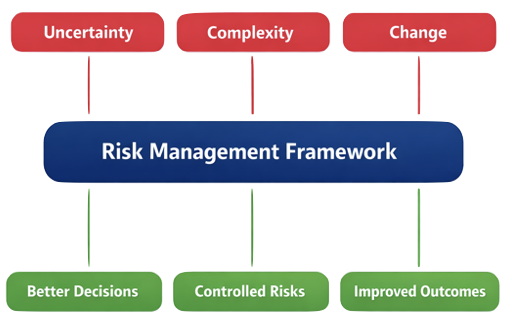
Whether developing safety-critical systems, managing cybersecurity threats, launching new products, or running daily business operations, organizations constantly face uncertainty.
The challenge is not eliminating all risks—this is rarely possible.
Instead, successful organizations identify, assess, and manage risks in a structured and informed manner.
This is where ISO 31000 comes into play.
ISO 31000 provides internationally recognized principles and guidelines for effective risk management across industries and organizational functions.
In this article, you will learn what ISO 31000 is, why it matters, and how it helps organizations make better decisions in uncertain environments.
Overview of ISO 31000 and modern risk management principles
If you want to understand risk management, engineering standards, and safety-critical systems in greater depth::
If risks are not properly understood, they can lead to:
financial losses
operational disruptions
project delays
regulatory violations
safety incidents
reputational damage
At the same time, risk management is not only about avoiding negative outcomes.
Effective risk management also helps organizations identify opportunities, improve decision-making, and increase resilience.
As systems and organizations become more interconnected and complex, structured risk management becomes increasingly important.
What is ISO 31000?
ISO 31000 is an international standard that provides principles, a framework, and a process for managing risk.
Unlike many industry-specific standards, ISO 31000 is designed for broad application across organizations of all sizes and sectors.
The standard does not prescribe specific risk controls.
Instead, it provides guidance on how organizations can systematically manage uncertainty and make informed decisions.
ISO 31000 promotes a risk-based approach that integrates risk management into governance, leadership, planning, and operational activities.
The objective is to improve organizational performance and support the achievement of objectives.
Key Elements of ISO 31000
ISO 31000 is built around several fundamental principles.
One important principle is that risk management should create and protect value.
Risk management should not become a bureaucratic exercise. It should support organizational objectives and improve outcomes.
Other key principles include:
Integration
Risk management should be embedded into organizational processes and decision-making.
Structure and Consistency
Organizations should use a systematic approach for identifying and managing risks.
Customization
Risk management activities should reflect the organization’s context and objectives.
Inclusiveness
Relevant stakeholders should be involved in risk-related decisions.
Continuous Improvement
Risk management systems should evolve as organizational needs and external conditions change.
These principles help establish a sustainable and effective risk management culture.
Risk Management Process
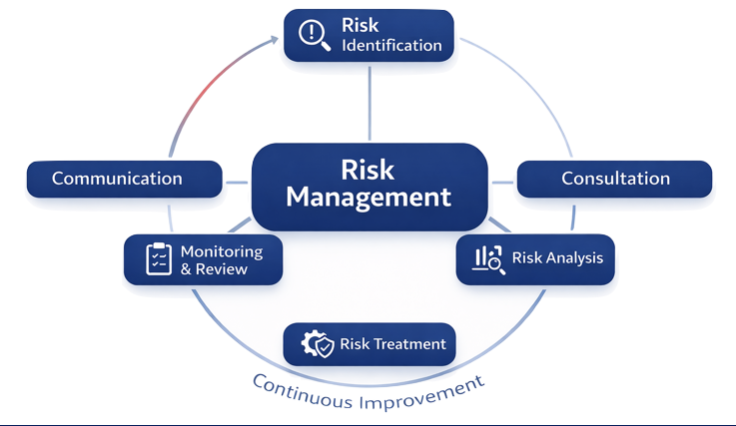
ISO 31000 defines a structured risk management process.
The process typically includes:
Establishing Context
Organizations define objectives, scope, stakeholders, and operating environments.
Risk Identification
Potential sources of uncertainty are identified.
Risk Analysis
The likelihood and consequences of identified risks are evaluated.
Risk Evaluation
Organizations determine which risks require treatment or additional attention.
Risk Treatment
Appropriate actions are implemented to reduce, transfer, avoid, or accept risks.
Monitoring and Review
Risk information is continuously monitored and updated.
Communication and Consultation
Stakeholders are informed and involved throughout the process.
The process is iterative and supports ongoing organizational learning.
The ISO 31000 risk management process from risk identification to continuous monitoring
Outputs of ISO 31000
Effective implementation of ISO 31000 generates several valuable outputs.
Typical outputs include:
risk registers
risk assessments
risk treatment plans
decision support information
risk reports
management reviews
performance monitoring activities
These outputs help organizations improve visibility into risks and support more informed decision-making.
The outputs also provide a foundation for compliance, governance, and continuous improvement activities.
Role Across Standards and Industries
One of the strengths of ISO 31000 is its broad applicability.
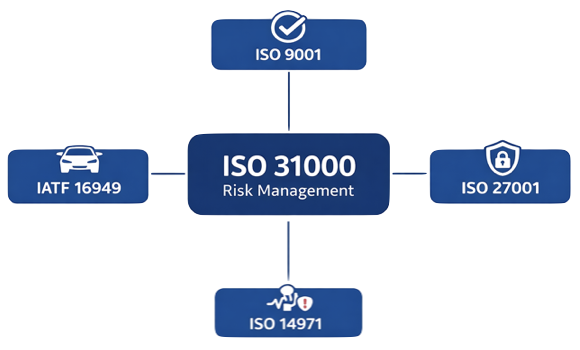
The standard serves as a foundation for many specialized risk management approaches.
Examples include:
Medical Devices
ISO 14971 applies risk management principles specifically to medical devices.
Automotive Functional Safety
ISO 26262 uses Hazard Analysis and Risk Assessment (HARA) to identify safety risks.
Automotive Cybersecurity
ISO 21434 uses Threat Analysis and Risk Assessment (TARA) to address cybersecurity risks.
Aerospace
ARP4761A applies structured safety assessment methods such as FHA, FTA, and FMEA.
Information Security
ISO 27001 uses risk-based approaches for information security management.
Although the terminology and implementation details differ, the underlying concepts are closely aligned with the principles of ISO 31000.
ISO 31000 provides risk management guidance across industries and standards
Challenges in Practice
Implementing effective risk management can be difficult.
One common challenge is treating risk management as a documentation exercise rather than a decision-making tool.
Organizations may also struggle with:
defining risk criteria
assessing uncertainty
maintaining risk registers
stakeholder engagement
organizational culture
resource limitations
Another challenge is balancing risk reduction with business objectives.
Not all risks should be eliminated.
Organizations must determine which risks are acceptable and which require action.
Effective risk management requires both analytical methods and sound judgment.
Common Misunderstandings
One common misconception is that risk management is only about avoiding problems.
In reality, risk management also supports opportunity identification and informed decision-making.
Another misunderstanding is assuming that risk management belongs only to dedicated risk specialists.
Effective risk management requires participation from leadership, engineering teams, operational staff, and other stakeholders.
Some organizations also believe that maintaining a risk register alone constitutes risk management.
However, documenting risks is only one part of a much broader management process.
Finally, ISO 31000 does not eliminate uncertainty.
Instead, it provides a structured approach for understanding and managing uncertainty more effectively.
Summary
ISO 31000 provides internationally recognized principles and guidelines for managing risk.
The standard helps organizations:
identify uncertainty
assess risks
make informed decisions
improve resilience
support continuous improvement
Its principles are applicable across industries and form the foundation for many specialized risk management standards used in automotive, aerospace, medical devices, cybersecurity, and quality management.
Understanding ISO 31000 is valuable for engineers, managers, project leaders, and decision-makers who operate in complex and uncertain environments.
If you prefer a visual explanation, this video explains ISO 31000 step by step: