ARP4754B Chapter 4 Explained – Aircraft and System Development Process
Modern aircraft are among the most complex engineering systems ever developed. Thousands of interconnected functions, hardware components, software applications, and human interactions must work together reliably while meeting strict safety and certification requirements.
Managing this complexity requires a structured systems engineering process.
This is the purpose of Chapter 4 of SAE ARP4754B – Aircraft and System Development Process.
Chapter 4 defines how aircraft functions are transformed into system requirements, allocated to aircraft systems, implemented, integrated, and verified throughout the development lifecycle.
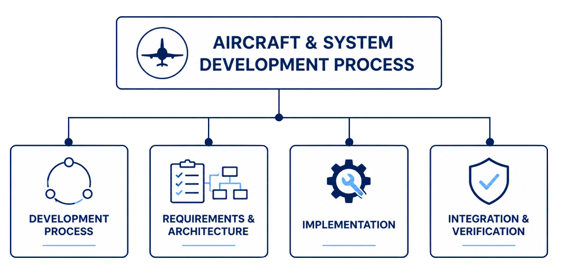
In this article, we explain the structure of Chapter 4 and the key activities that support successful aircraft and system development.
If you would like to deepen your understanding of ARP4754B, ARP4761A, DO-178C, DO-254, and aerospace systems engineering, explore our professional online training courses.
Aircraft development is far more than designing individual hardware or software components.
Engineers must ensure that every system contributes correctly to the overall aircraft behavior while satisfying safety, performance, reliability, and certification objectives.
Without a structured systems engineering process, organizations may experience:
incomplete or inconsistent requirements
interface incompatibilities
poor traceability
integration problems
increased certification risk
costly late-stage design changes
ARP4754B Chapter 4 provides a structured development process that coordinates all engineering disciplines and maintains consistency throughout the project lifecycle.
Structure of Chapter 4
ARP4754B Chapter 4 defines the structured systems engineering process used to transform aircraft requirements into verified aircraft systems.
General Aircraft & System Development Process
The development process begins with aircraft-level objectives and progressively refines them into detailed engineering solutions.
Typical activities include:
defining aircraft functions
capturing stakeholder needs
developing aircraft requirements
allocating requirements to aircraft systems
managing system interfaces
maintaining bidirectional traceability
planning verification activities
Each development phase builds upon the outputs of the previous phase, ensuring that every engineering decision remains linked to higher-level aircraft objectives.
This structured approach reduces project risk while improving consistency across multidisciplinary engineering teams.
Development of Aircraft Functions, Requirements and Architecture
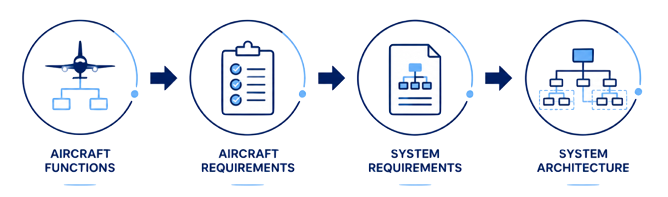
One of the central activities of Chapter 4 is transforming aircraft functions into implementable system architectures.
The process typically follows these steps:
Define aircraft functions.
Derive aircraft requirements.
Allocate requirements to aircraft systems.
Develop the system architecture.
Define interfaces between systems.
Allocate requirements to hardware and software.
Maintain complete traceability.
The resulting architecture becomes the technical foundation for subsequent hardware and software development.
Because aircraft systems are highly interconnected, careful interface definition and requirement allocation are essential for avoiding costly integration issues later in the project.
Aircraft functions are progressively transformed into system requirements and architectures, providing the foundation for hardware and software development.
Implementation
After the system architecture has been established, development proceeds to implementation.
Typical implementation activities include:
hardware development
software development
subsystem development
equipment integration
interface implementation
configuration management
Although implementation is often performed by specialized engineering teams, Chapter 4 ensures that all development activities remain aligned with the system architecture and allocated requirements.
This coordination is particularly important when multiple suppliers contribute to the same aircraft program.
System Integration and Verification
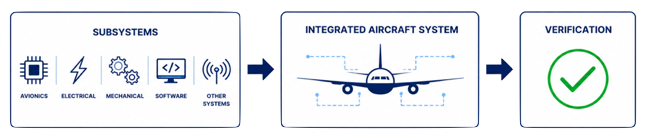
Once individual system elements have been implemented, they are progressively integrated into larger assemblies and ultimately into the complete aircraft.
Typical activities include:
subsystem integration
system integration
interface verification
requirements verification
functional testing
validation of aircraft functions
Verification confirms that each system satisfies its allocated requirements and that integrated aircraft behavior remains consistent with the original aircraft objectives.
By detecting integration issues early, organizations reduce development risk while improving certification readiness.
System Integration and Verification confirm that aircraft systems satisfy their allocated requirements and support successful certification.
How Chapter 4 Fits into ARP4754B
Chapter 4 forms the technical core of the ARP4754B development lifecycle.
Its relationship to the surrounding chapters can be summarized as follows:
Chapter 3 establishes the Development Assurance Planning framework.
Chapter 4 defines the Aircraft and System Development Process.
Chapter 5 introduces Integral Processes such as Safety Assessment, Requirements Management, Configuration Management, Process Assurance, and Verification.
Chapter 6 explains how modifications are managed throughout the aircraft lifecycle.
Together, these chapters provide a comprehensive framework for developing safe, reliable, and certifiable civil aircraft systems.
Summary
ARP4754B Chapter 4 defines the structured systems engineering process used to develop modern civil aircraft and their systems.
Its key activities include:
General Aircraft & System Development Process
Development of Aircraft Functions
Requirements Development
System Architecture
Implementation
System Integration
System Verification
By transforming aircraft-level objectives into verified system implementations, Chapter 4 provides the engineering foundation for successful aircraft certification.
For Systems Engineers, Aircraft Architects, Certification Engineers, Avionics Engineers, Project Managers, and Aerospace Development Teams, understanding Chapter 4 is essential because it defines how complex aircraft systems are systematically engineered from initial requirements through integration and verification.
If you prefer a visual explanation, this video explains ARP4754B Chapter 4