Software has become one of the most important elements of modern vehicle development.
From powertrain control and body electronics to advanced driver assistance systems and software-defined vehicles, software functionality continues to increase in complexity and importance.
As a result, organizations require structured development processes to ensure software quality, traceability, and reliability.
This is where the ASPICE Software Engineering (SWE) process group comes into play.
The ASPICE Software Engineering processes provide a framework for developing, verifying, integrating, and validating automotive software throughout its lifecycle.
In this article, we explain the ASPICE SWE process group and how its individual processes work together to support successful automotive software development.
Why Software Engineering Matters
Modern vehicles contain millions of lines of code.
Software controls critical functions such as:
braking systems
steering systems
powertrain management
battery management
driver assistance functions
infotainment systems
Poor software quality can lead to:
functional failures
integration issues
increased project costs
delayed releases
safety risks
Structured software engineering processes help organizations:
improve software quality
maintain traceability
manage complexity
reduce defects
support verification activities
ASPICE provides a systematic approach for achieving these objectives.
The ASPICE Software Engineering Processes
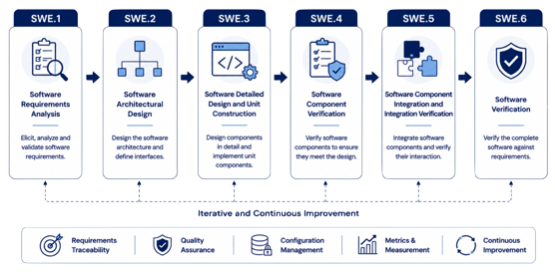
Overview of the ASPICE Software Engineering process group and its core software development processes
SWE.1 – Software Requirements Analysis
Software development begins with software requirements.
The objective of SWE.1 is to transform system requirements into detailed software requirements.
Typical activities include:
analyzing system requirements
defining software functionality
identifying interfaces
documenting software requirements
establishing traceability
Well-written software requirements should be:
complete
consistent
testable
unambiguous
traceable
The quality of software requirements strongly influences all downstream development activities.
SWE.2 – Software Architectural Design
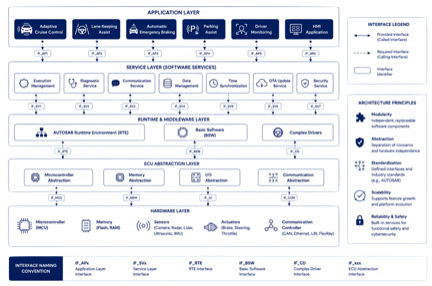
Once software requirements have been established, engineers develop the software architecture.
The architecture defines:
software components
interfaces
communication mechanisms
software decomposition
allocation of software requirements
A good software architecture helps:
manage complexity
support maintainability
improve scalability
simplify integration activities
The software architecture serves as the bridge between requirements and implementation.
If you want to understand ASPICE, Systems Engineering, Functional Safety, and Automotive Cybersecurity in greater depth:
SWE.3 – Software Detailed Design and Unit Construction
SWE.3 focuses on the implementation of software functionality.
Activities typically include:
detailed software design
software unit design
coding
static analysis
implementation reviews
Software units represent the lowest level of software decomposition.
The objective is to implement software units according to the software architecture while maintaining coding standards and quality requirements.
Traceability between requirements, architecture, design, and code remains important throughout this process.
SWE.4 – Software Unit Verification
After implementation, software units must be verified.
The purpose of SWE.4 is to demonstrate that software units perform as intended and satisfy their design requirements.
Typical verification activities include:
unit testing
code reviews
static analysis
coverage analysis
defect resolution
Early defect detection significantly reduces development costs and improves overall software quality.
Unit Verification therefore represents an important quality gate within the software lifecycle.
SWE.5 – Software Component Verification and Integration Verification
Software units do not operate in isolation.
They must be integrated into larger software components and tested together.
SWE.5 focuses on:
software integration
interface verification
interaction testing
integration testing
defect identification
The objective is to verify that integrated software components interact correctly and satisfy architectural expectations.
Many integration issues only become visible once components are combined, making this process particularly important.
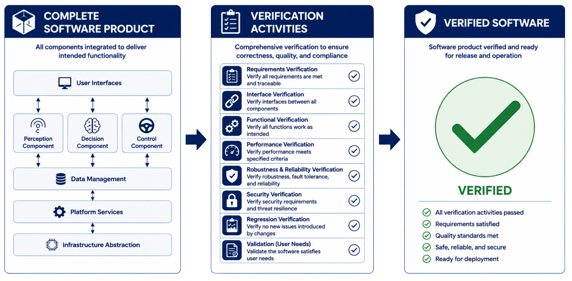
SWE.6 – Software Verification
SWE.6 represents the final software verification stage.
The objective is to verify that the complete software product satisfies its software requirements.
Typical activities include:
software qualification testing
requirements-based testing
test result evaluation
defect management
verification reporting
This process provides evidence that the software is ready for integration into the overall system.
Software Verification plays a critical role in demonstrating software quality and compliance with ASPICE expectations.
The ASPICE SWE processes form a structured software development and verification lifecycle
How SWE Processes Work Together
The ASPICE Software Engineering processes form a connected development chain.
The outputs of one process become inputs to the next:
Software requirements drive architectural design.
Architecture guides detailed design and implementation.
Implemented software units undergo verification.
Verified units are integrated into software components.
Integrated software is verified against requirements.
Throughout the lifecycle, traceability links are maintained between:
software requirements
software architecture
software units
verification activities
test results
This structured approach helps organizations manage software complexity and improve development quality.
Summary
ASPICE Software Engineering provides a structured framework for developing high-quality automotive software.
The SWE process group consists of:
SWE.1 Software Requirements Analysis
SWE.2 Software Architectural Design
SWE.3 Software Detailed Design and Unit Construction
SWE.4 Software Unit Verification
SWE.5 Software Component Verification and Integration Verification
SWE.6 Software Verification
Together, these processes support traceability, quality assurance, verification, and systematic software development.
As vehicles continue to evolve toward software-defined architectures, effective software engineering becomes increasingly important.
Understanding ASPICE SWE is therefore essential for software engineers, systems engineers, quality engineers, project managers, and organizations preparing for ASPICE assessments.
If you prefer a visual explanation, this video explains ASPICE Software Engineering Process Group step by step: