Developing a functionally safe vehicle requires much more than system, hardware, and software engineering.
Throughout the development lifecycle, numerous supporting activities ensure that requirements remain traceable, changes are controlled, tools are trustworthy, and safety evidence is properly managed.
This is the purpose of ISO 26262 Part 8 – Supporting Processes.
Part 8 provides the framework for managing the engineering activities that support every phase of Functional Safety, helping organizations maintain consistency, quality, and compliance throughout a project.
In this article, we explain the structure of ISO 26262 Part 8 and its key activities.
If you want to deepen your understanding of ISO 26262, ASPICE, Automotive Cybersecurity, and other engineering standards for safety-critical systems, explore our complete online training portfolio:
Functional Safety projects involve thousands of requirements, numerous engineering disciplines, multiple suppliers, and extensive verification activities.
Without structured supporting processes, organizations may encounter:
inconsistent requirements
uncontrolled design changes
outdated documentation
configuration errors
unqualified software tools
insufficient safety evidence
ISO 26262 Part 8 ensures that these supporting activities are managed systematically so that Functional Safety can be maintained throughout the entire development lifecycle.
Rather than creating safety directly, these processes enable every other safety activity to be performed reliably.
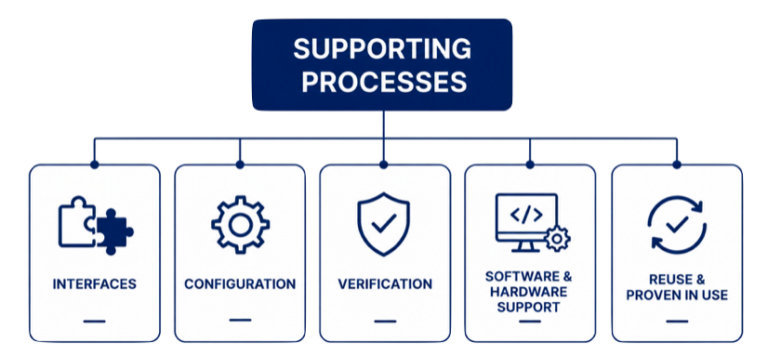
Structure of ISO 26262 Part 8
ISO 26262 Part 8 provides the supporting engineering processes that ensure consistency, traceability, and compliance throughout the complete Functional Safety lifecycle.
Interfaces, Safety Requirements and Configuration
Modern vehicle development involves cooperation between OEMs, suppliers, and multiple engineering disciplines.
ISO 26262 therefore emphasizes effective interface management.
Typical activities include:
defining responsibilities
managing supplier interfaces
exchanging safety-related information
coordinating engineering activities
At the same time, organizations must manage safety requirements throughout the project.
This includes:
maintaining bidirectional traceability
managing requirement changes
ensuring consistency across development artifacts
Configuration Management complements these activities by ensuring that every work product, requirement, design document, source file, and test result can be uniquely identified and reproduced.
Without effective configuration management, demonstrating compliance becomes extremely difficult.
Change Management and Verification
Change is unavoidable in every development project.
Requirements evolve, defects are discovered, and customer expectations change.
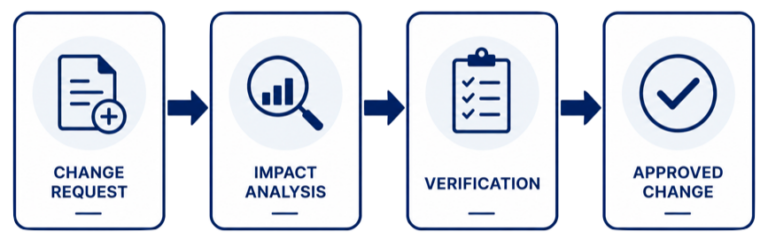
ISO 26262 requires every modification to be systematically evaluated before implementation.
Typical Change Management activities include:
impact analysis
approval workflows
implementation planning
traceability updates
regression planning
Verification ensures that changes do not introduce unintended safety issues.
Typical verification activities include:
requirements reviews
design reviews
static analysis
testing
confirmation of implemented changes
Together, Change Management and Verification help maintain Functional Safety despite continuous project evolution.
Controlled change management and systematic verification ensure that Functional Safety is maintained throughout continuous product evolution.
Documentation and Software Tools
Functional Safety depends on objective evidence.
Every safety activity should be documented to demonstrate compliance with ISO 26262.
Typical work products include:
safety plans
safety requirements
architecture documents
verification reports
validation reports
assessment records
Part 8 also introduces Confidence in the Use of Software Tools, often referred to as Tool Qualification.
Engineering tools used during development—such as requirements management tools, code generators, static analysis tools, or test automation frameworks—may influence Functional Safety.
Organizations therefore need to evaluate whether these tools require additional confidence measures before being used in safety-related projects.
Software Components and Hardware Evaluation
Many organizations reuse existing software libraries, operating systems, hardware components, or third-party intellectual property.
Part 8 provides guidance on evaluating these reusable elements before integrating them into safety-related systems.
Typical activities include:
evaluating previous development evidence
assessing compliance with safety requirements
identifying limitations
determining additional verification needs
This evaluation helps organizations balance development efficiency with Functional Safety assurance.
Proven in Use and Safety Elements out of Context
ISO 26262 recognizes that not every safety-related component is developed specifically for a single project.
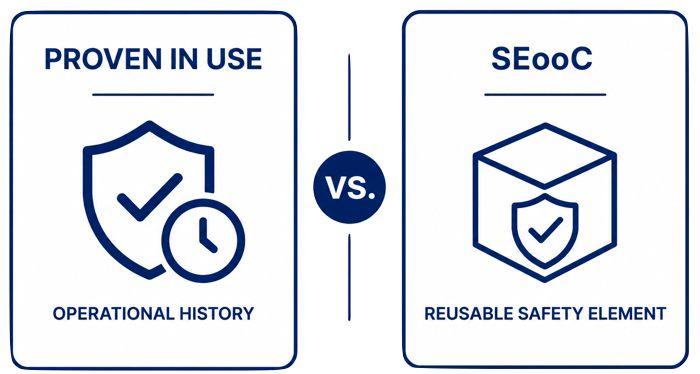
Two important concepts support component reuse.
Proven in Use (PiU)
A component may be accepted based on extensive operational experience demonstrating reliable behavior under representative conditions.
Typical evidence includes:
field operation history
failure statistics
maintenance records
operational environment
Safety Elements out of Context (SEooC)
Some components are developed independently of a specific vehicle project.
These Safety Elements out of Context are accompanied by assumptions and safety documentation that allow them to be integrated into multiple projects.
Both concepts help organizations reuse proven technologies while maintaining compliance with Functional Safety requirements.
Proven in Use and Safety Elements out of Context enable the safe reuse of hardware and software components while maintaining compliance with ISO 26262.
How Part 8 Supports the Entire Lifecycle
Unlike many other parts of ISO 26262, Part 8 is not limited to a single development phase.
Its supporting processes apply throughout the complete Functional Safety lifecycle.
They support:
Concept Phase
System Development
Hardware Development
Software Development
Integration
Verification
Validation
Production
Operation
Part 8 therefore acts as the engineering backbone of ISO 26262, ensuring that every development activity remains controlled, traceable, and properly documented.
Summary
ISO 26262 Part 8 provides the supporting engineering processes that enable successful Functional Safety projects.
Its key topics include:
Interface Management
Safety Requirements Management
Configuration Management
Change Management
Verification
Documentation
Confidence in the Use of Software Tools
Software Components and Hardware Evaluation
Proven in Use
Safety Elements out of Context (SEooC)
Together, these processes ensure that Functional Safety activities remain consistent, traceable, and compliant throughout the complete development lifecycle.
For Functional Safety Engineers, Systems Engineers, Software Engineers, Hardware Engineers, Quality Engineers, and Project Managers, understanding Part 8 is essential because these supporting processes provide the foundation upon which every other ISO 26262 activity depends.
If you prefer a visual explanation, this video explains ISO 26262-8 Supporting Processes step by step: