ISO 26262 Part 7 Explained – Production, Operation, Service and Decommissioning
Functional Safety does not end when a vehicle leaves the development department.
Even after system, hardware, and software development have been completed, safety must be maintained throughout production, vehicle operation, servicing, maintenance, and ultimately decommissioning.
This is the focus of ISO 26262 Part 7 – Production, Operation, Service and Decommissioning.
Part 7 extends Functional Safety beyond engineering and ensures that safety-related vehicles remain safe throughout their operational lifetime.
In this article, we explain the structure of ISO 26262 Part 7 and its key activities.
If you want to deepen your understanding of ISO 26262, ASPICE, Automotive Cybersecurity, and other engineering standards for safety-critical systems, explore our complete online training portfolio:
Developing a safe vehicle is only part of the challenge.
Even a perfectly engineered system can become unsafe if:
manufacturing processes introduce defects
incorrect components are installed
maintenance procedures are not followed
safety-related repairs are performed incorrectly
vehicle modifications compromise safety
decommissioning is carried out without considering safety risks
ISO 26262 Part 7 provides a structured framework to manage these risks throughout the vehicle lifecycle.
Its objective is to ensure that Functional Safety is preserved long after development has been completed.
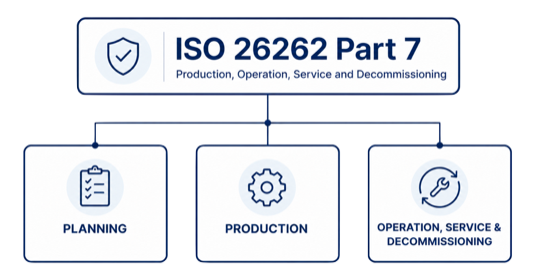
Structure of ISO 26262 Part 7
ISO 26262 Part 7 extends Functional Safety beyond development by addressing production, operation, service, and decommissioning throughout the complete vehicle lifecycle.
Clause 5 – Planning for Production, Operation, Service and Decommissioning
Planning begins long before the first production vehicle is built.
ISO 26262 requires manufacturers to prepare appropriate processes for all lifecycle phases that follow development.
Typical planning activities include:
defining production processes
preparing service documentation
establishing maintenance procedures
planning replacement of safety-related components
defining decommissioning strategies
assigning organizational responsibilities
Careful planning helps ensure that safety-related information is available to everyone involved throughout the product lifecycle.
Clause 6 – Production
Production must preserve the Functional Safety characteristics established during development.
Even small manufacturing deviations may compromise safety-related functions.
Typical production activities include:
manufacturing process control
production quality assurance
component traceability
verification of safety-critical assemblies
configuration management
handling manufacturing deviations
The objective is to ensure that every produced vehicle conforms to the validated safety design.
Production therefore becomes an essential part of the Functional Safety lifecycle rather than simply a manufacturing activity.
Clause 7 – Operation, Service and Decommissioning
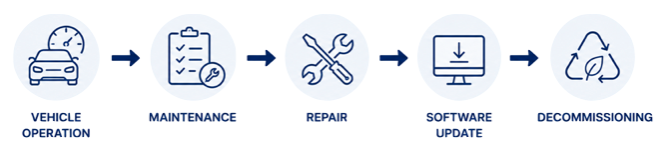
After production, the responsibility for Functional Safety continues throughout the operational lifetime of the vehicle.
Typical activities include:
vehicle operation
preventive maintenance
service procedures
replacement of safety-related components
software and hardware updates
management of product modifications
field monitoring
safe decommissioning and disposal
Repair procedures, replacement parts, and software updates must preserve the intended Functional Safety of the vehicle.
Manufacturers should also evaluate field experience to identify potential safety issues that may emerge during real-world operation.
At the end of the vehicle’s life, decommissioning activities should ensure that safety-related systems are handled appropriately and that any associated risks are managed.
ISO 26262 Part 7 ensures that Functional Safety is maintained throughout vehicle operation, servicing, maintenance, modifications, and end-of-life activities.
How Part 7 Fits into ISO 26262
ISO 26262 follows a structured Functional Safety lifecycle in which every part contributes to the development and operation of safe vehicles.
The relationship can be summarized as follows:
Part 2 establishes Functional Safety Management.
Part 3 defines the Concept Phase, including HARA, ASIL determination, Safety Goals, and the Functional Safety Concept.
Part 4 develops the Technical Safety Concept and the overall system architecture.
Part 5 implements the hardware architecture.
Part 6 develops and verifies the embedded software.
Part 7 ensures that Functional Safety is maintained throughout production, operation, servicing, and decommissioning.
Part 7 therefore extends Functional Safety beyond engineering and into the complete operational lifecycle of the vehicle
Summary
ISO 26262 Part 7 ensures that Functional Safety does not end when vehicle development is complete.
Its key activities include:
Planning for Production, Operation, Service and Decommissioning
Production Process Control
Operation and Maintenance
Service and Repair
Product Modifications
Decommissioning
Together, these activities help manufacturers preserve Functional Safety from the first production vehicle through years of operation and finally to the end of the vehicle’s service life.
For Functional Safety Engineers, Manufacturing Engineers, Quality Engineers, Service Engineers, Systems Engineers, and Project Managers, understanding Part 7 is essential because Functional Safety is a lifecycle responsibility—not just a development activity.
If you prefer a visual explanation, this video explains ISO 26262-7 Production, Operation, Service and Decommissioning step by step: