Modern vehicles are highly complex systems consisting of hardware, software, sensors, actuators, communication networks, and numerous interacting functions.
To manage this complexity, automotive development requires a structured systems engineering approach that ensures customer requirements are transformed into complete and verified system solutions.
This is exactly the purpose of the ASPICE System Engineering (SYS) process group.
ASPICE System Engineering provides the framework for defining, analyzing, designing, integrating, and validating vehicle systems throughout the development lifecycle.
In this article, we explain the ASPICE SYS process group and how its individual processes work together to support successful automotive projects.
Why System Engineering Matters
Many development issues can be traced back to poor system engineering.
Typical problems include:
unclear requirements
inconsistent system architecture
missing interfaces
integration failures
incomplete validation
As vehicles become increasingly software-defined, the importance of systems engineering continues to grow.
System Engineering helps organizations:
understand stakeholder needs
define system requirements
establish system architectures
coordinate hardware and software development
ensure traceability
verify and validate system behavior
Without strong System Engineering, even well-developed hardware and software components may fail to achieve overall system objectives.
The ASPICE System Engineering Processes
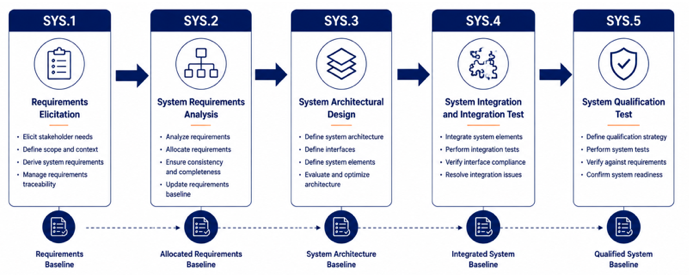
Overview of the ASPICE System Engineering process group and its core processes
SYS.1 – Requirements Elicitation
The development process starts with understanding stakeholder needs.
Stakeholders may include:
customers
vehicle manufacturers
end users
regulatory authorities
safety engineers
cybersecurity specialists
The goal of SYS.1 is to collect and document these expectations in a structured manner.
Examples may include:
performance requirements
safety expectations
cybersecurity objectives
functional needs
regulatory constraints
At this stage, requirements are often high-level and not yet technical.
The primary objective is to establish a clear understanding of what the system is expected to achieve.
If you want to understand ASPICE, Systems Engineering, Functional Safety, and Automotive Cybersecurity in greater depth:
Once stakeholder requirements have been collected, they must be transformed into technical system requirements.
This is the purpose of SYS.2.
Activities typically include:
refining stakeholder needs
resolving ambiguities
defining measurable requirements
establishing traceability
identifying interfaces
Well-written system requirements should be:
complete
consistent
verifiable
unambiguous
The quality of system requirements strongly influences the success of downstream development activities.
SYS.3 – System Architecture Design
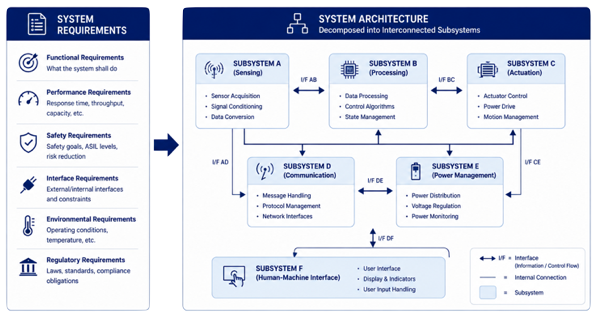
After defining system requirements, engineers develop the system architecture.
The architecture describes how the system is structured and how requirements are allocated to different system elements.
Typical activities include:
defining system components
identifying interfaces
allocating requirements
defining system behavior
supporting hardware and software decomposition
The system architecture serves as the bridge between requirements and implementation.
A robust architecture helps reduce integration risks and supports efficient development activities.
SYS.3 defines the system architecture and allocates requirements to system elements
SYS.4 – System Integration and Integration Test
Once system elements have been developed, they must be integrated and tested.
SYS.4 focuses on ensuring that individual components interact correctly when combined into a complete system.
Activities include:
integration planning
interface verification
integration testing
defect identification
issue resolution
The objective is to confirm that the integrated system behaves according to the defined architecture and requirements.
Integration testing often reveals problems that are not visible during isolated component testing.
SYS.5 – System Qualification Test
SYS.5 represents the final verification and validation stage at the system level.
The purpose is to demonstrate that the complete system satisfies its intended requirements and stakeholder expectations.
Typical activities include:
qualification testing
requirements verification
validation activities
test result evaluation
acceptance support
This process provides evidence that the system is ready for its intended operational environment.
System Qualification Testing is often one of the most visible milestones in the development lifecycle.
How SYS Processes Work Together
The strength of ASPICE System Engineering lies in the interaction between its processes.
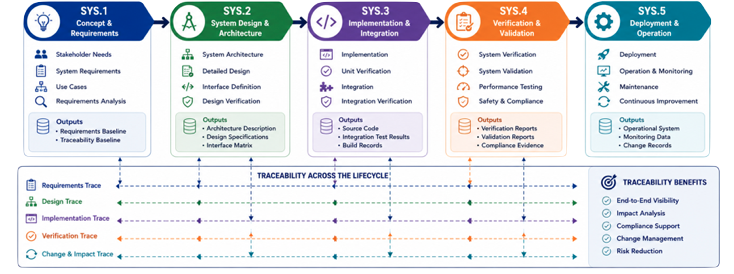
The outputs of one process become inputs to the next:
Stakeholder needs drive system requirements.
System requirements drive architecture development.
Architecture guides integration activities.
Integrated systems undergo qualification testing.
Throughout the lifecycle, traceability is maintained between:
stakeholder requirements
system requirements
architecture elements
verification activities
validation results
This structured approach helps organizations manage complexity and maintain consistency throughout development.
Rather than treating activities as isolated tasks, ASPICE promotes a connected systems engineering workflow.
ASPICE SYS processes create a structured path from stakeholder requirements to validated system solutions
Summary
ASPICE System Engineering provides the foundation for successful automotive development.
The SYS process group supports the transformation of stakeholder needs into complete and validated system solutions through:
SYS.1 Requirements Elicitation
SYS.2 System Requirements Analysis
SYS.3 System Architecture Design
SYS.4 System Integration and Integration Test
SYS.5 System Qualification Test
Together, these processes help organizations improve traceability, reduce integration risks, and deliver high-quality automotive systems.
As vehicles continue to increase in complexity, effective systems engineering becomes more important than ever.
Understanding ASPICE SYS is therefore essential for systems engineers, project managers, software engineers, hardware engineers, and organizations working within ASPICE-driven development environments.
If you prefer a visual explanation, this video explains ASPICE System Engineering Process Group step by step: