ISO 13485 Explained – Quality Management in Medical Devices
Quality management is a fundamental requirement in medical device development. Companies must ensure that their products are consistently safe, effective, and compliant with regulatory expectations.
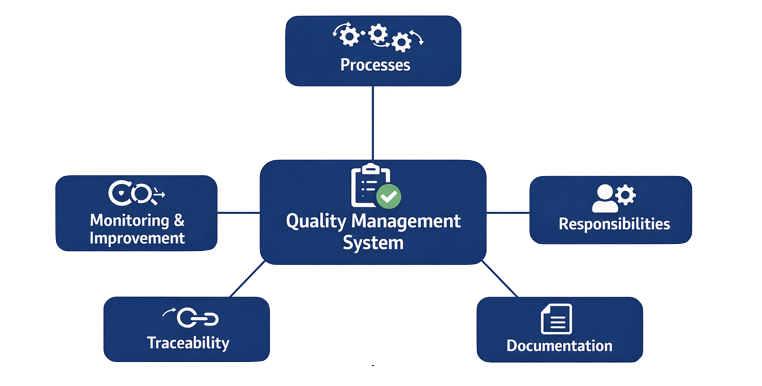
ISO 13485 defines the quality management system (QMS) that organizations must implement to achieve this. It provides the framework for managing processes, responsibilities, and documentation across the entire product lifecycle.
In this article, you will learn how ISO 13485 works in practice and why it is essential for medical device companies.
Why Quality Management Matters
Medical devices are used in safety-critical environments where failures can have serious consequences. Ensuring consistent product quality is therefore not optional.
Quality management ensures that processes are defined, controlled, and continuously improved. It allows organizations to produce reliable products and maintain compliance with regulations such as FDA requirements and EU MDR.
Without a structured QMS, companies would struggle to:
- Maintain consistency across projects
- Ensure traceability of decisions
- Pass audits and regulatory inspections
- Manage suppliers and production processes
Quality management is not just about control—it is about creating a system that ensures predictable and repeatable results.
What is ISO 13485?
ISO 13485 is the international standard for quality management systems in the medical device industry.
It defines how organizations must structure their processes to ensure compliance and product quality. Unlike general quality standards, ISO 13485 is specifically tailored to regulatory requirements in medical devices.
The standard covers areas such as management responsibility, resource management, product realization, and measurement and improvement.
ISO 13485 is not a technical standard. It does not define how to design a product. Instead, it defines how an organization must operate to ensure that products are developed and manufactured in a controlled and compliant way.
Key Elements of a QMS
A quality management system according to ISO 13485 is built on several core elements.
The organization must define clear processes and ensure that these processes are consistently followed. Responsibilities must be assigned, and management must actively support the system.
Documentation plays a central role. All activities must be traceable, which requires structured documentation of processes, decisions, and results.
Another key aspect is resource management. Personnel must be trained and competent, and the necessary infrastructure must be available.
Product realization ensures that development and production processes are controlled. This includes planning, design, supplier management, and manufacturing.
Finally, measurement and improvement ensure that the system evolves over time. Internal audits, performance monitoring, and corrective actions are essential to maintain and improve quality.
Outputs of ISO 13485
ISO 13485 requires organizations to generate clear and consistent outputs that demonstrate compliance.
These outputs include documented procedures, records of activities, audit results, and evidence of corrective actions. They provide proof that the organization operates according to defined processes.
The purpose of these outputs is not only documentation. They ensure transparency, traceability, and accountability.
During audits, these outputs are critical. They allow regulators and certification bodies to verify that the organization complies with requirements and maintains control over its processes.
Role within Medical Device Development
ISO 13485 plays a central role in integrating different aspects of medical device development.
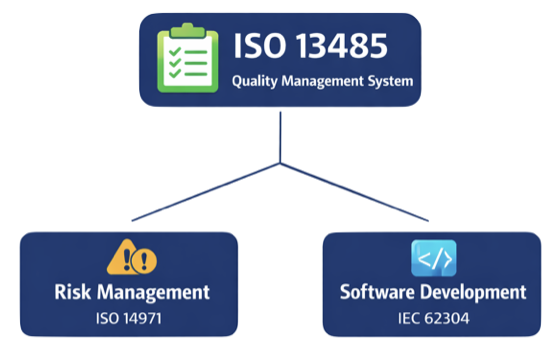
Risk management according to ISO 14971 defines what risks must be addressed. Software development according to IEC 62304 ensures that software is implemented correctly. ISO 13485 provides the overarching framework that ensures all activities are controlled and documented.
This creates a structured environment where development activities are aligned with regulatory expectations. Every decision, from design to production, is part of a controlled process.
Without ISO 13485, it would be difficult to ensure consistency across teams, projects, and products.
If you want to understand how ISO 13485 is applied in real projects and how it integrates with ISO 14971 and IEC 62304:
Challenges in Practice
Implementing ISO 13485 in real organizations can be complex. One challenge is defining processes that are both compliant and efficient. Overly rigid processes can slow down development, while insufficient control can lead to compliance issues.
Another challenge is maintaining documentation. Ensuring that all activities are properly recorded and traceable requires discipline and clear structures.
Organizations also struggle with integrating the QMS into daily work. If quality management is seen as a separate activity, it often leads to inefficiencies and inconsistencies.
A successful implementation requires that the QMS becomes part of the organizational culture rather than an external requirement.
Common Misunderstandings
There are several misconceptions about ISO 13485 that can lead to problems.
One common misunderstanding is that the standard is only relevant for quality departments. In reality, it affects the entire organization.
Another misconception is that ISO 13485 is mainly about documentation. While documentation is important, it is only a result of structured processes.
It is also often assumed that once a QMS is implemented, no further effort is required. In practice, continuous improvement and regular audits are essential.
Finally, some believe that ISO 13485 slows down innovation. In reality, a well-implemented QMS can improve efficiency by creating clear and predictable processes.
Summary
ISO 13485 defines how medical device companies manage quality and ensure compliance.
It provides a structured framework that integrates all aspects of development, from management responsibility to production and continuous improvement.
The standard ensures that processes are controlled, documented, and continuously optimized. It is essential for regulatory compliance and plays a central role in modern medical device development.
Understanding ISO 13485 is key for anyone working in engineering, quality management, or regulatory affairs within the medical device industry.