IEC 62304 Explained – Software Lifecycle in Medical Devices
Software plays a central role in modern medical devices. From diagnostic tools to life-supporting systems, software is often responsible for critical functionality. Ensuring that this software is developed in a safe and controlled way is essential.
IEC 62304 defines the required software lifecycle processes for medical device software. It provides a structured framework that ensures safety, traceability, and regulatory compliance.
In this article, you will learn how IEC 62304 works in practice and why it is a fundamental standard for medical device development.
Overview of the IEC 62304 software lifecycle in medical devices
Why Software is Different
Software behaves differently from hardware. While hardware failures are often caused by physical wear or external influences, software failures are typically systematic.
This means that software does not fail randomly. Instead, failures occur due to design errors, incorrect assumptions, or incomplete requirements. Once a defect exists in the code, it will consistently produce the same failure under the same conditions.
This characteristic makes software particularly challenging in safety-critical systems. It cannot simply be tested for reliability in the same way as hardware. Instead, the development process itself must ensure correctness.
IEC 62304 addresses this challenge by focusing on structured development processes rather than relying only on testing.
What is IEC 62304?
IEC 62304 is the international standard for medical device software lifecycle processes. It defines how software must be developed, maintained, and controlled to meet regulatory expectations.
The standard does not prescribe specific technologies or tools. Instead, it defines the processes that must be followed to ensure that software is safe and compliant.
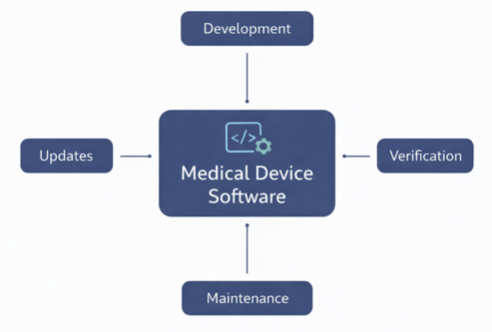
These processes include development, verification, maintenance, configuration management, and problem resolution. Together, they form a complete lifecycle model that ensures traceability and consistency.
IEC 62304 is closely connected to other standards such as ISO 14971 and ISO 13485. It does not operate in isolation but is part of a broader regulatory framework.
Software Lifecycle
At the core of IEC 62304 is the definition of a structured software lifecycle.
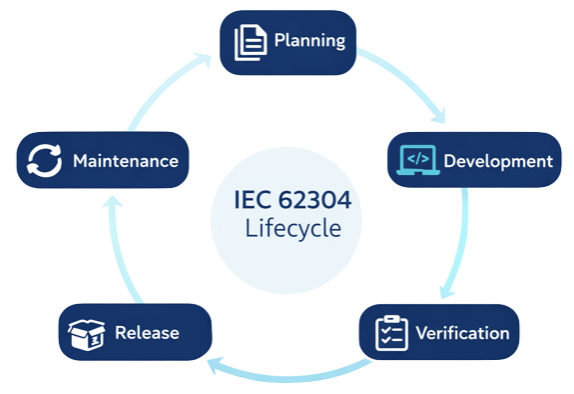
The lifecycle begins with planning and requirements definition. Clear and complete requirements are essential, as they form the basis for all subsequent activities. From there, the software is designed and implemented in a controlled manner.
Verification plays a central role throughout the lifecycle. Each step must be checked to ensure that it meets its intended purpose. This includes reviews, testing, and analysis.
Once the software is released, the lifecycle continues. Maintenance activities ensure that updates, bug fixes, and improvements are handled in a controlled way. This is especially important in regulated environments, where changes must be documented and justified.
The lifecycle is not strictly linear. It is iterative and requires continuous alignment between development, verification, and risk management.
Structured software lifecycle from requirements to maintenance according to IEC 62304
If you want to understand how IEC 62304 is applied in real projects and how it integrates with ISO 14971 and ISO 13485: Explore the full training here:
IEC 62304 introduces the concept of software safety classification. This classification reflects the potential impact of a software failure on patients or users.
Software is categorized into three classes based on risk severity. Lower-risk software requires less stringent processes, while higher-risk software must follow more rigorous controls.
The classification determines the level of documentation, verification effort, and process rigor required. It ensures that development activities are aligned with the potential consequences of failure.
This concept directly links IEC 62304 to risk management. The classification is typically derived from the risk analysis performed according to ISO 14971.
Outputs of IEC 62304
A key aspect of IEC 62304 is traceability. All development activities must produce documented outputs that demonstrate compliance.
These outputs include planning documents, requirements specifications, design descriptions, test results, and maintenance records. Together, they provide evidence that the software has been developed in a controlled and systematic way.
The goal is not documentation for its own sake. Instead, documentation ensures that decisions are transparent, traceable, and verifiable. This is essential for audits and regulatory approval.
Role within Medical Device Development
IEC 62304 does not operate in isolation. It is part of a larger system of standards governing medical device development.
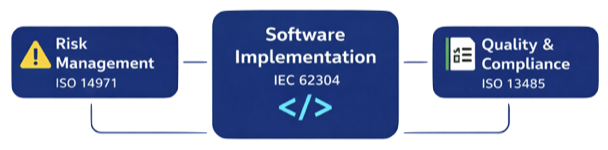
Risk management according to ISO 14971 defines what needs to be addressed. The software lifecycle defined by IEC 62304 provides the processes to implement those requirements. ISO 13485 ensures that all activities are embedded within a controlled quality management system.
This interaction creates a consistent and traceable development environment. Risks are identified, software is developed to mitigate those risks, and processes ensure that everything is documented and auditable.
Understanding this interaction is essential for working effectively in regulated environments.
Software lifecycle integrated with risk management and quality management systems
Challenges in Practice
Applying IEC 62304 in real projects can be challenging. One of the main difficulties is maintaining consistency across all lifecycle activities. Requirements, design, implementation, and verification must remain aligned at all times.
Another challenge is managing changes. Software evolves continuously, and each change must be evaluated, documented, and verified. This can become complex in large systems.
Organizations also struggle with balancing efficiency and compliance. Overly rigid processes can slow down development, while insufficient processes can lead to compliance issues.
A common problem is treating IEC 62304 as a documentation exercise rather than a development framework. This often leads to poor integration with actual engineering workflows.
Common Misunderstandings
There are several misconceptions about IEC 62304 that can lead to problems in practice.
One common misunderstanding is that testing alone ensures software safety. In reality, safety is achieved through a structured development process, not just through testing.
Another misconception is that IEC 62304 only applies to software engineers. In fact, it affects system design, risk management, and overall product development.
It is also often assumed that once software is released, the work is done. However, maintenance and post-market activities are essential parts of the lifecycle.
Finally, some believe that the standard is only about documentation. In reality, documentation is a result of structured engineering processes.
Summary
IEC 62304 defines how medical device software is developed in a safe, structured, and compliant way.
It addresses the unique challenges of software in safety-critical systems by focusing on lifecycle processes, traceability, and continuous control.
The standard ensures that software development is aligned with risk management and quality management requirements. It plays a central role in modern medical device development and is essential for regulatory compliance.
Understanding IEC 62304 provides a strong foundation for working with medical device software and navigating complex regulatory environments.
If you prefer a visual explanation, this video explains IEC 62304 step by step: