DO-178C Explained – Software Certification for Aircraft
Software plays a critical role in modern aircraft. From flight control systems to navigation and communication, many essential functions depend on reliable and predictable software behavior.
Unlike conventional software, aviation software must meet extremely strict safety and certification requirements. DO-178C defines the framework used to develop and certify this software.
In this article, you will learn how DO-178C works, why it is essential, and how it is applied in real aerospace projects.
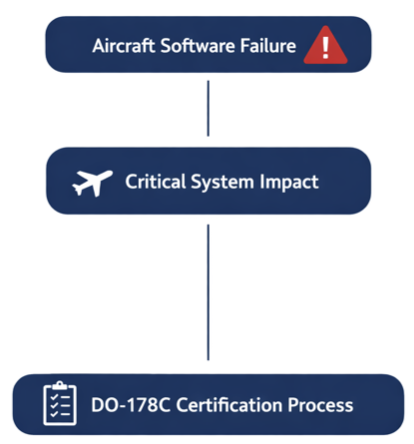
Overview of software certification for aircraft according to DO-178C
Why DO-178C Matters
Aircraft operate in highly safety-critical environments. Software failures can have severe consequences, making reliability and correctness essential.
DO-178C ensures that software is developed in a structured and controlled way. It provides the basis for demonstrating to certification authorities that the software performs as intended under all conditions.
Without such a standard, it would be extremely difficult to prove that complex software systems are safe enough for use in aviation.
The importance of DO-178C lies not only in safety but also in certification. Compliance with the standard is a key requirement for aircraft approval by authorities such as EASA or FAA.
What is DO-178C?
DO-178C is the internationally recognized guideline for the development of airborne software systems. It defines the processes, objectives, and evidence required to certify software used in aircraft.
The standard does not prescribe specific tools or programming languages. Instead, it focuses on ensuring that the development process is structured, traceable, and verifiable.
A key concept of DO-178C is that safety is achieved through process assurance. By following clearly defined processes and producing the required evidence, organizations can demonstrate that their software meets certification requirements.
Software Levels (A–E)
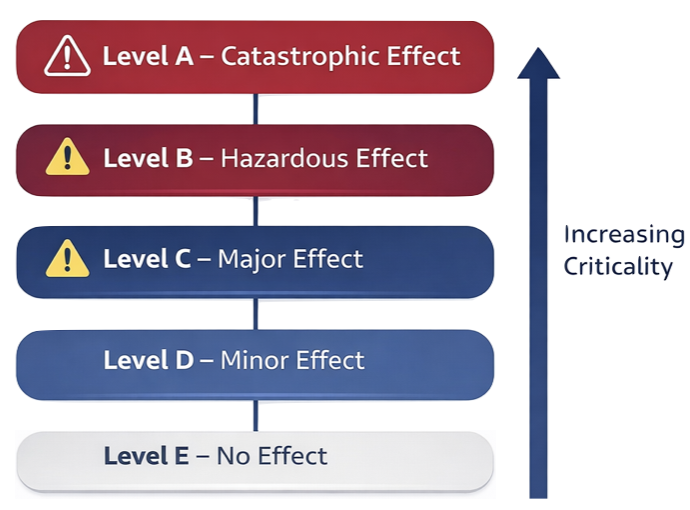
DO-178C introduces software levels based on the potential impact of a failure.
Software that could contribute to catastrophic failures is classified at the highest level, while software with no safety impact is classified at the lowest level.
These levels determine the rigor of development and verification activities. Higher levels require more extensive documentation, testing, and analysis.
The classification ensures that effort is aligned with risk. Systems with higher safety impact receive more attention and stricter controls.
Software classification levels based on failure impact in aerospace systems
Development Process
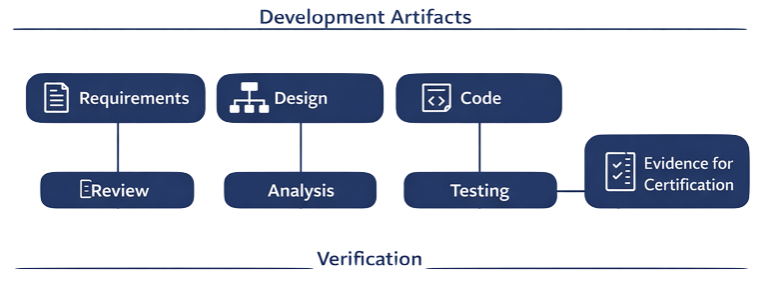
The development process defined by DO-178C ensures that software is built in a controlled and traceable way.
It begins with requirements, which must be clearly defined and structured. These requirements form the basis for design and implementation.
Traceability is a key element. Every requirement must be linked to design elements, code, and verification activities. This ensures that nothing is missing and that all functionality is properly implemented.
The development process also includes configuration management and quality assurance activities. These ensure that changes are controlled and that the process is consistently followed.
If you want to understand how DO-178C is applied in real projects and how it integrates with ARP4754B and ARP4761A:
Verification is one of the most critical aspects of DO-178C.
Each development step must be verified to ensure correctness. This includes reviews, testing, and analysis. The goal is to demonstrate that the software meets its requirements and behaves as expected.
Testing alone is not sufficient. Verification activities must cover requirements, design, and implementation.
Independence is another important concept. For higher software levels, verification must be performed independently from development to reduce the risk of systematic errors.
Validation ensures that the software fulfills its intended purpose in the overall system context.
Structured development and verification activities required for software certification
DO-178C vs ISO 26262
DO-178C is often compared to ISO 26262, the functional safety standard used in the automotive industry.
While both standards address safety-critical systems, their approaches differ significantly.
DO-178C focuses strongly on process assurance and certification. It defines strict objectives and evidence requirements that must be met to achieve approval.
ISO 26262, on the other hand, is more flexible and allows different approaches to achieving safety goals. It focuses on risk-based methods and system-level safety concepts.
The level of rigor in DO-178C is generally higher, reflecting the strict requirements of the aerospace industry.
Challenges in Practice
Applying DO-178C in real projects is complex and resource-intensive.
One major challenge is maintaining full traceability across all development artifacts. Requirements, design, code, and tests must remain aligned at all times.
Another challenge is managing the large amount of documentation required for certification. Producing and maintaining this documentation can be time-consuming.
Organizations also need to ensure that teams follow processes consistently. Deviations can lead to compliance issues and delays in certification.
Balancing efficiency and compliance is often difficult. Strict processes can slow development, but insufficient control can lead to costly rework.
Common Misunderstandings
Several misconceptions about DO-178C can lead to problems.
One common misunderstanding is that testing alone ensures compliance. In reality, compliance requires a complete set of processes and documented evidence.
Another misconception is that DO-178C defines how to write software. The standard focuses on processes, not on specific implementation methods.
It is also often assumed that certification can be added at the end of development. In practice, DO-178C must be considered from the very beginning.
Finally, some believe that the standard is only about documentation. In reality, documentation reflects the underlying engineering processes.
Summary
DO-178C defines how software for aircraft is developed and certified.
It ensures that software is built using structured processes, verified thoroughly, and supported by clear evidence. This approach enables organizations to demonstrate compliance with strict aviation safety requirements.
The standard plays a central role in aerospace engineering and is essential for developing reliable and certifiable software systems.
Understanding DO-178C is key for anyone involved in aviation software, system development, or certification activities.
If you prefer a visual explanation, this video explains DO-178C step by step: