
FHA Explained (ARP4761A) – Functional Hazard Assessment in Aerospace
Safety assessment is one of the most important activities in aerospace engineering. Modern aircraft systems are highly integrated and rely on complex interactions between software, hardware, avionics, sensors, and communication systems.
Understanding how failures can affect aircraft operation is essential for ensuring safety and supporting certification activities.
Functional Hazard Assessment (FHA) is one of the core analysis methods defined within ARP4761A. It helps engineers identify hazardous conditions associated with aircraft functions and evaluate their potential impact on safety.
In this article, you will learn how FHA works, why it is important, and how it fits into aerospace system development and certification processes.
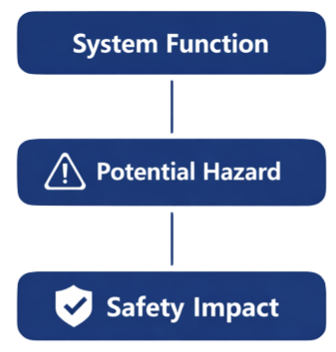
Why FHA Matters in Aerospace
Aircraft systems must achieve extremely high levels of safety and reliability. Even a single malfunction can potentially affect critical aircraft functions.
FHA provides the structured approach used to identify and classify hazardous conditions early in development.
This is important because early safety assessment activities strongly influence:
- system architecture decisions
- redundancy concepts
- development assurance strategies
- verification activities
- certification planning
Without FHA, it would be difficult to understand which aircraft functions are safety-critical and what level of rigor is required throughout development.
FHA therefore forms one of the foundations of aerospace safety engineering.
What is FHA?
Functional Hazard Assessment is a systematic process used to evaluate the effects of functional failures on aircraft operation.
The analysis focuses on aircraft functions rather than specific hardware or software failures.
The goal is to determine:
- what happens if a function fails
- how severe the consequences are
- which safety objectives are required
FHA helps engineers identify hazardous conditions and classify them according to their impact on aircraft safety.
Typical classifications may include:
- Minor
- Major
- Hazardous
- Catastrophic
These classifications influence subsequent development and certification activities.
If you want to understand how FHA is applied in real aerospace projects and how it integrates with ARP4761A, ARP4754B, and DO-178C:
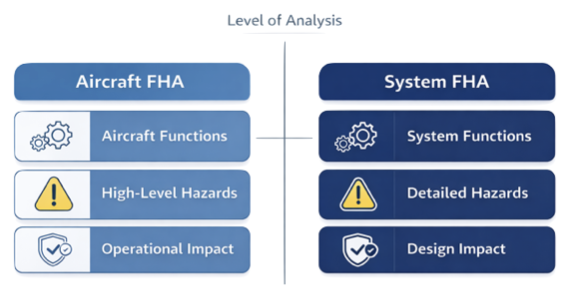
Aircraft vs System FHA
FHA can be performed at different levels within aerospace development.
Aircraft-level FHA evaluates failures in the context of overall aircraft operation. The focus is on how functional failures affect flight safety, crew workload, and operational capability.
System-level FHA provides more detailed analysis of specific aircraft systems and subsystems.
At this level, engineers evaluate:
- individual system functions
- failure effects
- operational dependencies
- interactions with other systems
The aircraft-level FHA typically defines the high-level safety objectives, while the system-level FHA refines these objectives into more detailed requirements and development constraints.
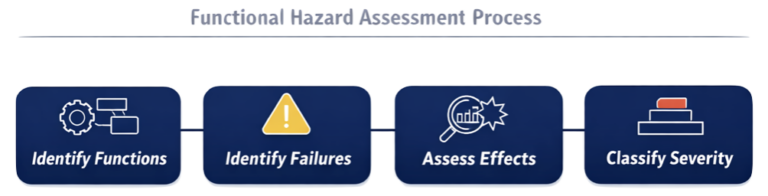
FHA Process
The FHA process begins by identifying aircraft or system functions.
For each function, engineers analyze possible failure conditions and evaluate their effects on aircraft operation.
The assessment considers factors such as:
- impact on safety
- crew workload
- operational capability
- passenger safety
- aircraft controllability
Based on this analysis, hazardous conditions are classified according to severity.
These classifications influence:
- development assurance levels
- architecture decisions
- redundancy requirements
- verification rigor
The process is iterative and evolves alongside system development activities.
Outputs of FHA
FHA produces several important outputs that support aerospace development and certification.
These outputs include:
- identified hazardous conditions
- severity classifications
- safety objectives
- operational assumptions
- development constraints
The results of FHA directly influence downstream activities such as:
- system architecture development
- fault tree analysis
- failure mode analysis
- software and hardware assurance activities
FHA therefore acts as a key bridge between safety assessment and system development.
FHA within ARP4761A
Within ARP4761A, FHA represents one of the primary safety assessment activities.
It works together with other analysis methods such as:
- Fault Tree Analysis (FTA)
- Failure Modes and Effects Analysis (FMEA)
- Common Cause Analysis (CCA)
While FHA focuses on identifying and classifying hazardous conditions, the other methods analyze failure propagation, root causes, and mitigation effectiveness.
ARP4761A integrates these analyses into a structured aerospace safety assessment framework.
Together, they provide the evidence needed to support aircraft certification and demonstrate acceptable safety levels.
Challenges in Practice
Performing FHA in real aerospace projects can be highly challenging.
One major difficulty is managing system complexity. Modern aircraft contain many interconnected systems, making it difficult to fully understand all operational dependencies.
Another challenge is maintaining consistency between FHA results and evolving system architectures. Design changes often require updates to safety analyses and assumptions.
Organizations also struggle with ensuring alignment between:
- system engineering
- safety engineering
- software development
- certification activities
Poor communication between teams can lead to inconsistent safety assumptions and incomplete analyses.
High-quality FHA requires deep system understanding and strong engineering judgement.
Common Mistakes
One common mistake is treating FHA as a documentation exercise rather than an engineering activity.
The real value of FHA lies in understanding system behavior and identifying potential safety risks early.
Another misconception is assuming that FHA only applies during early development phases. In reality, FHA must evolve together with system design throughout the lifecycle.
It is also often assumed that FHA alone is sufficient for safety assessment. In practice, FHA must be integrated with additional analyses such as FTA and FMEA.
Finally, some teams focus too heavily on templates and classifications while overlooking the broader system-level implications of hazardous conditions.
Summary
Functional Hazard Assessment is a central safety assessment activity in aerospace engineering.
FHA helps identify hazardous conditions, evaluate their severity, and define the safety objectives required for safe aircraft operation.
Within ARP4761A, FHA plays a critical role in connecting safety assessment with system development, architecture decisions, and certification activities.
Understanding FHA is essential for anyone involved in aerospace system engineering, aircraft certification, or safety-critical development.