ARP4761A Explained – Safety Assessment in Aerospace
Safety is one of the most critical aspects of aerospace engineering. Modern aircraft rely on highly integrated systems where failures can have severe consequences. Ensuring that these systems operate safely requires systematic safety assessment processes that are integrated throughout development.
ARP4761A provides the framework used in aerospace engineering to perform these safety assessments. It defines the methods used to identify hazards, analyze failures, evaluate risks, and support aircraft certification activities.
In this article, you will learn how ARP4761A works, why it is important, and how it interacts with aircraft system development processes.
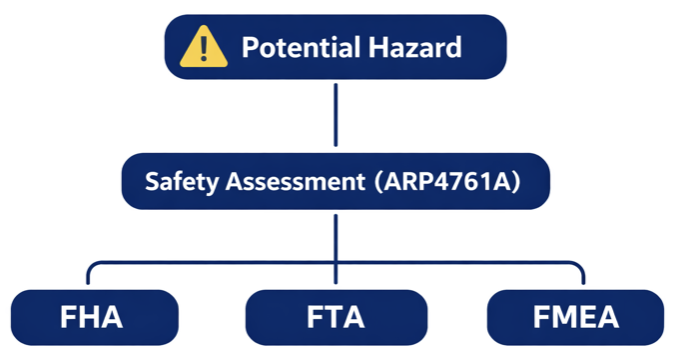
Overview of aerospace safety assessment according to ARP4761A
Why ARP4761A Matters
Aircraft systems are extremely complex. A single aircraft function may depend on software, hardware, sensors, communication networks, and redundant architectures working together correctly.
Without structured safety assessment activities, it would be impossible to fully understand how failures propagate through the system or how risks should be mitigated.
ARP4761A helps organizations:
identify hazardous conditions
evaluate failure effects
define safety objectives
support development assurance activities
provide evidence for certification authorities
The guideline plays a central role in ensuring that aircraft systems meet strict aerospace safety expectations.
What is ARP4761A?
ARP4761A is a guideline for performing safety assessments in civil aerospace systems.
It defines structured methods used to evaluate system safety throughout aircraft development. The guideline supports the identification of hazards and ensures that appropriate mitigation measures are implemented.
ARP4761A is closely connected to aircraft system development processes defined by ARP4754B. While ARP4754B focuses on system development, ARP4761A provides the safety assessment methods used to guide development decisions.
The guideline is widely used across the aerospace industry and supports certification activities for civil aircraft programs.
Safety Assessment Process
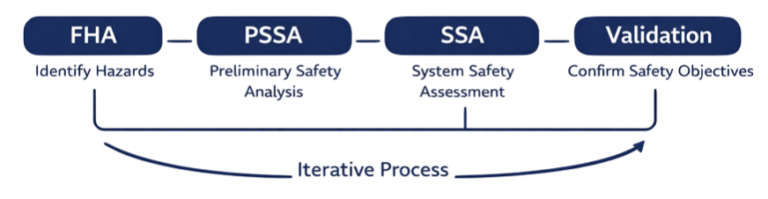
The safety assessment process defined by ARP4761A is iterative and integrated into system development activities.
The process typically begins with identifying aircraft-level functions and evaluating potential hazardous conditions associated with system failures.
Safety objectives are then derived based on the severity of these hazards. These objectives influence system architectures, redundancy concepts, and development assurance activities.
As the system design evolves, safety analyses become increasingly detailed. Engineers evaluate failure propagation paths, analyze combinations of failures, and verify that mitigation measures are effective.
The process continues throughout development and supports both design optimization and certification evidence generation.
Structured aerospace safety assessment process from hazard identification to risk mitigation
If you want to understand how ARP4761A is applied in real aerospace projects and how it integrates with ARP4754B and DO-178C:
ARP4761A includes several important safety assessment methods.
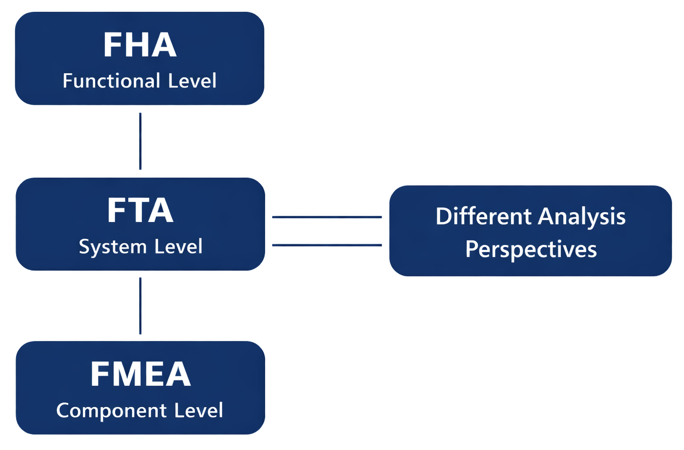
Functional Hazard Assessment (FHA) is used to identify and classify hazardous conditions associated with aircraft functions. It helps determine the severity of potential failures and establishes safety objectives.
Fault Tree Analysis (FTA) is a deductive analysis method that evaluates how combinations of failures can lead to undesired events. It is widely used to analyze complex system interactions and redundancy concepts.
Failure Modes and Effects Analysis (FMEA) is an inductive method used to evaluate the effects of individual component failures on the system.
Together, these methods provide complementary perspectives on system safety and help engineers understand both top-down and bottom-up failure behavior.
Key aerospace safety assessment methods including FHA, FTA, and FMEA
Relationship to ARP4754B
ARP4761A and ARP4754B are tightly interconnected.
ARP4754B defines the aircraft and system development processes, while ARP4761A provides the safety assessment methods used to support those development activities.
Safety analyses performed according to ARP4761A directly influence:
system architecture decisions
redundancy strategies
requirements allocation
development assurance levels
In practice, safety assessment and system development continuously interact throughout the lifecycle.
This integration is one of the defining characteristics of aerospace engineering processes.
ARP4761A vs HARA
ARP4761A is sometimes compared to HARA from ISO 26262, but the approaches differ significantly.
Both methods aim to identify hazards and evaluate risks. However, aerospace safety assessment is generally more process-driven and system-oriented.
HARA focuses strongly on severity, exposure, and controllability in automotive operational scenarios. ARP4761A focuses more extensively on system failure propagation, functional dependencies, and aircraft-level safety objectives.
The aerospace approach also places stronger emphasis on structured safety assessment methods such as FHA, FTA, and FMEA.
Although the industries differ, both approaches share the common goal of integrating safety into engineering decisions from the beginning.
Challenges in Practice
ARP4761A is sometimes compared to HARA from ISO 26262, but the approaches differ significantly.
Both methods aim to identify hazards and evaluate risks. However, aerospace safety assessment is generally more process-driven and system-oriented.
HARA focuses strongly on severity, exposure, and controllability in automotive operational scenarios. ARP4761A focuses more extensively on system failure propagation, functional dependencies, and aircraft-level safety objectives.
The aerospace approach also places stronger emphasis on structured safety assessment methods such as FHA, FTA, and FMEA.
Although the industries differ, both approaches share the common goal of integrating safety into engineering decisions from the beginning.
Common Misunderstandings
There are several misconceptions about ARP4761A.
One common misunderstanding is that safety assessment is a separate activity performed after development. In reality, safety assessment continuously influences system design decisions.
Another misconception is that FHA, FTA, and FMEA are independent analyses. In practice, these methods complement one another and must remain consistent.
It is also often assumed that safety assessment only supports certification. In reality, it is a critical engineering activity that improves system understanding and architecture quality.
Finally, some engineers believe that safety assessment is mainly documentation work. However, the real value lies in the engineering insights generated during the analysis process.
Summary
ARP4761A defines how safety assessment is performed in aerospace systems.
The guideline provides structured methods for identifying hazards, analyzing failures, evaluating risks, and supporting aircraft certification activities.
It works closely with ARP4754B system development processes and plays a central role in modern aerospace engineering.
Understanding ARP4761A is essential for anyone involved in aircraft system development, safety engineering, or aerospace certification.
If you prefer a visual explanation, this video explains ARP4761A step by step: