ISO 14971 Explained – Risk Management in Medical Devices
Risk management is one of the most critical aspects of medical device development. Every device, from simple tools to complex software-driven systems, must be safe for patients and users.
ISO 14971 defines the structured process used to identify hazards, analyze risks, and implement effective control measures throughout the entire lifecycle of a medical device.
In this article, you will learn how risk management works in practice and why it is essential for regulatory compliance.
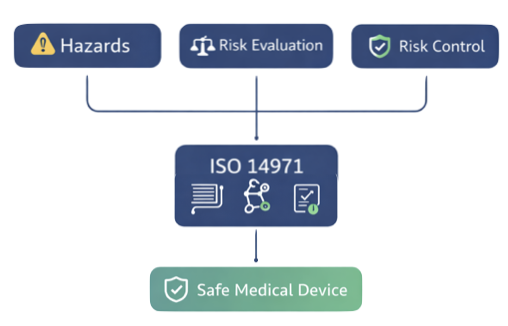
Overview of the ISO 14971 risk management approach in medical devices
Why Risk Management Matters
Medical devices operate in safety-critical environments. Even small failures can lead to serious consequences.
Risk management ensures that:
Potential hazards are identified early
Risks are systematically analyzed
Appropriate control measures are implemented
Devices remain safe throughout their lifecycle
Without a structured risk management process, it would be impossible to ensure compliance with regulations such as FDA requirements or EU MDR.
Risk management is not optional – it is a core requirement.
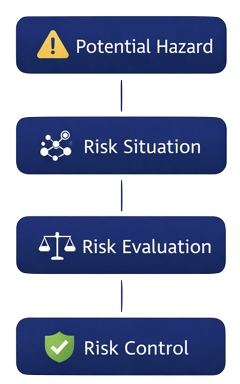
Risk management ensures safety and regulatory compliance in medical devices
What is ISO 14971?
ISO 14971 is the international standard for risk management of medical devices.
It defines:
A systematic risk management process
Responsibilities and documentation requirements
Continuous lifecycle integration
Post-production monitoring
The standard is not just about documentation—it is about engineering decisions based on risk.
It ensures that safety is built into the product from the very beginning.
Risk Management Process
The ISO 14971 process follows a structured sequence:
1. Hazard Identification
Identify potential sources of harm, such as:
Software errors
Hardware failures
User misuse
2. Risk Analysis
Estimate the risk by evaluating:
Severity of harm
Probability of occurrence
3. Risk Evaluation
Compare the estimated risk against predefined acceptance criteria.
Decide whether the risk is acceptable or requires mitigation.
4. Risk Control
Implement measures to reduce risk:
Design changes
Protective mechanisms
Information for safety (e.g. warnings)
5. Residual Risk Evaluation
After applying controls:
Assess remaining risks
Perform benefit-risk analysis if necessary
6. Post-Production Activities
Monitor the device after release:
Collect field data
Identify new risks
Improve the product continuously
This process is iterative and continues throughout the entire lifecycle.
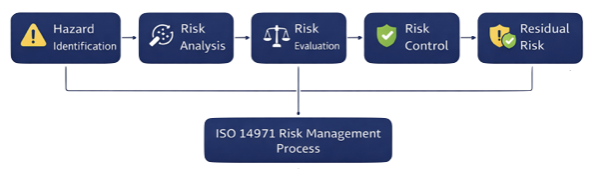
Structured risk management process from hazard identification to risk control and evaluation
Outputs of Risk Management
ISO 14971 requires clear documentation and traceability.
Key outputs include:
Risk management plan
Risk analysis documentation
Risk control measures
Residual risk evaluation
Risk management report
These outputs are essential for:
Regulatory approval
Audits
Internal quality assurance
If you want to learn how to apply ISO 14971 step by step in real projects:
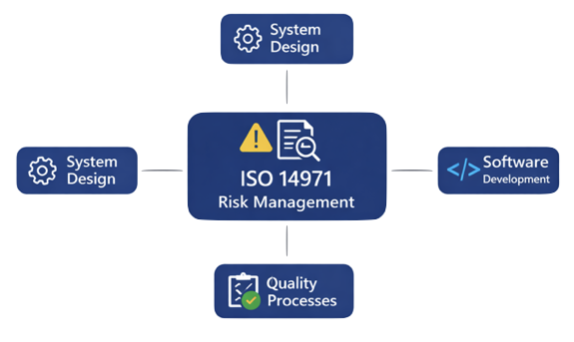
Risk management is not isolated—it is integrated into the entire development process.
It directly interacts with:
IEC 62304 (Software) → Software risks must be identified and controlled
ISO 13485 (QMS) → Risk management must be documented and controlled
Example:
A software function is identified as safety-critical → Risk is analyzed (ISO 14971) → Software is developed with controls (IEC 62304) → Process is documented (ISO 13485)
Risk management drives engineering decisions across the system.
Risk management interacts with software development and quality management processes
Challenges in Practice
In real-world projects, companies often face challenges such as:
Identifying all relevant hazards
Defining realistic risk acceptance criteria
Ensuring consistency across teams
Maintaining traceability between risks and controls
Integrating risk management into development workflows
A common issue is treating risk management as a documentation exercise instead of an engineering activity.
Common Misunderstandings
Several misconceptions can lead to serious issues:
❌ “Risk management is only paperwork” → It directly influences system design
❌ “Risk analysis is done once” → It must be continuously updated
❌ “Only safety engineers are responsible” → It involves the entire development team
❌ “Residual risk can be ignored” → It must always be evaluated
Understanding these points is critical for successful implementation.
Summary
ISO 14971 defines how risks are managed in medical device development.
It provides a structured and continuous process
It ensures safety is integrated into design
It supports regulatory compliance
It connects engineering, software, and quality processes
Risk management is not just a requirement—it is a core engineering discipline in medical device development.
If you prefer a visual explanation, this video explains ISO 14971 step by step: