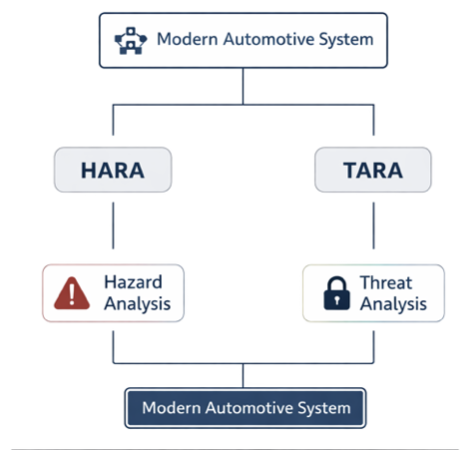
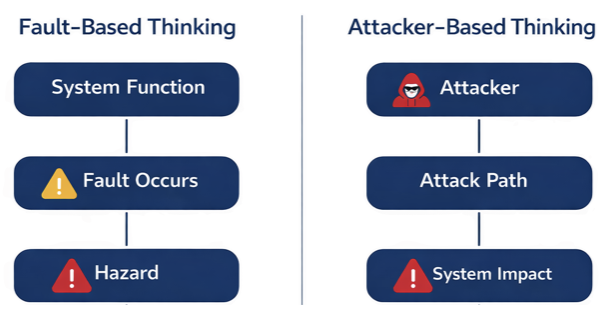
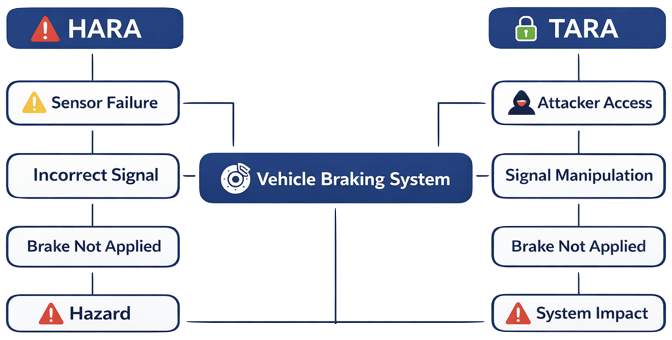
HARA vs TARA – Safety vs Cybersecurity in Automotive Engineering Why Compare HARA and TARA? Modern vehicles must be both safe and secure.Traditionally, automotive engineering focused on functional safety—ensuring that systems behave correctly even in the presence of faults.However, with increasing connectivity, a new challenge has emerged:Cybersecurity.Today, engineers must not only consider what happens when systems fail, but also what happens when systems are attacked.This is why both HARA and TARA are essential.HARA addresses safety risksTARA addresses cybersecurity risksUnderstanding the difference between these two approaches is critical for modern automotive development. What Is HARA? HARA stands for Hazard Analysis and Risk Assessment.It is a core activity in ISO 26262.HARA is used to identify hazards caused by malfunctioning system behavior and to assess the associated risks.Typical questions in HARA include:What could go wrong due to a system failure?What are the possible hazardous events?How severe are the consequences?How often could the situation occur?Can the driver control the situation?Based on this analysis, safety goals are defined.HARA focuses on unintentional failures. What Is TARA? TARA stands for Threat Analysis and Risk Assessment.It is a central concept in ISO/SAE 21434.TARA is used to identify potential cyber threats and evaluate their impact on the system.Typical questions in TARA include:What assets need protection?What could an attacker do?How likely is an attack?What would be the impact?Based on this analysis, cybersecurity goals and requirements are defined.TARA focuses on intentional attacks. Key Differences Between HARA and TARA Although both methods are used for risk assessment, they differ fundamentally in their approach.HARA is based on failures.TARA is based on threats.HARA evaluates risks using parameters such as:SeverityExposureControllabilityTARA evaluates risks using different criteria, such as:Attack feasibilityImpact on assetsThreat likelihoodAnother key difference is the source of risk.In HARA, risks arise from system malfunctions.In TARA, risks arise from malicious actors. Different Mindsets – Fault vs Attacker One of the most important differences between HARA and TARA is the required mindset.In functional safety, engineers think about failures.They ask:“What could go wrong?”In cybersecurity, engineers must think like attackers.They ask:“How could someone intentionally exploit this system?”This shift in perspective is not trivial.It requires a different way of thinking, different methods, and different expertise. Figure: Different perspectives in safety (failure-based) and cybersecurity (attacker-based) analysis How HARA and TARA Work Together In modern automotive systems, safety and cybersecurity are closely connected.A cyberattack can lead to safety-critical situations.For example:Manipulating sensor dataDisrupting communicationTriggering unintended system behaviorThis means that:Cybersecurity issues can become safety issues.In practice, HARA and TARA must be aligned.HARA defines safety-related risksTARA identifies security threats that could trigger those risksTogether, they provide a comprehensive view of system risk. If you want to understand ISO 26262 and ISO 21434 in detail: Automotive Courses Example Comparison Consider a braking system.From a HARA perspective:Hazard: Braking system does not activateCause: Sensor failure or software defectRisk: Loss of braking → potential accidentFrom a TARA perspective:Threat: Attacker manipulates braking signalCause: Unauthorized access or communication attackRisk: Same outcome → loss of brakingThis example shows that:Different causes can lead to the same hazardous outcome.This is why both analyses are required. Figure: Example showing how both system failure and cyberattack can lead to the same hazardous braking scenario Common Mistakes There are several common misunderstandings when comparing HARA and TARA.One mistake is assuming that one method can replace the other.In reality, both are required.Another misconception is treating cybersecurity as a subset of safety.While related, they address fundamentally different risks.A third mistake is ignoring the interaction between both domains.Security vulnerabilities can lead to safety hazards.Finally, some organizations apply HARA and TARA independently without alignment.This can lead to gaps in risk coverage. Summary HARA and TARA are both essential for modern automotive systems.Key takeaways:HARA focuses on safety and unintentional failuresTARA focuses on cybersecurity and intentional attacksBoth use structured risk assessment methodsThey require different mindsetsThey must be combined to ensure safe and secure systemsUnderstanding both approaches is critical for working in modern automotive engineering. If you prefer a visual comparison, this video explains HARA and TARA step by step: Explore Our Courses View Automotive Courses View Medical Device Courses View Aerospace/Aircraft Courses