Modern vehicles are no longer isolated systems. They are connected platforms that communicate with external services, other vehicles, and infrastructure.
This connectivity enables many advanced features—but it also introduces new risks.
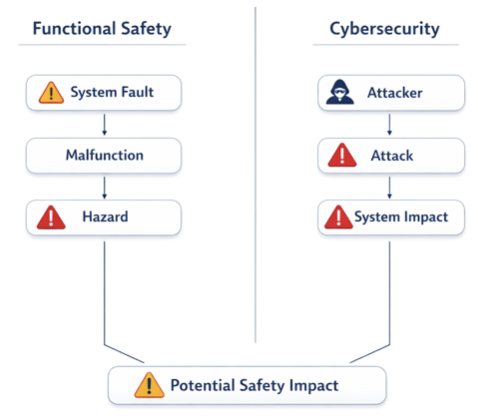
Unlike traditional failures, cybersecurity threats are intentional.
Attackers may try to:
Access vehicle systems
Manipulate signals
Disrupt functionality
Steal sensitive data
This makes cybersecurity fundamentally different from traditional engineering challenges.
To address these risks, the automotive industry developed ISO/SAE 21434.
What Is ISO 21434?
ISO 21434 is the international standard for cybersecurity in road vehicles.
It defines a structured framework for managing cybersecurity risks throughout the entire lifecycle of a vehicle system.
The goal is not to eliminate all threats—this would be impossible.
Instead, the goal is to:
Identify risks, reduce them, and manage them effectively.
ISO 21434 introduces processes, methods, and requirements that help organizations design secure systems from the very beginning.
Cybersecurity Lifecycle
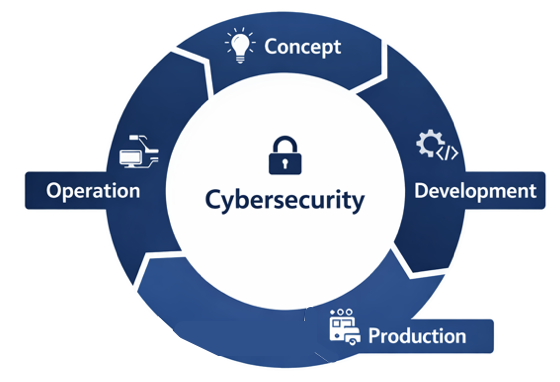
One of the key concepts in ISO 21434 is the cybersecurity lifecycle.
Similar to functional safety, cybersecurity is not treated as a one-time activity.
Instead, it is integrated across all phases of development:
Concept phase
System development
Production
Operation and maintenance
Cybersecurity must be considered from the earliest design decisions to the end of the product lifecycle.
This ensures that risks are addressed proactively, not reactively.
Figure: Cybersecurity lifecycle in ISO 21434 integrating security activities from concept to operation
TARA – Threat Analysis and Risk Assessment
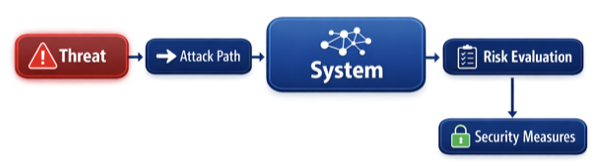
A central activity in ISO 21434 is TARA (Threat Analysis and Risk Assessment).
TARA is used to identify potential threats and evaluate their impact.
It answers key questions such as:
What could an attacker do?
Which assets are valuable?
How likely is an attack?
What would be the impact?
Based on this analysis, cybersecurity goals and requirements are defined.
TARA plays a role similar to HARA in functional safety—but focuses on intentional threats rather than accidental failures.
Figure: TARA process identifying threats assessing risks and defining cybersecurity measures in automotive systems
Security Measures
Once risks are identified, appropriate security measures must be implemented.
These measures can include:
Encryption and secure communication
Authentication mechanisms
Intrusion detection systems
Secure software updates
Security measures are designed to:
Prevent attacks
Detect attacks
Respond to attacks
Just like safety mechanisms, cybersecurity measures must be integrated into the system architecture.
If you want to understand ISO 21434 in detail and apply it in real projects: