How ISO 14971, IEC 62304 & ISO 13485 Work Together
Medical device development is one of the most highly regulated engineering domains. Unlike many other industries, safety, quality, and software development are governed by strict standards that must work together seamlessly.
Three of the most important standards are:
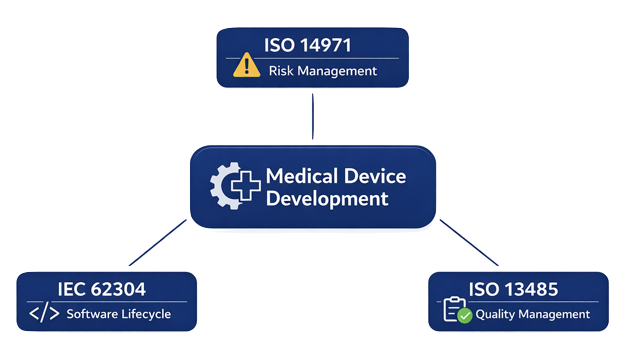
ISO 14971 – Risk Management
IEC 62304 – Software Lifecycle
ISO 13485 – Quality Management System (QMS)
Understanding how these standards interact is essential for engineers, quality managers, and regulatory professionals.
In this article, we break down each standard and explain how they work together in real-world medical device development.
Overview of the three key medical device standards and their roles in development
Why Multiple Standards?
At first glance, having multiple standards may seem unnecessary. Why not just one?
The reason lies in complexity and specialization.
Medical devices combine:
Hardware systems
Embedded software
Risk-critical functionality
Regulatory requirements
Each standard focuses on a specific aspect:
Risk → ISO 14971
Software → IEC 62304
Organization & processes → ISO 13485
Together, they form a complete framework for safe and compliant product development.
The Three Key Standards
To understand the big picture, it’s helpful to see these standards as complementary layers:
ISO 14971 ensures risks are identified and controlled
IEC 62304 ensures software is developed safely
ISO 13485 ensures the entire organization follows structured processes
They are not independent—they are deeply interconnected.
ISO 14971 – Risk Management
ISO 14971 defines how risks are managed throughout the lifecycle of a medical device.
Key concepts:
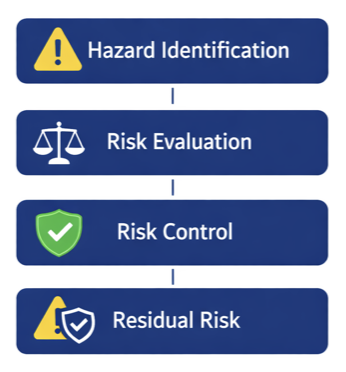
Hazard identification
Risk analysis and evaluation
Risk control measures
Residual risk assessment
Post-market surveillance
Risk management is not a one-time activity—it is continuous.
Every design decision, software function, and system interaction must be evaluated in terms of risk.
Example: A software malfunction could lead to incorrect patient data → this is identified as a hazard → risk is assessed → mitigation is implemented.
Risk management lifecycle including hazard identification, analysis, and control
IEC 62304 – Software Lifecycle
IEC 62304 focuses on software development processes for medical devices.
It defines:
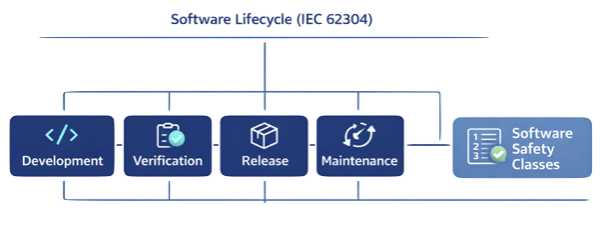
Software safety classification (Class A, B, C)
Development lifecycle processes
Verification and validation
Maintenance and updates
Problem resolution
Software is one of the biggest risk drivers in modern medical devices.
That’s why IEC 62304 is tightly linked to ISO 14971:
Software risks identified in ISO 14971 must be addressed through IEC 62304 processes.
Structured software development lifecycle for compliant medical device software
ISO 13485 – Quality Management System
ISO 13485 defines how organizations manage processes to ensure consistent quality and compliance.
It includes:
Process management
Documentation and traceability
Management responsibility
Supplier control
Audits and CAPA (Corrective Actions)
ISO 13485 ensures that:
Risk management (ISO 14971) and Software development (IEC 62304)
are not performed in isolation, but within a controlled and auditable system.
How They Work Together
The real value comes from integration.
Example workflow:
A hazard is identified → ISO 14971
A software-related risk is derived → ISO 14971
Software is developed to mitigate it → IEC 62304
The process is documented and controlled → ISO 13485
This creates a closed-loop system:
Risks drive development
Development mitigates risks
Processes ensure consistency and compliance
If you want to learn how to apply Medical Device standards step by step in real projects: