ASPICE Explained – Automotive Process Standard

Why ASPICE Matters in Automotive Development

Modern automotive systems are becoming increasingly complex. Vehicles rely on software, electronics, and distributed architectures to perform critical functions.

With this complexity comes a major challenge:

How can companies ensure that systems are developed in a structured, reliable, and repeatable way?

This is where Automotive SPICE comes into play.

ASPICE focuses on improving development processes. It ensures that engineering activities are well-defined, consistently executed, and continuously improved.

For OEMs and suppliers, ASPICE is not optional. It is often a mandatory requirement for collaboration.

What Is ASPICE?

Automotive SPICE (ASPICE) is a process assessment model used to evaluate and improve development processes in the automotive industry.

It is based on the international standard ISO/IEC 330xx and adapted specifically for automotive applications.

ASPICE does not define what a system must do.

Instead, it defines how systems should be developed.

This is an important distinction.

While safety standards focus on system behavior, ASPICE focuses on the quality of the development process itself.

The assumption is simple:

Better processes lead to better systems.

Process Areas Explained

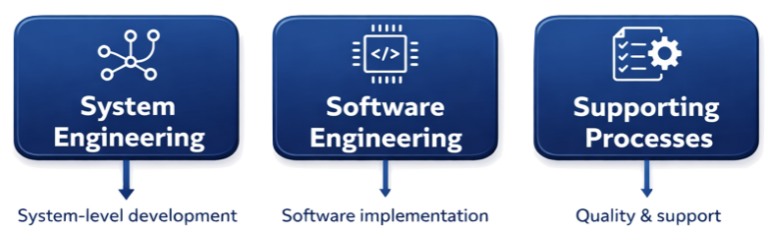
ASPICE defines a set of process areas that cover the entire development lifecycle.

These process areas are grouped into categories such as:

  • System engineering (SYS)
  • Software engineering (SWE)
  • Supporting processes (SUP)
  • Management processes (MAN)

Each process area describes:

  • Required activities
  • Expected work products
  • Process outcomes

For example:

  • SYS.2 → System Requirements Analysis
  • SWE.3 → Software Detailed Design
  • SWE.4 → Software Unit Verification

These process areas ensure that all relevant aspects of development are addressed in a structured way.

overview of ASPICE process areas including system engineering software engineering supporting and management processes
Figure: ASPICE process areas covering system engineering, software engineering, supporting, and management processes

Capability Levels (Level 0–5)

One of the central concepts in ASPICE is the capability level model.

Each process area is assessed based on its maturity.

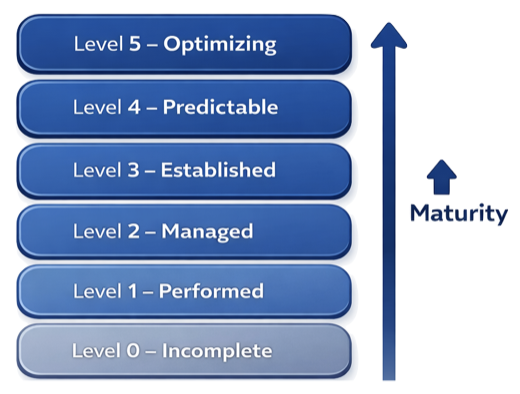
The levels range from Level 0 to Level 5:

  • Level 0 → Incomplete
  • Level 1 → Performed
  • Level 2 → Managed
  • Level 3 → Established
  • Level 4 → Predictable
  • Level 5 → Optimizing

At lower levels, processes may exist but are not consistently applied.

At higher levels, processes are well-defined, measured, and continuously improved.

Achieving higher levels requires significant effort and organizational maturity.

ASPICE capability levels from level 0 incomplete to level 5 optimizing process maturity model
Figure: ASPICE capability levels from incomplete processes to fully optimized and continuously improving processes

If you want to understand ASPICE and apply it in real projects:

How ASPICE Assessment Works

ASPICE assessments are performed to evaluate how well processes are implemented.

These assessments are typically conducted by trained assessors.

During an assessment:

  • Processes are reviewed
  • Work products are analyzed
  • Evidence is collected
  • Interviews are conducted

Each process area is rated based on defined criteria.

The result is a capability level that reflects the maturity of the process.

Assessments are often used in supplier selection and project evaluation.

ASPICE assessment process showing evaluation of processes work products and capability levels in automotive development
Figure: ASPICE assessment process evaluating process implementation, work products, and capability levels

ASPICE vs ISO 26262

ASPICE is often confused with ISO 26262.

However, these standards serve different purposes.

ISO 26262 focuses on functional safety.

It defines how to identify hazards, assess risks, and implement safety measures.

ASPICE focuses on process quality.

It ensures that development processes are structured and effective.

In practice, both standards are used together.

ISO 26262 defines safety requirements.

ASPICE ensures that these requirements are developed and implemented using robust processes.

Why Companies Require ASPICE

Many automotive companies require ASPICE compliance from their suppliers.

This is because process quality directly impacts product quality.

From an OEM perspective, ASPICE provides:

  • Transparency into supplier processes
  • Confidence in development quality
  • Reduced risk of project failures

For suppliers, achieving ASPICE levels is often necessary to win contracts.

It has become a key differentiator in the automotive market.

Common Misunderstandings

There are several common misconceptions about ASPICE.

One is the belief that ASPICE guarantees product quality.

In reality, ASPICE improves processes, but it does not directly guarantee system performance.

Another misunderstanding is treating ASPICE as a checklist.

ASPICE is not about ticking boxes. It is about implementing effective processes.

A third mistake is confusing ASPICE with safety standards.

ASPICE does not replace functional safety requirements.

Finally, some organizations focus only on achieving a certain level without truly improving their processes.

This can lead to superficial compliance rather than real quality improvements.

Summary

ASPICE is a key standard for process quality in automotive development.

Key takeaways:

  • ASPICE focuses on development processes, not system behavior
  • It defines structured process areas across the lifecycle
  • Capability levels measure process maturity
  • Assessments evaluate process implementation
  • ASPICE complements safety standards such as ISO 26262

Understanding ASPICE is essential for working in modern automotive engineering environments.

If you prefer a visual explanation, this video explains ASPICE step by step, including levels and assessments:

Leave a Comment

Your email address will not be published. Required fields are marked *

Cookie Consent with Real Cookie Banner