ARP4761A vs HARA – Aerospace vs Automotive Safety Analysis
Safety-critical industries all aim to achieve the same goal: preventing unacceptable risks and ensuring safe system behavior. However, the methods used to achieve this goal can differ significantly depending on the industry and regulatory environment.
In aerospace engineering, ARP4761A defines the safety assessment methods used to analyze aircraft systems and support certification activities. In the automotive industry, ISO 26262 introduces HARA as the foundation for functional safety analysis.
Although both approaches address hazards and risk reduction, they are based on different engineering assumptions, development processes, and safety philosophies.
In this article, you will learn how ARP4761A and HARA differ and why understanding these differences is important for safety-critical system development.
Why Compare Both?
Aerospace and automotive engineering increasingly face similar technical challenges. Modern vehicles and aircraft both rely on software-driven architectures, distributed electronics, sensors, communication networks, and automated functions.
As systems become more autonomous and interconnected, safety engineering methods across industries are becoming more relevant to one another.
Comparing ARP4761A and HARA helps engineers:
- understand different safety philosophies
- recognize industry-specific assumptions
- improve system-level thinking
- better evaluate risk assessment approaches
It also highlights how safety engineering evolves depending on operational environments, certification expectations, and acceptable risk levels.
What is ARP4761A?
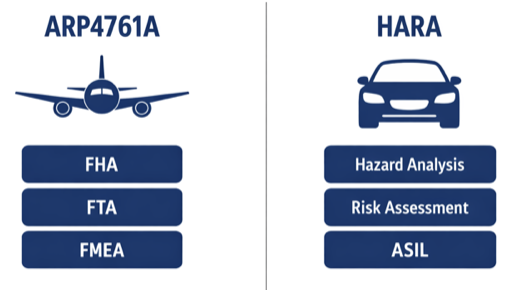
ARP4761A is the aerospace guideline for safety assessment processes in civil aircraft systems.
It defines structured analysis methods used to identify hazards, evaluate system failures, and support aircraft certification.
The guideline includes methods such as:
- Functional Hazard Assessment (FHA)
- Fault Tree Analysis (FTA)
- Failure Modes and Effects Analysis (FMEA)
These analyses help engineers understand how failures propagate through complex aircraft systems and how safety objectives can be achieved through architecture and redundancy.
Aerospace safety assessment focuses strongly on system interactions, failure combinations, and rigorous safety assurance.
What is HARA?
HARA stands for Hazard Analysis and Risk Assessment and is one of the central activities within ISO 26262.
The purpose of HARA is to identify hazardous events associated with malfunctioning automotive systems and evaluate the resulting risks.
The analysis is based on three key parameters:
- Severity
- Exposure
- Controllability
These factors are used to derive ASIL levels, which determine the required rigor of safety activities throughout development.
HARA is highly scenario-oriented and focuses strongly on how drivers and operational situations influence risk.
If you want to understand aerospace and automotive safety engineering in greater depth:
Key Differences
Although both approaches aim to improve safety, their methodologies differ significantly.
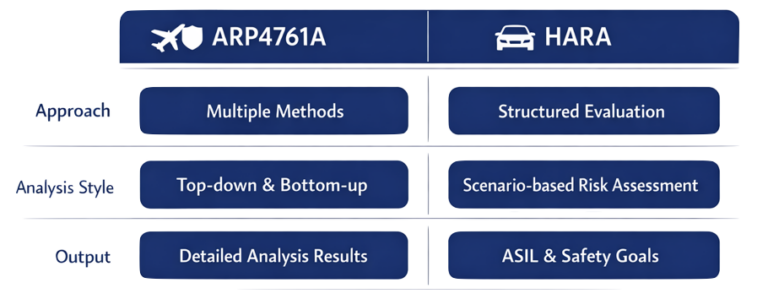
ARP4761A focuses heavily on system failure propagation and technical analysis. Aerospace systems are typically developed under extremely strict certification requirements with strong emphasis on redundancy and fault tolerance.
HARA, on the other hand, incorporates operational driving scenarios and human controllability into risk evaluation. Automotive systems operate in highly dynamic environments where user behavior plays a major role.
Another important difference is the level of process rigor. Aerospace safety assessment generally involves more detailed and formalized analysis activities due to the certification expectations in aviation.
The allocation of safety objectives also differs. Aerospace often derives development assurance activities from system-level hazards, while automotive development uses ASIL classifications to define safety requirements.
Different Mindsets
One of the most interesting differences between aerospace and automotive safety engineering is the underlying engineering mindset.
Aerospace engineering traditionally assumes that failures must be controlled through highly robust architectures, redundancy, and extensive verification activities. The goal is to minimize the probability of catastrophic failures to extremely low levels.
Automotive engineering, while also safety-focused, must balance safety with cost, scalability, production volume, and real-world driving variability.
This leads to different optimization strategies:
- aerospace prioritizes maximum assurance and certification rigor
- automotive prioritizes scalable risk reduction across large product volumes
These differences strongly influence how safety analyses are structured and applied.
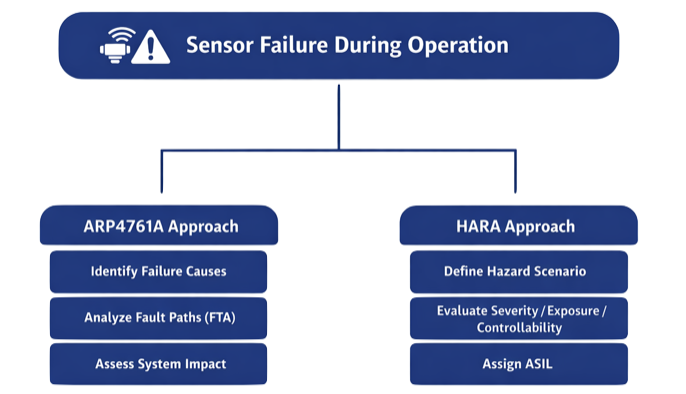
Example Comparison
Consider a loss of braking functionality.
In an aerospace context, engineers would analyze:
- system-level failure propagation
- redundant architectures
- failure combinations
- probability calculations
- aircraft-level hazard classifications
The focus would be on ensuring that no single failure can lead to catastrophic system behavior.
In an automotive HARA context, the analysis would focus more strongly on:
- driving scenarios
- vehicle speed
- traffic environment
- driver controllability
- exposure frequency
The resulting ASIL classification would then determine the required development rigor.
Both approaches address safety, but they analyze risk from different perspectives.
How They Fit Together
Despite their differences, ARP4761A and HARA share many underlying principles.
Both approaches:
- integrate safety into development early
- influence architecture decisions
- guide verification activities
- support systematic risk reduction
As vehicles become more automated and aircraft systems become increasingly software-driven, the boundaries between industries continue to narrow.
Cross-industry understanding is becoming more valuable, especially for engineers working with advanced autonomous or safety-critical technologies.
Common Mistakes
One common mistake is assuming that ARP4761A and HARA are directly interchangeable. While they share similarities, they were developed for different operational environments and certification frameworks.
Another misconception is that one approach is inherently “better” than the other. In reality, both methods are optimized for the specific needs of their industries.
It is also often assumed that safety analysis is mainly documentation work. However, the real value lies in understanding system behavior and improving engineering decisions.
Finally, some engineers focus too heavily on process compliance while overlooking the architectural and system-level insights generated by safety analysis activities.
Summary
ARP4761A and HARA represent two different approaches to safety-critical system analysis in aerospace and automotive engineering.
ARP4761A focuses on aerospace safety assessment through methods such as FHA, FTA, and FMEA, while HARA evaluates automotive hazards using severity, exposure, and controllability.
Both approaches aim to integrate safety into development from the beginning, but they reflect different engineering environments, certification expectations, and operational assumptions.
Understanding these differences provides valuable insight into how safety-critical systems are engineered across industries.