Modern aircraft are among the most complex engineering systems ever built. They combine software, hardware, avionics, communication systems, sensors, and highly integrated architectures that must operate reliably under strict safety requirements.
Developing these systems requires more than technical expertise alone. It requires structured development processes, clear traceability, and systematic safety integration.
ARP4754B provides the framework used in aerospace engineering to manage aircraft and system development in a controlled and certifiable way.
In this article, you will learn how ARP4754B works, why it is important, and how it interacts with other aerospace standards such as DO-178C and ARP4761A.
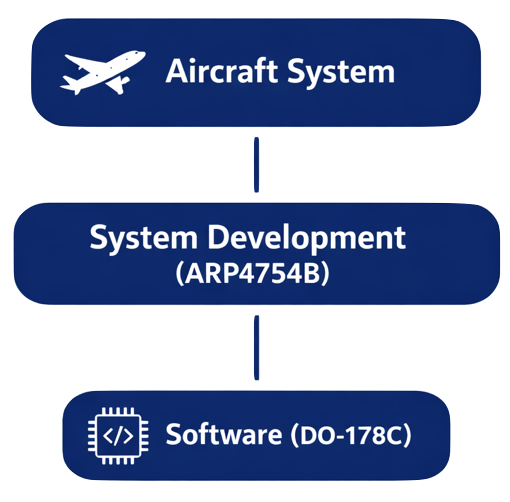
Overview of aircraft system development according to ARP4754B
Why ARP4754B Matters
Aircraft systems are highly interconnected. A single function may involve multiple hardware components, software modules, communication interfaces, and external systems.
Without a structured development approach, complexity quickly becomes unmanageable.
ARP4754B helps organizations:
structure system development activities
manage requirements consistently
ensure traceability
integrate safety considerations early
support certification activities
The guideline is especially important because aerospace certification authorities require evidence that systems were developed using systematic and controlled processes.
ARP4754B creates the foundation for this process assurance.
What is ARP4754B?
ARP4754B is a guideline for the development of civil aircraft and aircraft systems. It defines how system-level development activities should be performed throughout the lifecycle.
The focus is not limited to software or hardware individually. Instead, ARP4754B addresses the aircraft system as a whole.
The guideline covers:
requirements engineering
system architecture development
integration activities
validation and verification
allocation of functions to hardware and software
development assurance concepts
One of the key ideas behind ARP4754B is that safety and development must be tightly integrated from the beginning of a project.
System Development Lifecycle
At the center of ARP4754B is the system development lifecycle.
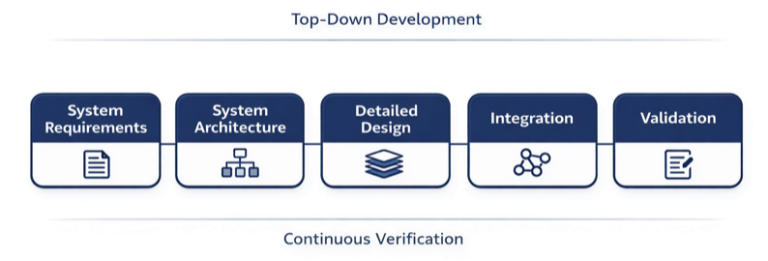
The lifecycle begins with aircraft-level functions and operational needs. These high-level objectives are transformed into system requirements that define what the system must achieve.
From there, system architectures are developed to implement the required functionality. These architectures must consider performance, reliability, safety, maintainability, and certification constraints simultaneously.
As development progresses, requirements are refined and allocated to lower-level components. Verification and validation activities ensure that the implemented system fulfills its intended purpose and satisfies all requirements.
The lifecycle is iterative rather than strictly sequential. Requirements, architecture, and safety assessments continuously influence one another throughout development.
Aircraft system development lifecycle from requirements to validation according to ARP4754B
If you want to understand how ARP4754B is applied in real aerospace projects and how it integrates with DO-178C and ARP4761A:
One of the most important aspects of ARP4754B is the allocation of system functions to hardware and software components.
At the aircraft system level, functions are initially defined independently of implementation technologies. Later, these functions are distributed across hardware and software architectures.
This allocation process is critical because it determines:
system complexity
failure behavior
redundancy concepts
verification effort
certification strategy
Software-related functions are typically developed according to DO-178C, while hardware development may follow standards such as DO-254.
ARP4754B acts as the coordinating framework that ensures all development domains remain aligned.
Relationship to DO-178C
ARP4754B and DO-178C are closely connected but serve different purposes.
ARP4754B focuses on aircraft and system-level development. It defines how requirements are derived, how architectures are developed, and how functions are allocated across the system.
DO-178C focuses specifically on airborne software development and certification.
In practice, ARP4754B provides the system-level context for DO-178C activities.
For example:
system requirements derived in ARP4754B become software requirements for DO-178C
safety objectives defined at system level influence software assurance activities
verification activities must remain aligned across both standards
Understanding this relationship is essential for effective aerospace development.
Safety Integration (ARP4761A)
Safety assessment is deeply integrated into ARP4754B development activities.
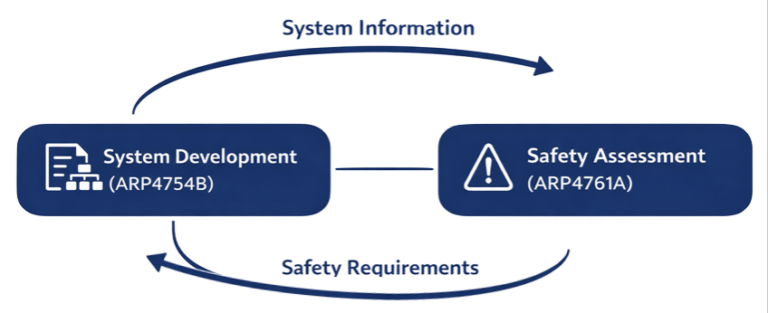
ARP4761A provides the safety assessment methods used to identify hazards, evaluate risks, and define safety objectives.
These safety analyses directly influence:
system architecture decisions
redundancy concepts
development assurance levels
allocation strategies
Safety is therefore not treated as a separate activity performed after development. Instead, it continuously shapes system design decisions throughout the lifecycle.
This integration between development and safety engineering is one of the defining characteristics of aerospace engineering processes.
Relationship between aircraft system development, software certification, and safety assessment
Challenges in Practice
Applying ARP4754B in real projects can be highly challenging.
One major difficulty is managing the large number of interconnected requirements across different engineering domains. Maintaining consistency between system, hardware, and software requirements requires significant coordination.
Another challenge is balancing development efficiency with certification rigor. Aerospace projects often involve extensive documentation, reviews, and verification activities that can increase project complexity.
Organizations also struggle with integrating safety assessment activities into fast-moving development environments. Changes in system architecture frequently require updates to requirements, safety analyses, and verification artifacts.
Large-scale traceability management is another common challenge, especially in complex aircraft programs involving multiple suppliers and engineering teams.
Common Misunderstandings
There are several misconceptions about ARP4754B.
One common misunderstanding is that the guideline only applies to large aircraft manufacturers. In reality, its principles are relevant for many aerospace development projects involving safety-critical systems.
Another misconception is that ARP4754B is primarily about documentation. While documentation is important, the guideline is fundamentally about structured system engineering and development assurance.
It is also often assumed that safety assessment is separate from development. In practice, safety activities are tightly integrated into the entire lifecycle.
Finally, some engineers view ARP4754B and DO-178C as independent standards. In reality, they are closely interconnected and must work together consistently.
Summary
ARP4754B defines how aircraft systems are developed in a structured, traceable, and certifiable way.
The guideline provides the system-level framework that coordinates requirements engineering, architecture development, safety integration, and verification activities across aerospace projects.
It also establishes the connection between system development, software certification (DO-178C), and safety assessment (ARP4761A).
Understanding ARP4754B is essential for anyone involved in aerospace system engineering, certification, or safety-critical aircraft development.
If you prefer a visual explanation, this video explains DO-178C step by step: