Safety Mechanisms Explained – ISO 26262 in Practice
Why Safety Mechanisms Matter in Automotive Systems
Modern vehicles depend on complex electrical and electronic systems to perform safety-critical functions such as braking, steering, and acceleration.
But no system is perfect.
Hardware components can fail. Software can contain defects. Sensors can provide incorrect data. In safety-critical environments, these failures must not lead to hazardous situations.
This is where safety mechanisms play a crucial role.
In ISO 26262, safety mechanisms are used to detect faults, control their effects, and ensure that the system remains in a safe state.
Without safety mechanisms, even well-designed systems could become dangerous in case of failures.
What Are Safety Mechanisms?
Safety mechanisms are technical measures implemented in a system to ensure that faults are either detected or mitigated.
They are a fundamental part of functional safety engineering.
A safety mechanism can serve different purposes:
Detect a fault
Prevent a fault from causing harm
Control the system after a fault occurs
Importantly, safety mechanisms are not limited to one specific technology. They can be implemented in hardware, software, or at the system level.
For example, a watchdog timer in software can detect timing failures, while redundancy in hardware can provide fault tolerance.
The key idea is simple:
If something goes wrong, the system must either detect it or remain safe.
Types of Safety Mechanisms
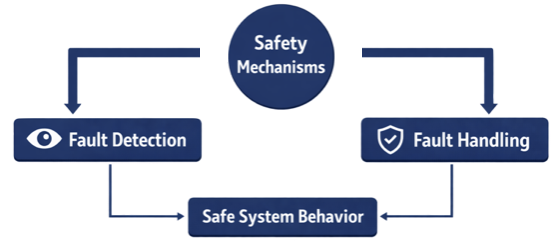
Safety mechanisms can be broadly divided into two main categories.
The first category focuses on fault detection.
These mechanisms monitor the system to identify abnormal behavior.
The second category focuses on fault handling.
These mechanisms ensure that once a fault is detected, the system transitions into a safe state.
This distinction is important because detecting a fault alone is not sufficient. The system must also respond appropriately.
In practice, both types are often combined to achieve the required level of safety.
Figure: Overview of safety mechanisms divided into fault detection and fault handling in ISO 26262
Fault Detection Mechanisms
Fault detection mechanisms are responsible for identifying errors or abnormal system behavior.
They continuously monitor system inputs, outputs, and internal states.
Typical examples include:
Range checks for sensor values
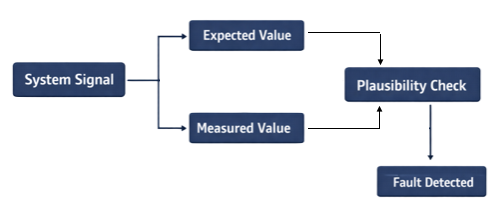
Plausibility checks between signals
Watchdog timers to monitor software execution
Redundant calculations to detect inconsistencies
For example, if a sensor provides a value outside its expected range, the system can detect that something is wrong.
Similarly, if two independent calculations produce different results, this indicates a potential fault.
Detection mechanisms are essential because they provide the first indication that something has gone wrong.
Figure: Examples of fault detection mechanisms including monitoring, plausibility checks, and watchdog functions
Fault Handling Mechanisms
Once a fault has been detected, the system must respond in a safe way.
This is the role of fault handling mechanisms.
These mechanisms define how the system behaves after a fault occurs.
Typical strategies include:
Switching to a safe state
Limiting system functionality
Activating backup systems
Shutting down specific components
For example, if a critical sensor fails, the system may disable certain functions or switch to a degraded mode.
The goal is not necessarily to maintain full functionality, but to ensure safety.
This distinction is important.
Safety mechanisms are not about keeping the system fully operational at all costs. They are about preventing hazardous situations.
Example: Sensor Monitoring
To better understand safety mechanisms, consider a simple example.
A vehicle relies on a sensor to measure speed or distance.
If the sensor provides incorrect data, the system may behave incorrectly.
A safety mechanism can be implemented to monitor the sensor.
For example:
Check whether the sensor value is within a valid range
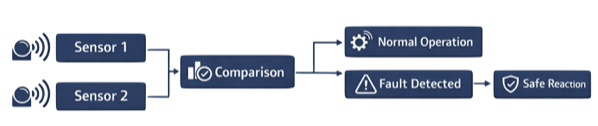
Compare it with values from another sensor
Monitor whether the signal changes in a plausible way
If an inconsistency is detected, the system can react.
It may ignore the faulty signal, switch to a backup sensor, or enter a safe state.
This example shows how detection and handling mechanisms work together.
Figure: Sensor monitoring example where invalid signals are detected and handled to maintain system safety
If you want to understand how safety mechanisms are implemented in real projects, including HARA, ASIL, and system design, explore the full training: