Functional Safety Lifecycle Explained – ISO 26262 Overview

Why the Functional Safety Lifecycle Matters

Modern automotive systems are becoming increasingly complex. Vehicles rely on a combination of hardware and software to perform safety-critical functions such as braking, steering, and driver assistance.

Ensuring safety in such systems cannot be achieved through isolated activities. Instead, safety must be systematically addressed throughout the entire development process.

This is exactly why the functional safety lifecycle is a central concept in ISO 26262.

The lifecycle ensures that safety is not treated as an afterthought, but as an integral part of engineering — from early concept decisions to production and operation.

What Is the Functional Safety Lifecycle?

The functional safety lifecycle defines a structured sequence of activities that guide the development of safety-critical automotive systems.

Rather than focusing on individual steps, the lifecycle connects all safety-related activities into a coherent process.

It ensures that:

  • Hazards are identified early
  • Risks are systematically assessed
  • Safety requirements are defined and implemented
  • Systems are verified and validated

This structured approach helps engineers manage complexity and maintain consistency across the entire development process.

Overview of the Lifecycle Phases

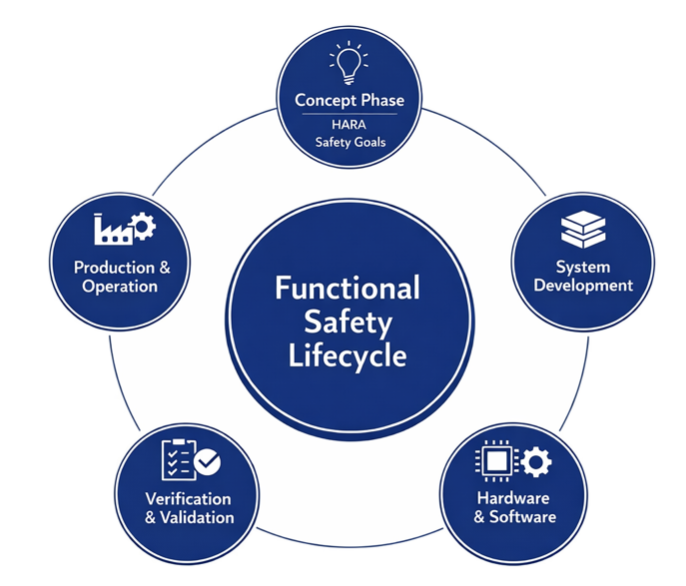
The ISO 26262 safety lifecycle consists of multiple phases, each addressing specific aspects of development.

The most important phases include:

  • Concept phase
  • System-level development
  • Hardware and software development
  • Verification and validation
  • Production and operation

Each phase builds on the previous one, creating a continuous flow of safety activities.

ISO 26262 functional safety lifecycle overview from concept phase to production and operation
Figure: Functional safety lifecycle in ISO 26262 from concept to production and operation

Concept Phase

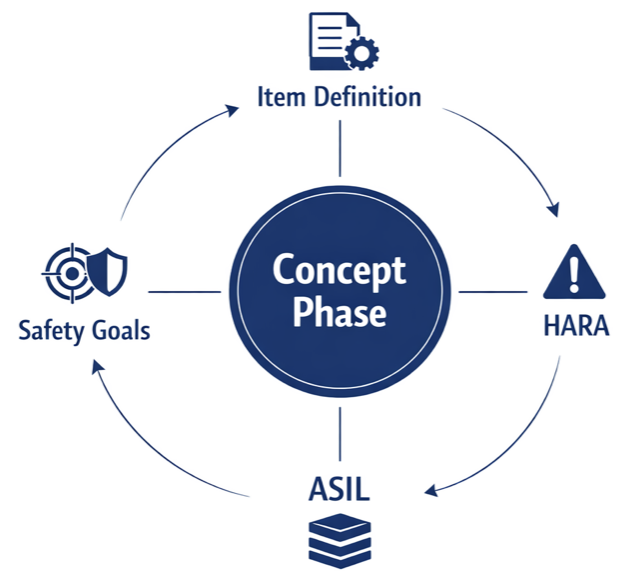
The concept phase is where functional safety begins.

During this phase, engineers perform key activities such as:

  • Item definition
  • Hazard Analysis and Risk Assessment (HARA)
  • ASIL determination
  • Definition of safety goals

This phase establishes the foundation for all subsequent safety activities.

If hazards are not correctly identified at this stage, the entire safety concept may be flawed.

concept phase in ISO 26262 including HARA ASIL determination and safety goals
Figure: Concept phase activities including hazard analysis and safety goal definition

If you want to understand how safety goals are applied in real automotive projects, including HARA, ASIL, and system development, explore the full training:

System-Level Development

In the system-level phase, safety goals are translated into system architecture and functional safety requirements.

Engineers define how safety functions are distributed across system elements.

This includes decisions such as:

  • System decomposition
  • Allocation of safety mechanisms
  • Definition of interfaces

This phase connects high-level safety objectives with actual system design.

Hardware and Software Development

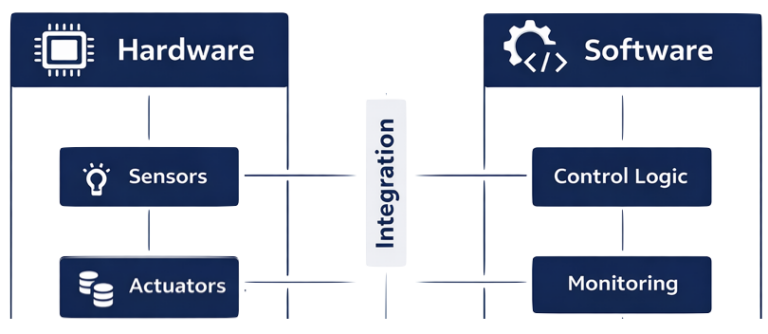
After system-level design, safety requirements are implemented in hardware and software.

At the hardware level, engineers focus on random failures, such as component faults.

At the software level, the focus is on preventing systematic faults through robust development processes and testing.

Both domains must work together to ensure that safety requirements are correctly implemented.

system hardware and software safety development structure in ISO 26262

Verification and Validation

Verification and validation activities ensure that the system meets its safety requirements.

Verification answers the question:

“Did we build the system correctly?”

Validation answers:

“Did we build the correct system?”

These activities include testing, analysis, and reviews performed throughout the lifecycle.

They are essential for providing evidence that safety objectives have been achieved.

Production and Operation

Functional safety does not end with development.

Production processes must ensure that systems are built according to specifications.

During operation, systems must continue to behave safely under real-world conditions.

This includes considerations such as:

  • Maintenance
  • Field monitoring
  • Updates and modifications

This phase ensures that safety is maintained throughout the system’s lifetime.


How Everything Connects

One of the most important aspects of the functional safety lifecycle is its interconnected nature.

Each phase is linked through traceability.

For example:

  • Safety goals are derived from HARA
  • Requirements are derived from safety goals
  • Verification ensures that requirements are fulfilled

This creates a continuous chain of safety-related information.

Without this connection, inconsistencies and gaps may arise.


Common Mistakes in the Lifecycle

There are several common mistakes when applying the functional safety lifecycle.

  • Treating safety as a late-stage activity
  • Weak traceability between lifecycle phases
  • Incomplete hazard analysis
  • Insufficient verification

Another common issue is viewing phases as isolated steps rather than a connected process.

The lifecycle must be understood as an integrated system.


Summary

The functional safety lifecycle is a structured framework that ensures safety is addressed throughout the entire development process.

Key points:

  • Safety is integrated from concept to operation
  • HARA, ASIL, and safety goals form the foundation
  • Requirements guide implementation
  • Verification ensures correctness
  • Traceability connects all phases

Understanding the lifecycle is essential for working effectively with ISO 26262.


If you prefer a visual explanation, this video provides a clear overview of the ISO 26262 safety lifecycle from concept to production:

Leave a Comment

Your email address will not be published. Required fields are marked *

Cookie Consent with Real Cookie Banner