Safety Goals Explained – Functional Safety in ISO 26262
Why Safety Goals Matter in Functional Safety
Modern vehicles rely on complex electronic and software-based systems to control critical functions such as braking, steering, and acceleration.
When these systems fail, the consequences can be severe.
This is why functional safety is a central aspect of automotive engineering. But identifying hazards alone is not enough. Engineers also need to define what the system must achieve to remain safe.
This is where safety goals come into play.
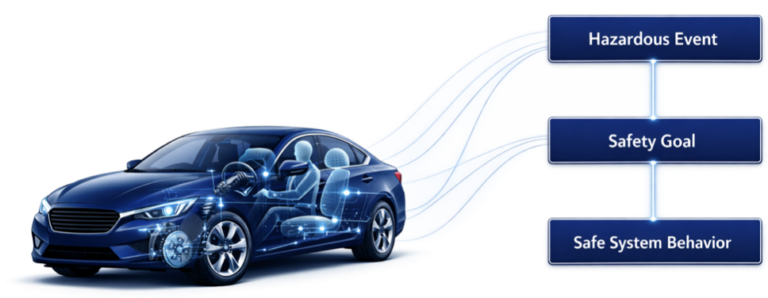
Safety goals translate risk analysis into clear engineering objectives. They define how hazardous situations must be prevented or controlled, forming the foundation for all further safety activities.
Figure: Safety Goals in ISO 26262
What Are Safety Goals?
In ISO 26262, safety goals are high-level safety requirements derived from hazard analysis.
They describe what must be achieved to prevent or mitigate hazardous events, without specifying how this should be implemented.
For example:
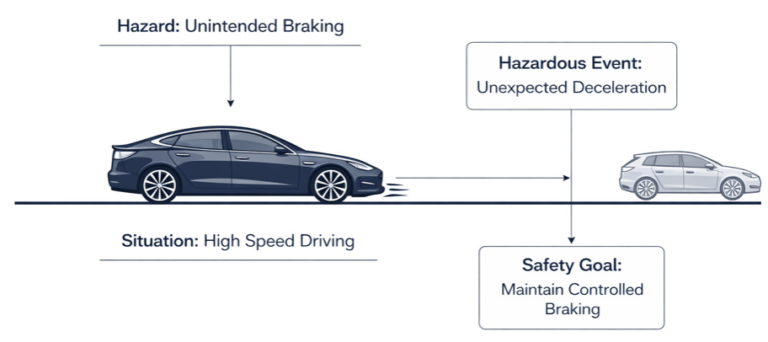
Prevent unintended braking
Ensure braking is available when required
Safety goals are intentionally abstract. This allows engineers to explore different technical solutions while maintaining a clear safety objective.
From HARA to Safety Goals
Safety goals are directly derived from the Hazard Analysis and Risk Assessment (HARA).
During HARA, engineers identify hazardous events and evaluate their risk based on:
Severity
Exposure
Controllability
The result of this evaluation is an ASIL classification, which defines how critical the hazard is.
Based on this analysis, safety goals are defined to address the identified risks.
This creates a clear traceability chain:
Hazard → Hazardous Event → ASIL → Safety Goal
This traceability is essential for ensuring consistency and completeness throughout the development process.
Figure: Derivation of safety goals from hazard analysis and risk assessment (HARA) in ISO 26262
What Makes a Good Safety Goal?
A well-defined safety goal has several important characteristics.
First, it must clearly address the hazard.
Second, it must be understandable and unambiguous.
Third, it should be solution-independent, meaning it does not prescribe a specific technical implementation.
Finally, it must be verifiable.
A good safety goal provides clear direction without restricting design choices too early.
Poorly defined safety goals, on the other hand, can lead to confusion, incorrect implementations, or gaps in safety coverage.
Safety Goals and ASIL
Each safety goal is assigned an Automotive Safety Integrity Level (ASIL).
ASIL reflects the level of risk associated with the corresponding hazardous event.
Higher ASIL levels require:
More rigorous development processes
Stronger safety mechanisms
More extensive verification activities
This means that safety goals are not only qualitative statements — they also define the required level of engineering rigor.
From Safety Goals to Requirements
Safety goals are only the starting point.
To implement them, engineers derive:
Functional safety requirements
Technical safety requirements
Functional safety requirements describe what functions are needed to achieve the safety goal.
Technical safety requirements define how these functions are implemented in the system.
This step transforms abstract safety goals into concrete engineering tasks.
If you want to understand how safety goals are applied in real automotive projects, including HARA, ASIL, and system development, explore the full training: