Automotive Standards Explained – ISO 26262, ASPICE & Cybersecurity

Why Are There So Many Automotive Standards?

Modern vehicles are no longer purely mechanical systems. They are complex, software-driven platforms that combine electronics, connectivity, and intelligent behavior.

With this increasing complexity comes a critical challenge:

How can safety, security, and quality be ensured across such systems?

This is why multiple automotive standards exist.

Each standard focuses on a specific aspect of system development. Instead of covering everything in one framework, the industry uses specialized standards to address different types of risks and requirements.

Some standards focus on safety. Others on development processes. Others on cybersecurity or system behavior.

Understanding how these standards differ—and how they work together—is essential for anyone working in automotive engineering.

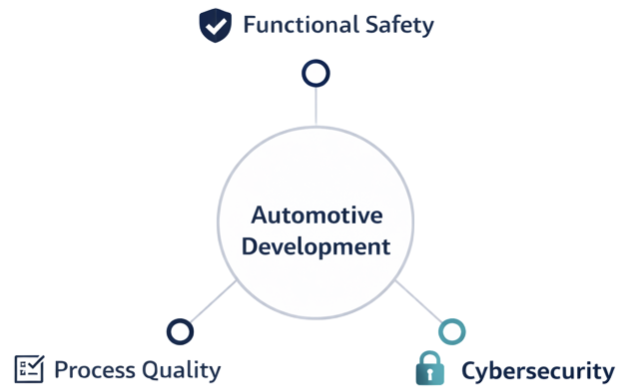
overview of automotive standards including ISO 26262 ASPICE ISO 21434 and SOTIF in modern vehicle development
Figure: Overview of key automotive standards covering functional safety, cybersecurity, process quality, and intended functionality

The Big Picture

To understand automotive standards, it helps to look at the overall landscape.

At a high level, four key domains must be covered:

  • Functional safety
  • Development processes
  • Cybersecurity
  • Intended system behavior

Each of these domains is addressed by a specific standard.

  • ISO 26262 → Functional safety
  • Automotive SPICE → Process quality
  • ISO/SAE 21434 → Cybersecurity
  • ISO 21448 → SOTIF

These standards do not compete with each other.

They complement each other.

ISO 26262 – Functional Safety

ISO 26262 focuses on functional safety.

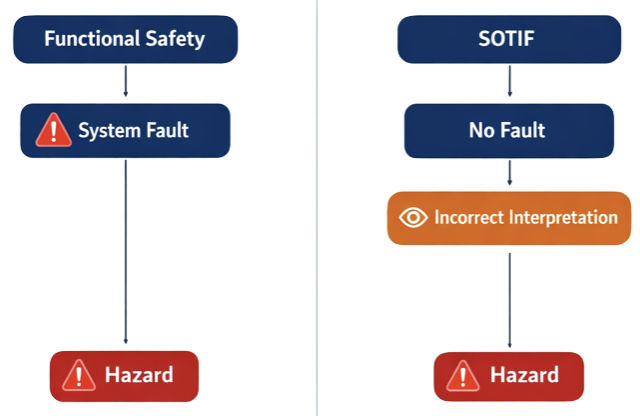
It addresses hazards caused by malfunctioning behavior of electrical and electronic systems.

For example:

  • A braking system that does not activate
  • A steering system that behaves unexpectedly
  • A sensor providing incorrect data

The standard defines a structured approach to identify hazards, assess risks, and implement safety measures.

Key concepts include:

  • Hazard Analysis and Risk Assessment (HARA)
  • Automotive Safety Integrity Levels (ASIL)
  • Safety goals and safety requirements
  • Verification and validation

ISO 26262 ensures that systems behave safely—even in the presence of faults.

ASPICE – Process Quality

Automotive SPICE focuses on process quality.

While ISO 26262 focuses on what needs to be safe, ASPICE focuses on how systems are developed.

It defines a framework for assessing and improving development processes.

This includes areas such as:

  • Requirements engineering
  • System and software development
  • Testing and validation
  • Project management

ASPICE does not directly define safety requirements.

Instead, it ensures that development processes are robust, repeatable, and well-controlled.

Strong processes reduce the likelihood of systematic errors.

If you want to understand these standards in detail and apply them in real projects:

SOTIF – Safety of the Intended Functionality

ISO 21448 (SOTIF) addresses a different type of risk.

It focuses on hazards that occur without system faults.

This is especially relevant for advanced driver assistance systems (ADAS) and autonomous driving.

For example:

  • A camera system misinterprets an object
  • An AI model makes an incorrect decision
  • A sensor has inherent limitations

In these cases, the system works as designed—but the design itself is insufficient.

SOTIF addresses these limitations and ensures that systems behave safely under real-world conditions.

comparison between ISO 26262 functional safety and SOTIF ISO 21448 showing fault-based and performance-based risks
Figure: Comparison between ISO 26262 (fault-based safety) and SOTIF (performance limitations without faults)

How These Standards Work Together

These standards are not isolated.

They form a comprehensive framework for modern automotive development.

A typical system may involve:

  • ISO 26262 for functional safety
  • ASPICE for development processes
  • ISO 21434 for cybersecurity
  • ISO 21448 for intended functionality

Each standard addresses a different risk dimension.

Together, they ensure:

  • Safe system behavior
  • Secure system operation
  • High-quality development processes
  • Robust system performance

Understanding their interaction is key to building complex automotive systems.

Common Misunderstandings

There are several common misconceptions about automotive standards.

One is the belief that a single standard is sufficient.

In reality, no single standard covers all aspects of modern systems.

Another misunderstanding is confusing safety with cybersecurity.

These are fundamentally different domains with different objectives.

A third mistake is viewing ASPICE as a safety standard.

ASPICE improves processes but does not replace safety requirements.

Finally, some assume that these standards are independent.

In practice, they are highly interconnected.

Summary

Automotive standards are essential for managing the complexity of modern vehicle systems.

Key takeaways:

  • Multiple standards exist because different risks must be addressed
  • ISO 26262 focuses on functional safety
  • ASPICE ensures process quality
  • ISO 21434 addresses cybersecurity
  • SOTIF covers limitations of intended functionality
  • Together, these standards create a comprehensive framework

Understanding these standards is the foundation for working in modern automotive engineering.

If you prefer a visual overview, this video explains the most important automotive standards and how they fit together:

Leave a Comment

Your email address will not be published. Required fields are marked *

Cookie Consent with Real Cookie Banner