Redundancy Explained – Why Systems Need Backup in ISO 26262
Why Redundancy Matters in Safety-Critical Systems
Modern automotive systems must operate safely even in the presence of faults. This requirement becomes increasingly important as vehicles rely more on electronics and software to control critical functions such as braking, steering, and acceleration.
However, no system is completely free of failures.
Components can break, sensors can deliver incorrect values, and software can behave unexpectedly. In safety-critical environments, such failures must not lead to hazardous situations.
This is where redundancy becomes essential.
Redundancy ensures that even if one part of a system fails, another part can take over or support the function. It is one of the most important design principles in functional safety and a key concept in ISO 26262.
What Is Redundancy?
Redundancy means that a system includes additional elements beyond what is strictly necessary for normal operation.
These additional elements serve as backups or parallel components that increase system reliability and safety.
In simple terms:
Instead of relying on a single component, the system uses multiple components to perform the same or similar function.
If one component fails, the others can compensate.
Redundancy can be applied at different levels:
Sensors
Control units
Communication paths
Software functions
The goal is always the same:
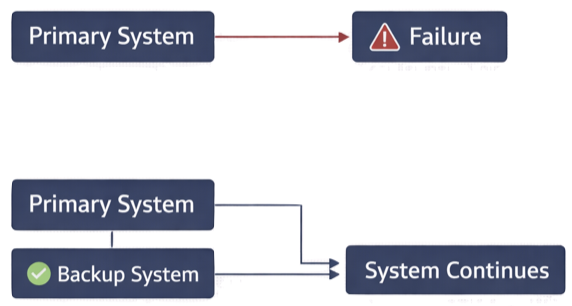
Avoid single points of failure.
Figure: Comparison between a single system and a redundant system to avoid single points of failure
Types of Redundancy
Redundancy can be implemented in different ways, depending on the system requirements.
One common approach is hardware redundancy, where multiple physical components perform the same function.
Another approach is software redundancy, where the same function is implemented using different algorithms or logic paths.
There is also information redundancy, where additional data is used to detect or correct errors.
Each type of redundancy has its advantages and trade-offs.
Hardware redundancy often provides strong fault tolerance but increases cost and complexity.
Software redundancy can be more flexible but may be less effective against certain types of faults.
In practice, systems often combine multiple types of redundancy to achieve the desired level of safety.
Active vs Passive Redundancy
Redundancy can also be classified based on how the redundant elements are used.
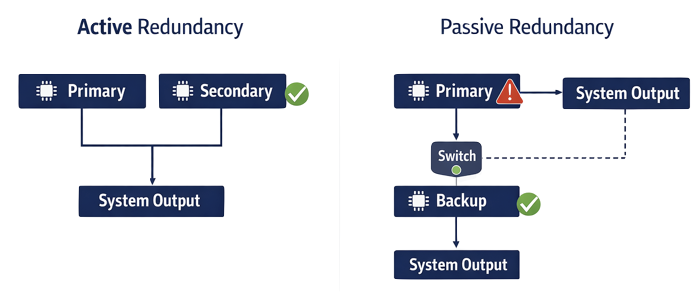
In active redundancy, multiple components operate simultaneously.
They continuously produce outputs that can be compared or combined.
If one component fails, the system can immediately detect the discrepancy and react.
In passive redundancy, backup components remain inactive until they are needed.
They are only activated when the primary component fails.
Active redundancy typically allows faster fault detection and response.
Passive redundancy may reduce resource usage but can introduce delays when switching to the backup system.
The choice between active and passive redundancy depends on the safety requirements and system constraints.
Figure: Active redundancy with parallel systems and passive redundancy with standby backup components
Example: Dual Sensor System
Consider a vehicle that relies on a sensor to measure speed or distance.
If the system depends on a single sensor, a failure could lead to incorrect system behavior.
To improve safety, engineers can introduce redundancy by using two sensors.
Both sensors measure the same physical quantity.
The system compares their outputs.
If the values differ significantly, this indicates a fault.
The system can then:
Ignore the faulty sensor
Switch to the valid sensor
Trigger a safe system response
This dual-sensor approach is a simple but powerful example of redundancy.
It reduces the risk of incorrect behavior caused by a single faulty component.
Figure: Dual sensor redundancy example where two independent sensors are compared to detect faults
If you want to understand how redundancy is applied in real projects, including ASIL, safety mechanisms, and system architecture, explore the full training: