HARA Explained – Hazard Analysis and Risk Assessment (ISO 26262)
Why HARA Matters in Functional Safety
Modern vehicles rely heavily on complex electrical and electronic systems. These systems directly influence vehicle behavior — including braking, steering, and acceleration.
But what happens if one of these systems fails?
A malfunction may lead to a hazardous situation, especially when safety-critical functions are involved. In such cases, engineers must ensure that risks are systematically identified, analyzed, and reduced.
This is exactly where HARA comes into play.
Hazard Analysis and Risk Assessment (HARA) is one of the most important activities in ISO 26262. It forms the foundation for all safety-related decisions in automotive development.
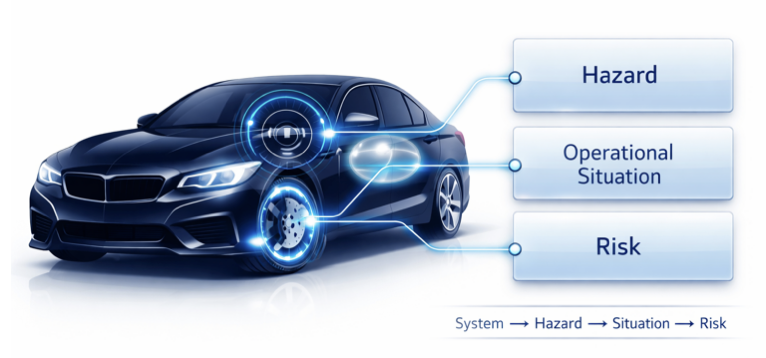
Figure: HARA in ISO 26262 - From Item Definition to ASIL Classification
What Is HARA?
HARA stands for Hazard Analysis and Risk Assessment.
It is a structured process used to:
Identify hazards
Define hazardous events
Assess risks
Derive safety goals
The purpose of HARA is to understand what can go wrong in a system and how critical the consequences could be.
Instead of reacting to failures after they occur, engineers use HARA to anticipate potential problems early in the development process.
This proactive approach is essential for building safe and reliable automotive systems.
Figure: Hazard Analysis and Risk Assessment (HARA) process in ISO 26262 from hazard identification to safety goals
HARA in the ISO 26262 Process
HARA is performed during the concept phase of ISO 26262.
At this early stage, engineers define the system under consideration — referred to as the item — and analyze potential hazards associated with it.
The results of HARA directly influence:
Safety goals
Functional safety requirements
System architecture decisions
This makes HARA a central element in the ISO 26262 safety lifecycle.
Without a proper HARA, all downstream safety activities may be based on incomplete or incorrect assumptions.
From Item to Hazardous Event
The HARA process starts with defining the item.
An item is the system or function being analyzed, such as a braking system or steering system.
Once the item is defined, engineers identify possible hazards that may occur if the system malfunctions.
However, a hazard alone is not enough.
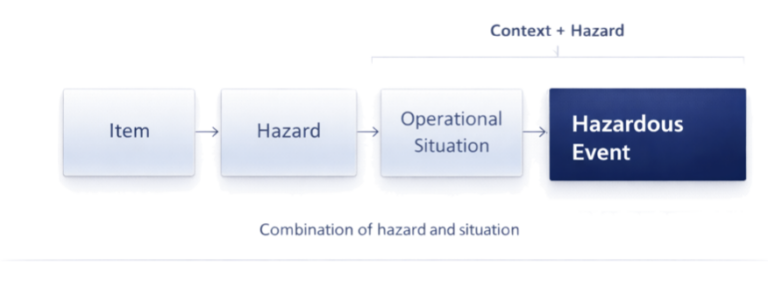
To properly assess risk, engineers define hazardous events.
A hazardous event combines:
A hazard
An operational situation
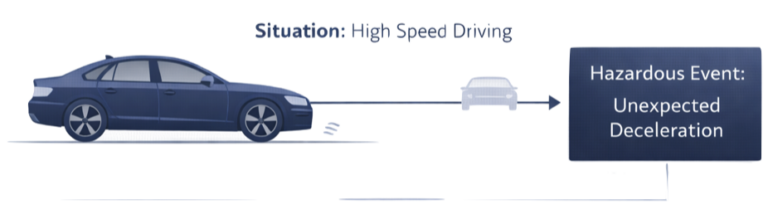
For example:
Hazard: unintended braking
Situation: driving on a highway
Together, this forms a hazardous event that can be evaluated.
Hazard vs. Hazardous Event
Understanding the difference between a hazard and a hazardous event is critical.
A hazard is a potential source of harm.
A hazardous event describes the situation in which that hazard leads to a dangerous scenario.
This distinction is important because risk cannot be assessed without context.
The same hazard may have very different consequences depending on the situation.
Figure: Difference between a hazard and a hazardous event in functional safety context
Operational Situations and Operating Modes
To define hazardous events, engineers must consider operational situations and operating modes.
Operational situations describe external conditions, such as:
Highway driving
Urban traffic
Parking
Operating modes describe the state of the system, for example:
Normal operation
Degraded mode
Fault condition
By combining hazards with these contexts, engineers can systematically identify relevant hazardous events.
Risk Assessment in HARA
Once hazardous events are defined, the next step is risk assessment.
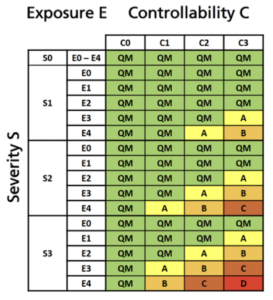
In ISO 26262, risk is evaluated using three parameters:
Severity (S)
Exposure (E)
Controllability (C)
These parameters describe:
How serious the potential harm is
How often the situation occurs
Whether the driver can avoid the hazard
This structured evaluation ensures that risk assessment is consistent and objective.
Figure: ASIL determination based on severity, exposure, and controllability parameters
From Risk Assessment to ASIL
The result of the risk assessment is the Automotive Safety Integrity Level (ASIL).
ASIL defines how much risk reduction is required.
Higher risk leads to higher ASIL levels, which require more rigorous development processes.
This creates a direct link between HARA and engineering effort.
HARA does not just identify problems — it defines how strictly they must be addressed.
From HARA to Safety Goals
Based on the risk assessment, engineers define safety goals.
Safety goals describe what the system must achieve to prevent or mitigate hazardous situations.
For example:
Prevent unintended braking
Ensure braking is available when required
These goals form the foundation for all safety requirements in later development phases.
If you want to learn how to perform HARA in real projects, including practical examples and engineering workflows, explore the full training: