ASIL Decomposition Explained – ISO 26262 Advanced Concept
Why ASIL Decomposition Matters in Functional Safety
In modern automotive systems, ensuring functional safety often requires meeting very high safety integrity levels. For critical functions such as braking or steering, this typically means achieving ASIL D, the highest Automotive Safety Integrity Level defined in ISO 26262.
However, implementing a full ASIL D solution in a single system can be extremely complex, expensive, and difficult to validate.
This raises an important engineering question:
Is it always necessary to build one extremely robust system — or is there a smarter way to achieve the same level of safety?
This is exactly where ASIL decomposition comes into play.
ASIL decomposition allows engineers to distribute safety requirements across multiple elements, enabling more efficient architectures while still meeting the required level of safety. Instead of relying on a single high-integrity system, safety can be achieved through redundancy and independence.
What Is ASIL Decomposition?
ASIL decomposition is a concept in ISO 26262 that allows a safety requirement with a high ASIL (for example ASIL D) to be split into multiple requirements with lower ASIL levels.
At first glance, this may seem counterintuitive. How can two lower integrity elements provide the same level of safety as one high-integrity element?
The key lies in independence.
If two systems operate independently and both contribute to safety, the overall system can achieve a high level of reliability even if each individual component has a lower ASIL rating.
In simple terms:
Instead of building one extremely reliable system, engineers build multiple sufficiently reliable systems that back each other up.
The Core Idea Behind ASIL Decomposition
The fundamental principle of ASIL decomposition is redundancy combined with independence.
A safety function is implemented using multiple channels or elements. Each channel is capable of detecting or mitigating failures, and together they provide the required safety performance.
This is often referred to as a multi-channel architecture.
For decomposition to be valid, these channels must not fail in the same way or due to the same cause. Otherwise, the benefit of redundancy is lost.
This is why independence is not just a design choice — it is a strict requirement.
ASIL decomposition is therefore not simply about splitting requirements. It is about designing architectures that ensure faults are unlikely to affect all channels simultaneously.
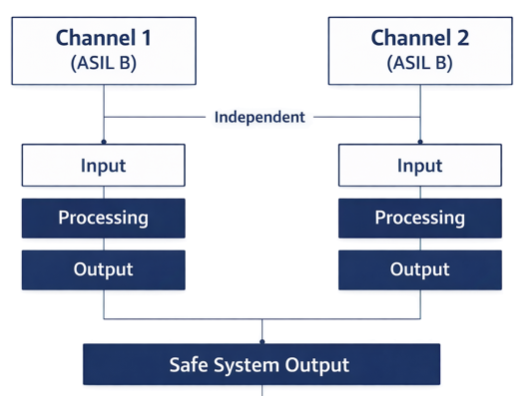
Figure: ASIL decomposition concept where an ASIL D requirement is split into two independent ASIL B channels
Basic Example – Two-Channel Architecture
Consider a safety function that requires ASIL D.
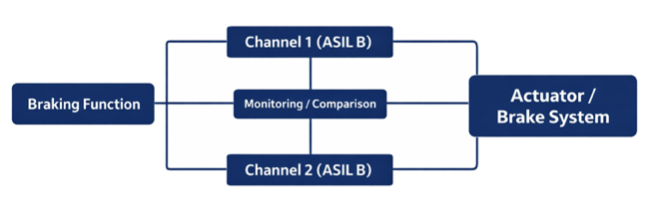
Instead of implementing this function in a single ASIL D system, engineers may decompose it into two independent channels, each developed according to ASIL B.
Each channel monitors the system and can detect or mitigate failures.
If one channel fails, the second channel still provides protection.
Together, these two channels achieve a level of safety equivalent to the original ASIL D requirement.
This approach is widely used in automotive systems, especially in safety-critical applications such as braking, steering, and advanced driver assistance systems.
However, this example only works if the channels are truly independent.
Figure: Two-channel architecture used in ASIL decomposition to achieve redundancy and improve safety
If you want to understand ASIL decomposition in real projects, including architecture design, HARA, ASIL determination, and safety requirements, explore the full training:
ASIL decomposition is only valid if strict conditions are met.
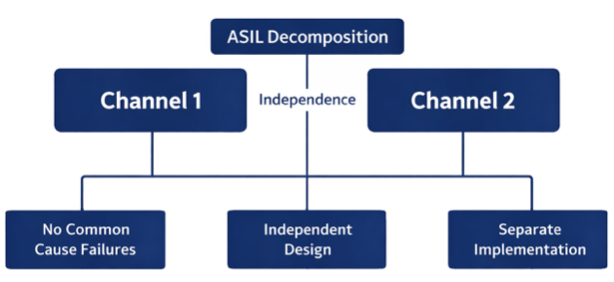
One of the most important requirements is independence between channels.
Independence must be ensured at multiple levels, including:
Functional independence
Hardware independence
Software independence
Freedom from common cause failures
This means that both channels should not share critical components, design flaws, or failure mechanisms.
For example, if both channels rely on the same sensor or software module, a single fault could affect both simultaneously.
In such a case, decomposition would not provide the intended safety benefit.
ISO 26262 therefore requires a careful analysis of dependencies and potential common cause failures.
Figure: Independence between channels as a key requirement for valid ASIL decomposition in ISO 26262
Benefits of ASIL Decomposition
ASIL decomposition provides several important advantages in real-world projects.
First, it enables more efficient system architectures.
Designing a single ASIL D system can be extremely demanding. By decomposing requirements, engineers can use components and processes that are less complex while still achieving the required safety level.
Second, decomposition can reduce development effort and cost.
Lower ASIL levels often require less stringent processes, making development more manageable.
Third, it allows greater flexibility in system design.
Engineers can combine different technologies or approaches to achieve safety, rather than relying on a single solution.
Finally, ASIL decomposition supports scalability.
As systems become more complex, multi-channel architectures become increasingly important for managing safety.
Limitations and Risks
Despite its advantages, ASIL decomposition is not a universal solution.
One of the main risks is insufficient independence between channels.
If both channels are affected by the same failure mechanism, the entire safety concept may fail.
Another limitation is increased architectural complexity.
While decomposition can reduce complexity at the component level, it often increases system-level complexity due to additional interfaces, monitoring mechanisms, and coordination between channels.
Verification can also become more challenging.
Ensuring that both channels operate correctly and independently requires thorough testing and analysis.
Therefore, ASIL decomposition must be applied carefully and only when its assumptions are fully satisfied.
Common Mistakes in ASIL Decomposition
There are several common pitfalls when applying ASIL decomposition.
One frequent mistake is assuming independence without proper analysis.
True independence requires detailed consideration of hardware, software, and system interactions.
Another mistake is overusing decomposition.
Not every safety requirement should be decomposed. In some cases, a single high-integrity solution may be more appropriate.
A third issue is ignoring common cause failures.
Even well-designed systems can fail if both channels are affected by the same external factor.
Finally, some engineers treat decomposition as a shortcut to reduce effort.
In reality, decomposition requires careful design and validation to ensure safety is not compromised.
Summary
ASIL decomposition is an advanced concept in ISO 26262 that enables efficient and flexible safety architectures.
Instead of implementing a single high ASIL system, engineers can distribute safety requirements across multiple independent channels.
Key takeaways:
ASIL decomposition splits high ASIL requirements into lower ASIL elements
Independence between channels is essential
Redundancy enables equivalent safety performance
Decomposition can reduce complexity and cost
Careful design and validation are required
Understanding ASIL decomposition is essential for designing modern safety-critical automotive systems.
If you prefer a visual explanation, this video explains ASIL decomposition step by step, including real-world architecture examples: